Talking Godot: George Costigan and Matthew Kelly interviewed by Mark Brown
Interview at the Citizens Theatre, Glasgow, 21 November, 2025
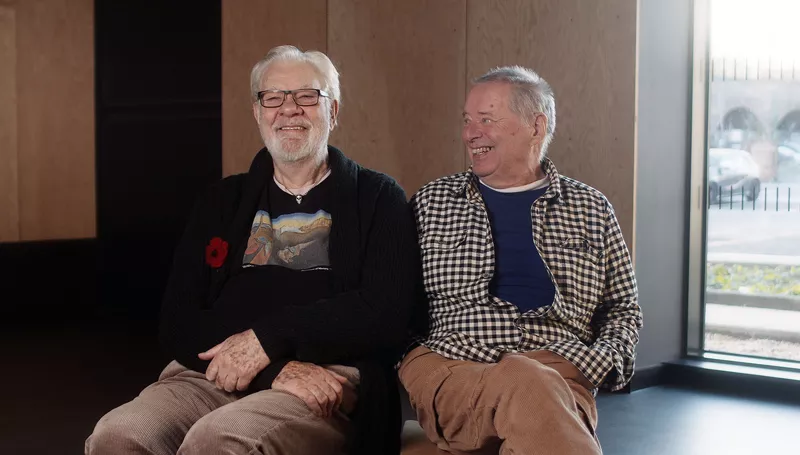
Celebrated actors, and long-time friends, George Costigan and Matthew Kelly will play the famous cerebral tramps Vladimir and Estragon in Samuel Beckett’s Waiting for Godot in a touring production, directed by Dominic Hill (artistic director of Glasgow’s Citizens Theatre) in the spring of 2026. Mark Brown met the pair at the Clydeside playhouse to talk all things Godot.
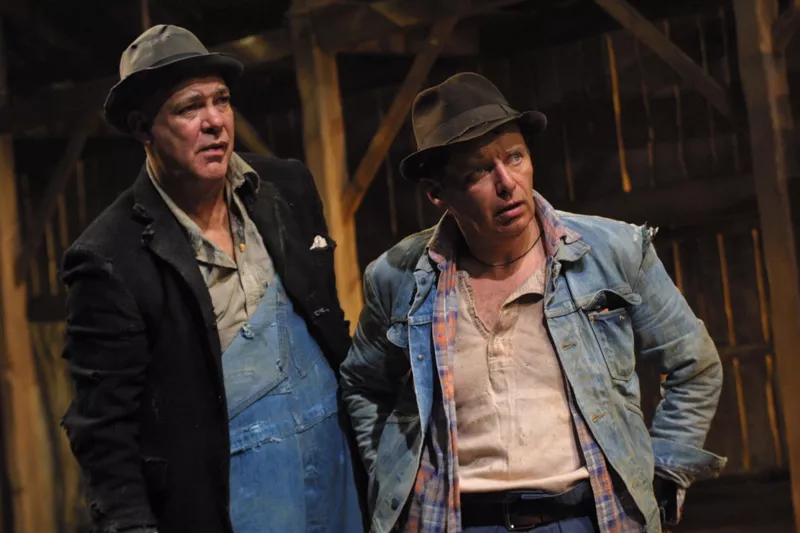
Matthew Kelly and George Costigan in Of Mice and Men at Birmingham Rep.
Photo courtesy Birmingham Rep.
George Costigan and Matthew Kelly are veteran English actors who have enjoyed rich and varied careers on stage and screen. They have also been friends since their college days at Manchester Polytechnic (now Manchester Metropolitan University) in the 1960s. Kelly was born David Allan Kelly, and Costigan knows him as “Dave”. Their deep friendship played no small part in their being cast – as Vladimir and Estragon, respectively – in a forthcoming production of Samuel Beckett’s modern classic Waiting for Godot.
The show is being co-produced by the Citizens Theatre, Glasgow, Liverpool Everyman, and the Playhouse and Octagon Theatre, Bolton. It will premiere on Clydeside in February and March of 2026 before touring to Merseyside and Lancashire.
I meet Costigan and Kelly on a cold, crisp and sunny morning in Glasgow at the magnificently redeveloped Citz (as the Citizens is affectionately known in Scotland). The playhouse – which sits in the Gorbals community on the south bank of the River Clyde – began a multi-million pound renewal in 2018. It was supposed to take two years, but – thanks to delays that cannot be explained entirely by the Covid-19 pandemic – the project ultimately ran to seven years.
The prolonged closure has been disastrous for the theatre culture of the city of Glasgow and of Scotland more widely. However, the redevelopment – which maintains the extraordinary, grand-yet-intimate main house, but is otherwise a brilliant, twenty-first century transformation of the building – has met with general approval.
An expansive, glass and metal exterior welcomes visitors into a spacious, open-plan foyer-bar area. Beyond that, sweeping staircases of wood and metal carry people to the circle level, past the exterior of the main auditorium which – pared back to its original stone – looks almost like a medieval castle.
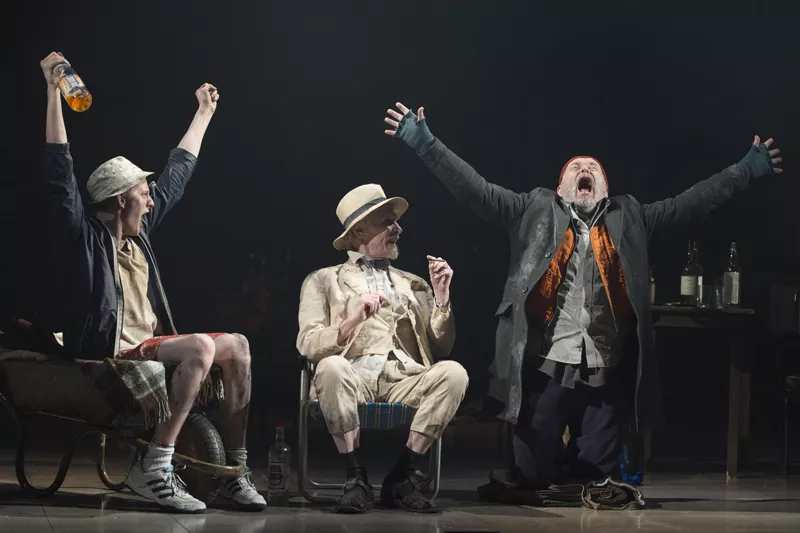
George Costigan (right) in Oresteia: This Restless House at Citizens Theatre.
Photo credit: Tim Morozzo.
It seems fitting – given, not only the Citz’s position as Scotland’s pre-eminent repertory theatre, but also Hill’s deserved reputation as a great director of classic plays (be they ancient, Renaissance or modern) – that one of the first plays to be staged in the revamped playhouse is Godot. My interview with Costigan and Kelly takes place in the new stalls studio where I find the actors in relaxed and jovial mood. Costigan is celebrating England’s revival, following a disastrous start, in the first Test against Australia.
The actors have worked together sporadically over the years, they tell me. They did children’s theatre in the early days and got together again in 2002 for a staging of John Steinbeck’s novel Of Mice and Men at Birmingham Rep (a production that transferred to the Savoy Theatre in the West End of London the following year).
“We’re in touch nearly every day, sending crappy jokes and stuff”, says Kelly, with a laugh. “It feels like we’ve been together all the time. We had such a marvellous time being together on Of Mice and Men.” The success of the Steinbeck production and the continuing strength of their friendship – and, as Costigan comments, the fact they are now the right ages to play Beckett’s cerebral tramps Vladimir (Didi) and Estragon (Gogo) – makes their being cast together in Godot feel not only comfortable, but somewhat auspicious.
Both men have history with the play. This production will be Kelly’s fourth Godot. It will be Costigan’s second. For Kelly, however, it will be the first time he has played the role of Estragon.
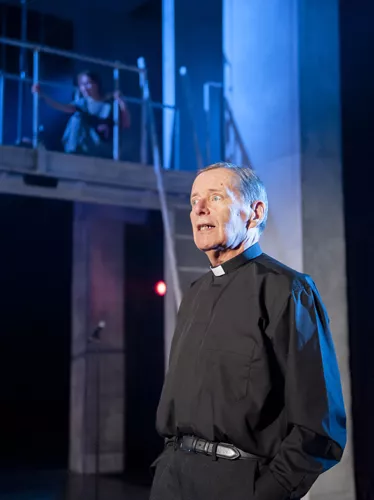
George Costigan in The Duchess of Malfi at Citizens Theatre.
Photo credit: Tim Morozzo.
Kelly was, he says candidly, “a terrible stage manager” on the 1972 Godot that starred David Suchet. Later, in 1986, he remembers – when he was 36 years of age (“way too young”, he believes) – he played Vladimir. Finally, in 2010, he was Pozzo in a staging in which Ian McKellen performed the role of Vladimir.
The latter production travelled ultimately to Cape Town in South Africa, where it played to audiences in the Black townships. Those performances would certainly have met with Beckett’s approval. The dramatist was famously (and vehemently) opposed to apartheid. In 1963 he signed a petition asserting his refusal to grant performance rights for his plays in South Africa. In 1980, he granted the rights to play Godot to the Baxter Theatre, Cape Town on the understanding that the work would be played to racially inclusive audiences.
“I was frightened going into the townships”, Kelly admits. “But they couldn’t have been kinder.” The life experiences of the people living there made the play absolutely comprehensible, the actor says. “We had huge audiences, with a massive age range.” Playing to those audiences in South Africa has left its mark on Kelly. “Now”, he tells me, “reading the part of Estragon, you go, ‘oh, that’s what people’s lives are actually like.’”
The Manchester-born actor is approaching his fourth Godot with obvious excitement. “Every time I’ve done the play, I’ve really enjoyed doing it”, he says. “It’s such blinding writing, it just makes us laugh all the time. Every single page makes us laugh. And to do it with somebody that I have such a close relationship with … It’s such a joyful thing to play.”
Such is the drama’s reach, says Costigan, that, if he could, he would do an outdoor version that would begin at Buchanan Steps (which sweep down from the Glasgow Royal Concert Hall to the top of the major, pedestrianized thoroughfare of Buchanan Street). Estragon, he suggests, “would be sat there” on the steps. “Pozzo and Lucky would start somewhere up the top of town. You’d have stage managers timing it so that Pozzo beats Lucky, whips him all the way to where Vladimir and Estragon are waiting. And you’d only do the first act. If you want to watch the second act, you can come back and watch it tomorrow.”
In fact, Costigan has various ideas about how to stage Godot. One is that he and Kelly should alternate in the roles of Vladimir and Estragon. Another is for an outdoor production in which the set would be “on a car wrecking lot. The whole road is just broken cars, with a tree growing out of it.”
I suggest that the actor’s various visions of Godot attest to the resonating universality of Beckett’s masterpiece. Costigan agrees, remembering the story he was told about a production of the play, starring African-American actor Wendell Pierce in the role of Vladimir, that took place in New Orleans in 2007, two years after Hurricane Katrina wreaked devastation on the city.
“Pierce walked from about a mile away, and the audience waited for him to get there”, Costigan says. “This is after Katrina, when they’d all been waiting for help. He finally gets there and Estragon says, ‘Nothing to be done’, and Vladimir replies, ‘I’m beginning to come round to that opinion’.” The deep pathos of those opening lines resonated with the New Orleans audience.
Indeed, in Costigan’s own experience Godot always affects audiences, but not always in the same way. “One of the reasons I wanted to do it again was that, when I did it in Manchester – and I’d never been in a show like this before, ever – we played a Saturday matinee, and they laughed their fucking faces off! It was one of those situations, as an actor, when the audience starts laughing and you go, ‘is there a gag down there [in the stalls]? What are they laughing at?’” The actors were “chasing” the audience, Costigan continues, trying to catch up with the energy in the auditorium. “They were so full of it”, he says. “By the end of it, we [the actors] were all surfing away like billy-o, having a wonderful time.
“So, come the evening show, we can’t fucking wait. But there was hardly a peep from the audience! Even the big gags didn’t raise a laugh. We [actors] were wondering what we were doing wrong. But, when we got to the end, they clapped their hands off! They’d had a wonderful evening … I’d never been in a play that could do that, and I’ve been in some pretty good plays.” The actor continues to be amazed that Godot “took two different sets of people in totally different directions”.
As to their own forthcoming production, “We’re the best team”, Kelly says of the initial, three-strong group of director Hill, Costigan and himself. “It’s a team event. I love team events.” Making this Godot is, he continues, akin to, “larking about like children in the dressing-up box, but on something that’s really quite important”.
On working with Costigan again, he says, simply, “I can’t think of anybody better to do it with.” It is, he continues, great to be working with “somebody that’s that trustworthy and that fearless”. Turning to Costigan, he says – one part humour to two parts sincere affection – “You’re great, you!”
The actors’ mutual respect is extended to Hill. Costigan has worked with Hill multiple times on productions such as Crime and Punishment (2013), Oresteia: This Restless House (2016) and Long Day’s Journey Into Night (2018). I have long considered Hill to be the pre-eminent theatre director working in Scotland and a natural successor at the Citz to the late, great Giles Havergal (who was director at the Gorbals playhouse from 1969 to 2003). I suggest to Costigan that Hill is a somewhat reserved man, who dislikes the limelight and is, I imagine, in his “natural environment” in the rehearsal room.
“You’re absolutely right!”, the actor replies. “He just comes to life there. It’s a privilege to play with him. It’s a privilege to be in this city, it’s a privilege to do this script and it’s a privilege to be with him [Kelly] again. And Dom will just complete the whole circle.”
Kelly is working with Hill for the first time. However, he is already deeply impressed by the director. “He has a vision”, the actor comments, “and he knows exactly what he wants to do with it”. Godot “can be set in any time, in any way”, he observes, “but Dom [Hill] made a very good point about it. It can be done as a piece of museum theatre, and that is what it should never be. It should never be reverential.”
Costigan agrees that Hill has a brilliant grasp of Beckett’s play. Indeed, even at this early stage, he is excited by the visual aesthetic that Hill and designer Jean Chan have developed for their production. “He [Hill] showed us a picture of the set the other day”, the actor says. “It’s really clever. I won’t spoil it for you [by describing it], but my breath was really taken away by it. I thought it was fantastic.”
The enthusiasm of Costigan and Kelly, both for the play and for working on it together, is palpable and infectious. Talking with them, one becomes increasingly impatient to see what these old friends – excellent actors both – come up with as they take on Beckett’s most famous characters. Inevitably, however, theatre lovers in Glasgow, Liverpool and Bolton will just have to wait.
Waiting for Godot is at the Citizens Theatre, Glasgow, 20 February to 14 March, 2026; then touring to Liverpool Everyman and Octagon Theatre, Bolton.