“Catarina and the Beauty of Killing Fascists” at the Dorfman, National Theatre
Jeremy Malies on the South Bank
★☆☆☆☆
25 September 2026
The title character here is the real-life if mythologized Catarina Eufémia, an agricultural worker in southern Portugal. In 1954, at the age of 26, she was shot dead during a strike by an officer of the National Republican Guard. There has been a persistent rumour that she was pregnant with a child by dictator António de Oliveira Salazar. Eufémia became a symbol for those resisting Salazar’s rule.

Photo credit: Carlos Fernandes.
Catarina and the Beauty of Killing Fascists was first produced in Lisbon six years ago and is the work of Tiago Rodrigues who wrote the text and directs. Rodrigues is the artistic chief of Festival d’Avignon. The action is presented here in Portuguese (there is also a German version) with English surtitles.
Rodrigues has explained that his piece was deliberately conceived as a fictional story but starting from a documented kernel of fact. The setting is the near future – 2028. A few miles outside Lisbon, a family of moderately affluent farm workers has assembled at a comfortable summer house for a dinner of pigs trotters against the backdrop of chattering from swallows.
There is immediate tedium, limp humour, and hackneyed figurative language as one of a pair of sisters (everybody is styled as Catarina) is teased for her veganism, a lifestyle choice that is gaining even more traction at the end of the decade. This Catarina is played by Carolina Passos Sousa. Her denunciation of the meat trade as “One of the cruellest and most polluting industries on this planet” garners no sympathy from her carnivore relatives and farming colleagues. I don’t understand why veganism is introduced into a play that starts and ends with more significant political issues and human rights.
The script is very much about the soil, about land. It put me in mind of Ken Loach’s film Land and Freedom set during the Spanish Civil War. There is soil in view as António Parra pushes a wheelbarrow of the stuff which we later realize he intends to put in a fresh grave. The seeming spontaneity of Parra’s acting, its fluency, and unfeigned intensity mark him out as one of the best things in this dire project.
The trunk of what we later realize is a cork tree dominates the main room. A group of five relatives cluster at the table. Romeu Costa plays a character who is clearly not part of the group. He sits at the end of another trestle table and is static, possibly restrained in some way.
The backdrop is initially incessant drumming followed by minimalist pulsing piano music, the work of Pedro Costa. All the characters (except the stranger) wear dresses. This took my eye off the ball as I wondered whether people of both sexes work the land here in loose robes. Things consistently hit the wrong note and came across as tricksy and distracting. Later, the approach degenerated into sixth-form agitprop smartness.
Exposition embedded in the dialogue tells us that for one day in the year this family avenges the death of Catarina Eufémia by killing a fascist. As the father figure, António Fonseca hops onto a table and gives a bog-standard account of the Trolley Problem. This is the moral quandary in which you are observing a runaway train heading towards a group of people who have no means of escape. You can save them by adjusting the points such that the train goes onto a siding where it will kill a single person who is tied to the track.
To be fair to Rodrigues, this chestnut is indeed relevant to the overall structure of his play in which the characters commit murder in order to further their perceived goal of improving society as a whole. But there are surely less hackneyed ways of having the discussion, and I groaned audibly when I realized what was going to be served up to me.
Things degenerate further with the use of quotations, often aphorisms. “Anyone who starts a blaze is asking the future a question” is an early insertion. Some of the sayings are taken from the essays of Bertolt Brecht but they are made unwieldy by being plucked out of context and delivered in arch, clever-clever tones.
The writing succeeds in conveying the single-mindedness of the characters. Brecht’s “We must not fear death but rather an inadequate life” struck me as particularly apt. But Rodrigues, who during his work at Avignon must be exposed to work in every conceivable theatrical genre, shows no interest in going up and down the gearbox in terms of pace. Only for fleeting instances when the natural world is invoked (bird migration for instance) is there any sense of lyricism. Characters explode momentarily before relapsing into stoicism.
The family reflect that veganism is likely to be in vogue for some time, that there is extreme heat in North Africa, and the late 2020s have seen a war elsewhere in Europe. Okay! There was unearned, hesitant laughter from limp jokes on press night. The platitudes became incessant and we learn that, “In every woman lives a rebel.” Right!
It becomes clear that this is not an observer on the end of the table but a captured middle-ranking fascist who will be killed shortly. Rodrigues supposes (for the sake of debate) that by 2028 the Far Right in Portugal will be in power. Beatriz Maia plays the young Catarina who is expected to carry out the killing for this year. She impresses when breaking with her family’s custom and questioning whether this is the best way to deal with a force that they all agree is ruining their society.
Warm orange lighting by Nuno Meira gives proceedings the quality of a still life painting. The set by F. Ribeiro features slatted partitions on castors which make for fluent changes with the captured fascist even being moved around while bound to these.
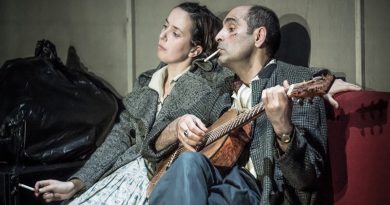
In keeping with the Brechtian distancing effect, the actors consistently break the fourth wall and Fonseca even hands his camera to an audience member asking them to take a family snap. (Illustrated.) But this becomes clunky as the mother, played by Isabel Abreu, points to resonant words such as “Vengeance” on the surtitles which conveniently slow down for a while.

Photo credit: Carlos Fernandes.
I wonder what Brecht, who knew a thing or two about fascists and was pursued for real by them, would think of an interrogation scene in which the captured fascist is derided for not recognizing a quotation from Mother Courage! Admittedly, there is a single gem of an idea revealed at this point. As part of the ritual, the fascist to be executed is offered a lifeline. He can be spared and go into business with one of the brothers if he gives up the name of a major (covert) party member. Of course he is not spared and the name given is the person selected the following year.
But there is a twist. Towards the close of the play, the floor is given to the fascist for a continuous, uninterrupted 20-minute monologue describing his party’s views and analysis of present-day society. This is the crux of the evening as Costa’s character outlines every myopic, prejudiced, intolerant perception of so-called law and order politics you could imagine across nationalism, identity, language, immigration, asylum, border controls, assimilation, family structures, police powers, and criminal sentencing.
Contrary to the giddy PR blurb, the play has not been blazing a trail in Europe. It has on occasion created disquiet and even (in the German version) an attempt to invade the stage at this point. But as on the evening I attended, the production has frequently been met with bemused silence and embarrassment. There was a bit of fidgeting and a few half-hearted catcalls perhaps just to fill the void.
The issues discussed in this play could not be more topical. A video of a British anti-migrant vigilante slashing a rubber dinghy has just gone viral and at the weekend the Far-Right party AfD recorded further wins in German state elections putting chancellor Friedrich Merz under pressure.
In Portugal, the radical party Chega (“Enough”) led by André Ventura continues to trouble mainstream observers. The stances on migration (their phrase is “a firm and responsible migration policy”), rejection of multiculturalism, advocacy of a points system for non-Schengen workers, robust pro-life attitudes, and draconian proposals on LGBT+ and gender issues are all worrisome. Chega currently has 60 seats in a 230-seat Assembly of the Republic with no upper house for possible checks and balances. The script here does not mention a party name but it’s clear that it is Chega in Rodrigues’s clumsy crosshairs. I maintain that his script and general approach are inept and unfit for the gravity of the situation.
There are no fewer than six dramaturgs working at the National Theatre. I question this as a programming decision by that team and artistic director Indhu Rubasingham. The whole evening was glib, excessively worthy, predictable, and guilty of pushing on an open door.