“The Playboy of the Western World” at the Lyttelton, National Theatre
Neil Dowden on the South Bank
★★★☆☆
15 December 2025
John Millington Synge’s 1907 The Playboy of the Western World not only deals with mythologizing but has a mythic place in Irish theatre history. Part of the Irish Literary Revival, it was a seminal work in the rise of Ireland’s national theatre, the Abbey Theatre (co-founded only three years earlier by W.B. Yeats, Lady Gregory, and Synge). But its notoriety was ensured by the riots that spread all over Dublin when it was first staged, as it was regarded by nationalists as an attack on the Irish character (and especially an insult to women). More than a hundred years later it’s hard to see what all the fuss was about for a play that satirizes the glorification of violence and the precariousness of celebrity.
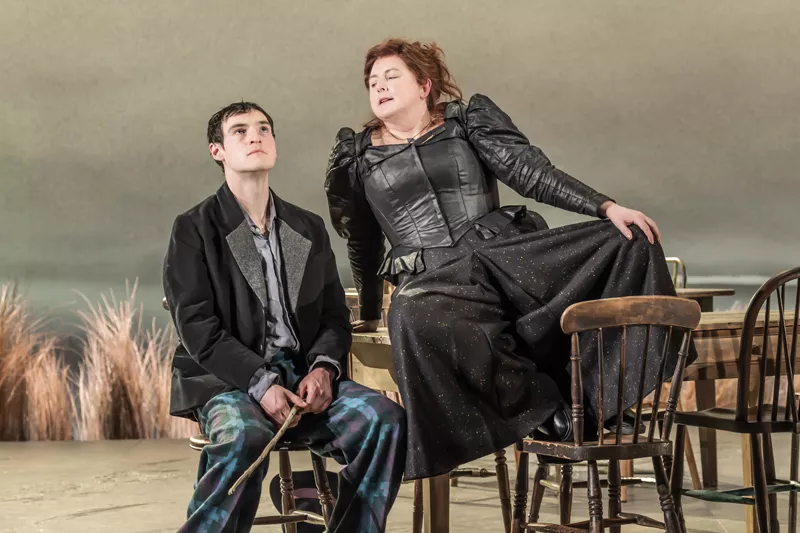
Éanna Hardwicke and Siobhán McSweeney.
Photo credit: Marc Brenner.
After stranger Christy Mahon walks into the public house of a village in County Mayo on the west coast of Ireland all hell breaks loose. He claims he has killed his abusive father by splitting his skull with a spade while out in the fields of their farm, and is now on the run. He becomes a renegade hero, or antihero, similar to an American Wild West outlaw, admired by men and desired by women. The pub’s barmaid (and daughter of the publican) Pegeen Mike falls for the handsome, self-aggrandizing Christy and throws over her wimpish fiancé cousin Shawn Keogh, while the Widow Quin becomes her rival for the young man’s favour. But when Mahon Senior turns up large as life looking for his son the village turns against Christy.
The scenario is allegedly inspired by a true story told to Synge by an Aran Islander – though that could well be myth-making too. It may be a revered part of the Irish theatre canon and regularly revived, but Playboy is a slippery work to pull off as it’s made up of a hodgepodge of styles and tones. Written in the then Hiberno-English dialect of the region – “Western World” refers to the west of Ireland – it sees Synge mixing naturalistic, rural colloquial speech with heightened, lyrical romantic imagery (mainly from Christy), while the mood shifts between social satire, black comedy, full-on farce, and personal tragedy, in a play that riffs off Irish folk traditions and rituals.
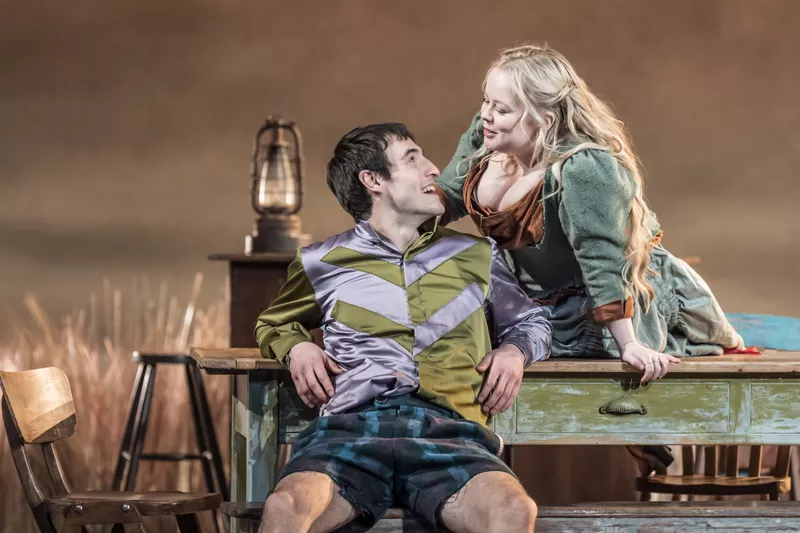
Éanna Hardwicke and Nicola Coughlan.
Photo credit: Marc Brenner.
This entertaining and atmospheric production directed by Caitriona McLoughlin (appropriately enough the Abbey’s present artistic director) and featuring a largely Irish cast feels authentic enough but doesn’t quite succeed in making the play’s disparate elements gel. It’s true that it’s not always easy to take in the demotic dialogue, but the real issue is lack of consistency. Generally, the broad comedy works better than the dark disillusionment at the heart of the work. Although there are fine individual scenes, the journey of Christy from callow youth to opportunistic braggart to fallen idol and finally mature independent man doesn’t fully convince.
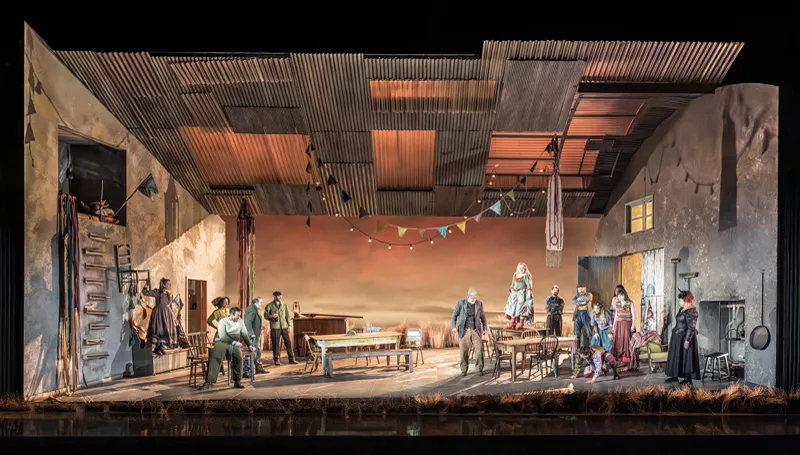
Katie Davenport’s impressively detailed design of a wooden and stone shebeen with rickety corrugated iron roof, stable door, and ever-burning open hearth fire is fringed front and back with rows of reeds, while there is a backdrop of a desolate Atlantic coastline – it feels like the edge of the world. The characters’ tweedy rustic clothes (many woven in western Ireland) are redolent of the peasant culture of the period. They are bolstered by straw-like costumes and masks for biddy boys, and mummers or wrenboys, for the festivities of the mule race, while a procession of dark-hooded, keening figures appears at the start and end as the rain pours down. Anna Mullarkey’s score includes an Irish vocal lament for the dead as well as fiddle-playing, enhanced by Adrienne Quartly’s moody soundscape and James Farncombe’s murky lighting design which makes it seem like a fog has descended.
Éanna Hardwicke (award-winner for playing a creepy, true-life murderer in TV’s The Sixth Commandment) is a beguiling Christy, an unreliable narrator full of wide-eyed naivety who reinvents himself, but he seems too weakly passive to engender such female adulation. Nicola Coughlan (best known for Bridgerton and Derry Girls) gives Pegeen Mike a feisty spirit and ends heartbroken having lost her romantic ideal. Siobhán McSweeney (also in Derry Girls) is delightfully funny as the manipulative Widow Quin on the lookout for a new young husband. Declan Conlon plays the indestructible hot-blooded Old Mahon, Marty Rea is an amusingly pusillanimous Shawn Keogh, and Lorcan Cranitch pulls out all the stops to make landlord Michael Flaherty’s drunken rant as incoherent as possible.