“Our Town” at Theatr Clwyd
Mark Brown in Mold
★★★★☆
15 February 2026
The theatre sectors of the nations of the United Kingdom have not had their troubles to seek in recent years. Various factors – including the Covid-19 pandemic, neglectful stewardship by arts funding organizations and the political class, and, on occasion, poor leadership within theatre organizations themselves – have taken their toll.
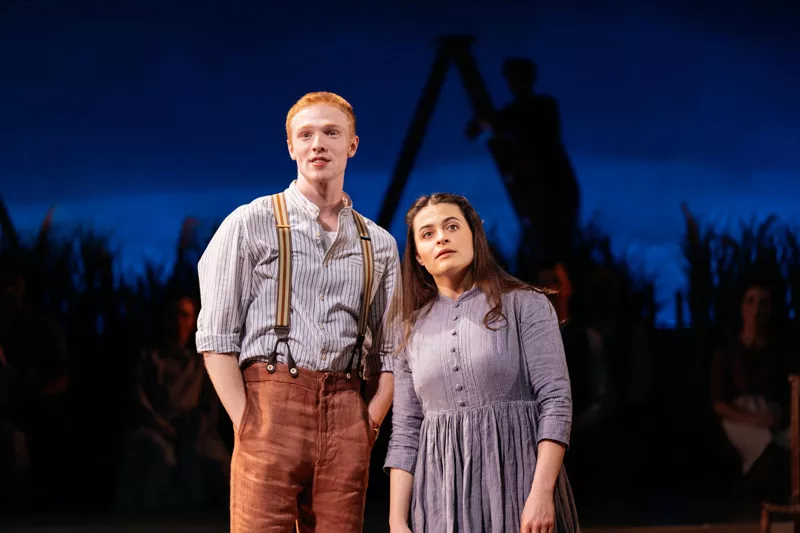
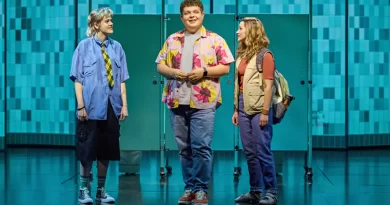
Peter Devlin and Yasemin Özdemir.
Photo credit: Helen Murray.
Nowhere is this truer than in Wales. Indeed, in 2024 the National Theatre of Wales (NTW) – a company that sought to follow the “theatre without walls” model of the National Theatre of Scotland – went to the wall after its entire funding was removed by the Arts Council of Wales.
However, following the pain, disappointment and recriminations of the demise of the NTW, the new Welsh National Theatre (WNT) was announced last year. Rising from the ashes of the NTW, the WNT has been established with the Welsh actor and cultural activist Michael Sheen as its first artistic director.
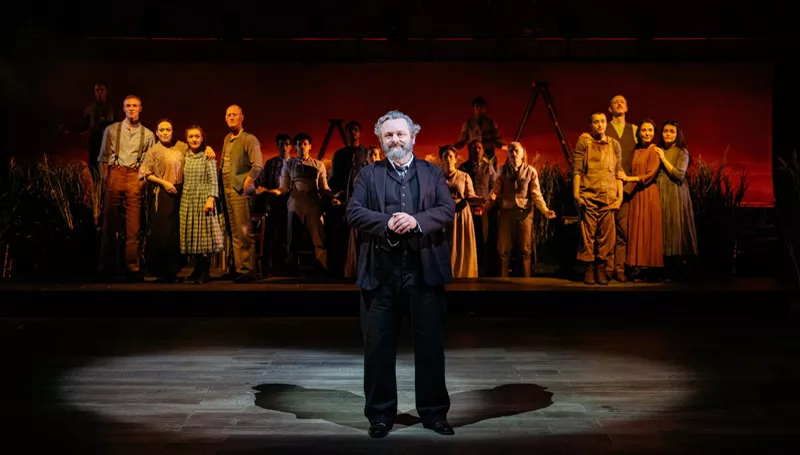
This sure-footed, compelling, decidedly Welsh rendering of Thornton Wilder’s play Our Town – which plays Theatr Clwyd until 21 February, transferring to the Rose Theatre, Kingston-upon-Thames, 26 February to 28 March – is the company’s inaugural show. A co-production with the Rose Theatre, it boasts steady, emotionally generous direction by Francesca Goodridge and a typically fine performance from Sheen (as the omnipotent Stage Manager/narrator) at the head of a universally strong, palpably committed cast.
There are – in Wilder’s tale of the small, fictional New Hampshire town of Grover’s Corners in the early-20th century – shades of Dylan Thomas’s great, Welsh dramatic poem Under Milk Wood. Like Thomas’s characters – from Captain Cat and Rosie Probert to Nogood Boyo – the personalities of Our Town emerge from imagination and memory in terms that are vivid, sympathetic and deeply humane.
Indeed, in a three-act drama that considers life, love and death in a close-knit community, the beautiful envisioning of the final act is reminiscent of the gorgeous, elegiac stage poem Solemn Mass for a Full Moon in Summer by the great Quebecois playwright Michel Tremblay. Whereas Tremblay expresses a secular, but decidedly Catholic humanism, rooted in his background in a working-class district of Montreal, the practical-yet-devout Christianity of Wilder’s characters is predominantly Protestant.
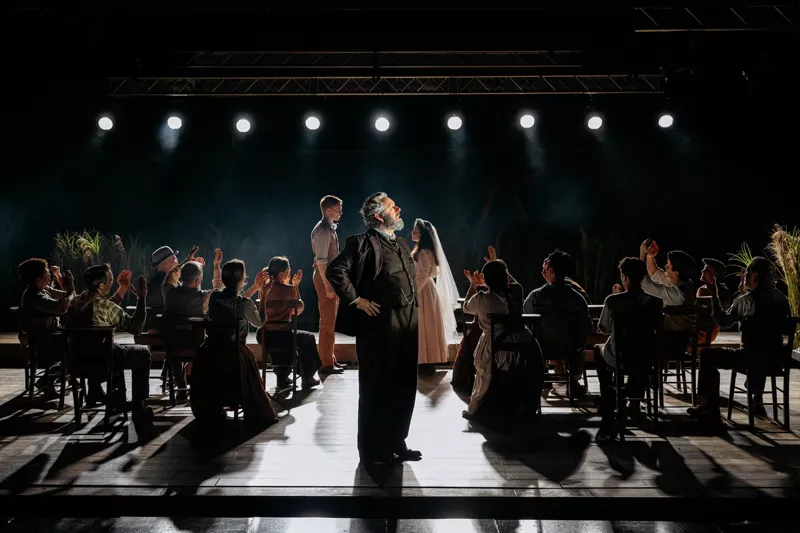
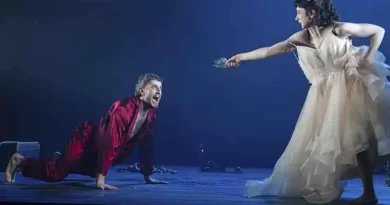
Photo credit: Helen Murray.
Wise and avuncular, Sheen’s metatheatrical character (who is, at once, apart from Grover’s Corners in time and place, yet very much of the community) introduces us to the likes of young Emily Webb, the cleverest girl in the town, and George Gibbs, the would-be farmer who seeks to win her heart. The Stage Director takes us through the years as the cycle of life and death plays itself out.
It is often said that the genius of Wilder’s play is that its evocation of community reminds us that there is great emotional weight in the quotidian rituals of our lives. This production – in which Welsh place names nestle alongside American ones – puts an unapologetically emotive, even somewhat sentimental, emphasis on this important aspect of the drama.
Welsh communities past and present – places that have endured and survived war and waves of economic change, just as Wilder’s imagined town has done – are summoned up in the playing of a large, universally fine ensemble. Nia Roberts plays Mrs Webb (mother of Emily) with a wonderfully relatable dignity, wisdom and big-heartedness.
Rhys Warrington gives a calibrated, affecting performance as Simon Stimson. The character’s self-destructive alcoholism is tied agonizingly here to his necessarily secret homosexuality.
The production also boasts a charmingly honest characterization of the sincere, self-doubting George by Peter Devlin. However, if anyone shines brightest in this marvellous cast, it is young Yasemin Özdemir who plays Emily with gorgeous spirit, generosity and, ultimately, pathos.
Courtesy of designer Hayley Grindle, the first and second acts evoke the rurality of the play’s setting by way of minimal pieces of set (such as banks of high growing grass that are wheeled into place). The final act – in which the souls of the dead hover above the seemingly mundane, but painfully significant lives of the living – is visualized in powerfully simple, practical and impressionistic terms.
This is an American classic which – in the hands of Goodridge, Sheen and the WNT – is both as universal and as Welsh as it can be in its evocation of the precariousness of human existence and the sense of community that so often makes it bearable.