“Macbeth” at Tobacco Factory, Bristol
Simon Thomas in South West England
★★★☆☆
26 February 2026
Macbeth is one of Shakespeare’s shortest and most tightly constructed plays, qualities enhanced by judicious snips and some reordering by editor Robin Belfield in Bristol Tobacco Factory Theatres’ latest production. There’s even the inclusion of a rendition of his Sonnet number 29 (“When in disgrace with fortune and men’s eyes”), set to music and sung by the Macbeths as they greet their guests to the midway banquet, although the reason for this interpolation is not immediately apparent.

Patrycja Kujawska and Stu McLoughlin.
Photo credit: Craig Fuller.
As with her impressive The Winter’s Tale a year ago, director Heidi Vaughan’s Shakespeare is marked by an intelligent and pellucid understanding of the text, although it perhaps doesn’t always fully mine the implications of the naked ambition and tyranny of the Scottish tragedy. In a modern world where pride trumps reason and the irrationality and egoism of the supposedly good guys is almost indistinguishable from the despotism of the bad, the play has stranger resonances than ever before.
Vaughan’s production is lean, fast moving, and clear, although Patrycja Kujawska’s heavily accented Lady Macbeth tests comprehension at times. Stu McLoughlin is unusual casting for the wayward thane. Tall and slender, he seems better suited to his role of Autolycus in last year’s production and lacks the warrior-like dynamism and psychotic ambition of Macbeth, although his earnest portrayal contrasts well with the feral intensity of Kujawska’s overweening queen. More than ever, one senses a woman of destiny held back by a lumbering and unimaginative man.
When budgets are low, a Peter Brook type stripping back to absolute minimalism is preferable to a slightly botched attempt at decorative illusion. I remember a production of his many years ago that used just six house bricks and rehearsal clothing to fill the empty space and create visual wonders. It’s an approach that would suit this company more than underfunded sets and costumes (designer Edwina Bridgeman) that struggle to summon up regal wealth and opulence. An example is the aforementioned banquet scene when a ring of wooden stools would have been preferable to the offered kitchen table draped in gold material.

Maggie Tagney.
Photo credit: Craig Fuller.
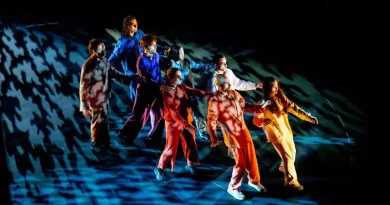
On the other hand, Vaughan uses the in-the-round space extremely well, constantly catering for the audience on all sides of the auditorium. There are bursts of physical activity in the form of elemental, ritualistic dance (movement by Dan Canham) that invigorate the action. The battle scenes are thrillingly dangerous, with staves flying around perilously close to front-row spectators at times, as the actors whirl and flail in fights carefully choreographed by Annie Mackenzie. The killing of Banquo and fleeing of Fleance is all the more effective for being played out in complete darkness, allowing the imagination to fill the gaps and create images from sound alone.
A cast of ten, with inevitable doubling and tripling of parts, is again drawn largely from a pool of locally based actors. There’s strong work from Alice Barclay (last season’s Hermione) as Ross, Saikat Ahamed as Banquo, and Maggie Tagney as Duncan/Porter/Doctor. Adam Mirsky, who like Kujawska is a veteran of Emma Rice’s Wise Children, doubles a murderer with a wide-eyed and youthful Malcolm. Guy Hughes is a stolid Macduff and Phil King is underused as Lennox. Gender-blind casting creates equal opportunities for a balanced cast.
The production rattles through at just over two hours and, while never quite reaching the heights of last year’s The Winter’s Tale, is an accessible and engaging account of one of the bard’s most perfect texts.