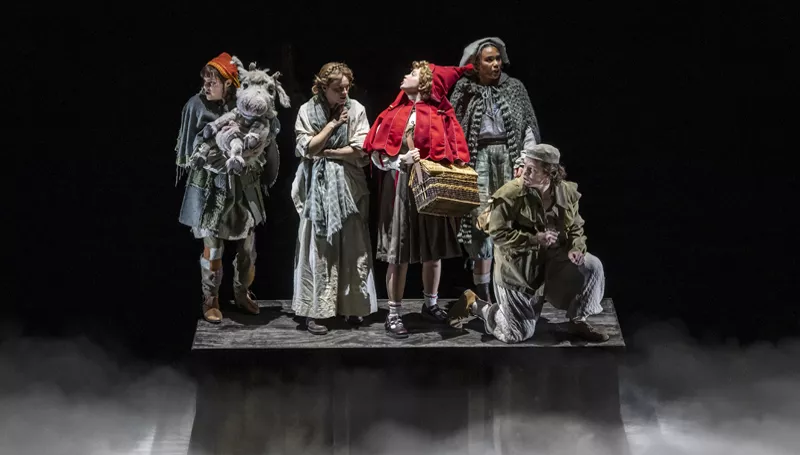
“Into the Woods”, Bridge Theatre
Jeremy Malies on the South Bank
★★★★☆
15 December 2025
The front of house manager, or so I think, shuffles onto the stage apron. He is dishevelled and stressed. Is Kate Fleetwood (playing the Witch and the starriest element in a cast that is a firmament) unwell? Perhaps there is a technical problem? But Michael Gould as the Narrator begins in familiar fashion. “Once upon a time …”
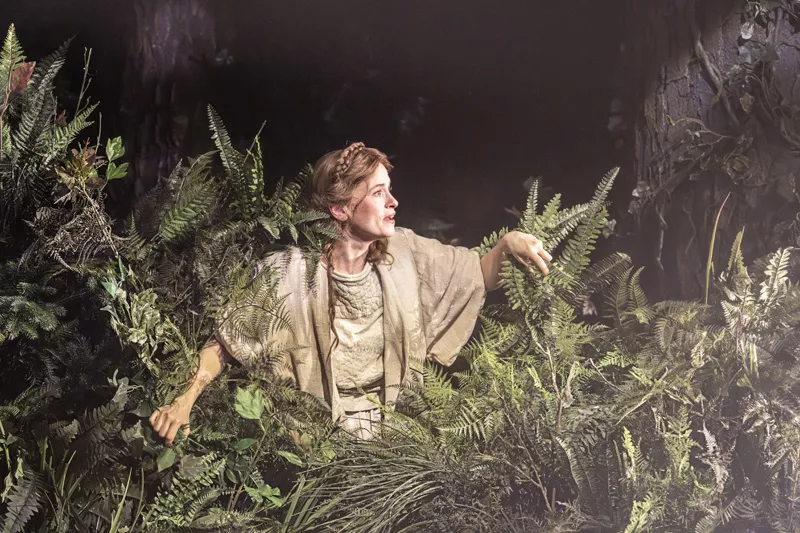
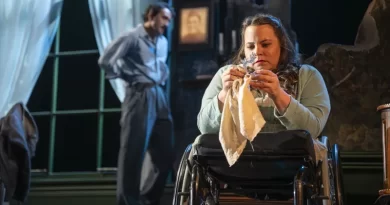
Katie Brayben as the Baker’s Wife.
Photo credit: Johan Persson.
So are we on familiar ground? Only if you have seen Stephen Sondheim and James Lapine’s 1987 musical many times. This production consistently defies expectations. Initially I think it might be minimalist when designer Tom Scutt opens with a black backdrop against the Baker’s shop and an enormous raised “Into the Woods” stencilled across the curtain. Scutt later opens up the scene to reveal a panoramic forest with shafts of sun penetrating the ferns and bracken. It’s both lush and darkly gothic with a sombreness that accompanies the life lessons of the Brothers Grimm. If you upset things here, you will surely pay for it in the Second Act.
Parents and children are the predominant theme. The Baker (Jamie Parker) and Baker’s Wife (Katie Brayben) are struggling to have a child. Gracie McGonigal as Little Red Ridinghood could have leapt out of Enid Blyton. She is scouring the woods intrepidly in search of bread to bring to her ill grandmother played by Valda Aviks.
Director Jordan Fein (Fiddler on the Roof) brings rigour to all this not just in the plot’s moral instruction but in the way that he refuses to opt for easy laughs. There are two princes (Cinderella’s Prince: Oliver Savile; Rapunzel’s Prince: Rhys Whitfield). Obvious gags about the behaviour of contemporary princes are avoided to my surprise. This might be panto season, but we are in a different realm.
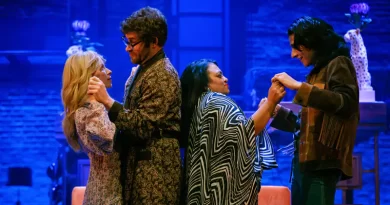
And yet the princes are a source of humour with movement director Jenny Ogilvie often placing them as though they are tarot card characters. Savile makes a point of staying generic until intense, seemingly spontaneous feelings spill over for Cinderella played by Chumisa Dornford-May. She, with Fleetwood, is the huge success of the night and notably in the penultimate number “No One Is Alone” with its plea for empathy and understanding that Sondheim and Lapine establish as the prevailing theme. Without labouring the idea, Dornford-May manages to underline the point in Lapine’s book that this is the Grimm version of Cinderella in which she has a dead mother buried in the woods.
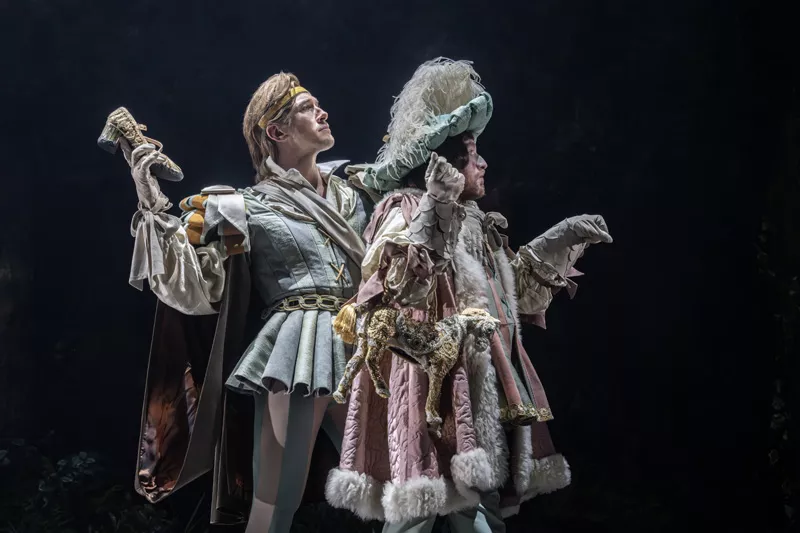
Oliver Savile and Hughie O’Donnell.
Photo credit: Johan Persson.
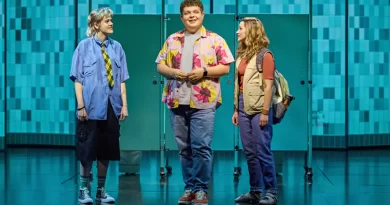
I did wonder if Fein might have made the production more arch, self-aware, and self-deprecating. Only the Jack and the Beanstalk theme (which is indeed pantomime) lies outside Grimm. And it’s this strand that produces many of the laughs, with non-binary Jo Foster pushing at gender ambivalence and scoring with the line, “But mother I’m a man now!” It’s about the only sortie into modern-day relevance. Matters are slick and even at two hours 40 minutes with an interval we roll merrily along. Fein streamlines the evening by opting not to show the Giant (the character is actually the Giant’s Wife) though we hear her as voiced by Aviks. Adam Fisher’s deft sound design does indeed suggest that she has taken a few strides across the Thames to come into the auditorium from the rear.
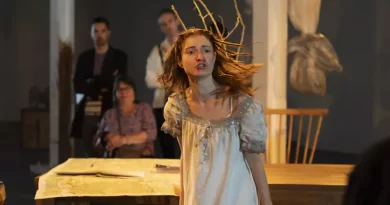
After his great start Gould has little impact playing the Mysterious Man. In terms of pure stagecraft, Fein’s best moment, for me, is the killing and skinning of the wolf behind a gauze screen in which you see just enough to understand that it’s gory without there being too much blood. But don’t bring your kids (even adolescents) to this; you will put them off pantomime – and indeed Sondheim – for life. Fein also calibrates the knockabout physical humour of Bella Brown’s hair as Rapunzel while balancing it with the inevitable neurosis that will come with being locked in a tower for 17 years.
Musical director Mark Aspinall eases the performers through the unexpected or atypical harmonic structures and demands on breath control. Fleetwood has the stiffest tasks in these respects with the song “Last Midnight” in which the project truly lifts off and becomes world-class. She negotiates the tension in the song between self-reproach for bad decisions and simply being a victim of circumstance. Elsewhere Fleetwood sits precisely on the sinister off-beats that accompany her entrances and makes it credible that the other characters should find her terrifying.
Aideen Malone’s lighting design creates threatening silhouettes from the sinister blackbirds roosting above the playing area. They too contribute to the fractured fairy-tale environment. This is a predatory place in which survival means you must learn that the forest is no place for dreaming and an environment where, as Cinders tells us, “Opportunity is not a lengthy visitor.” It isn’t every man for himself – family bonds are important – but there are few rules and anything can happen.
Musical supervisor Mark Aspinall propels this with all the bounce and off-centre beats that Sondheim calls for without appearing rushed. These stories are central to all cultures and folklore meaning that box-office business is already brisk, and the production has just been extended to 30 May 2026. The Bridge Theatre has indeed laid a golden egg.