“High Noon” at Harold Pinter Theatre
Franco Milazzo in the West End
★★★☆☆
14 January 2026
Eric Roth’s adaptation of the classic 1952 film High Noon (directed by Thea Sharrock) arrives in London for its world premiere with the swagger of a Hollywood heavyweight and the bow-legged gait of a man who has spent far too long in the saddle. It wants to be a muscular American reckoning, a last-stand western parable for a divided age staged in real time, yet it turns up just after Kenrex has already tilled much of the same blood-soaked ground. One year earlier and the show’s themes of a terrorized town, civic cowardice, and a desperate lawman on a mission against the odds might have felt more impactful. Now they feel like a slightly belated sermon delivered to a congregation already nursing a hangover.
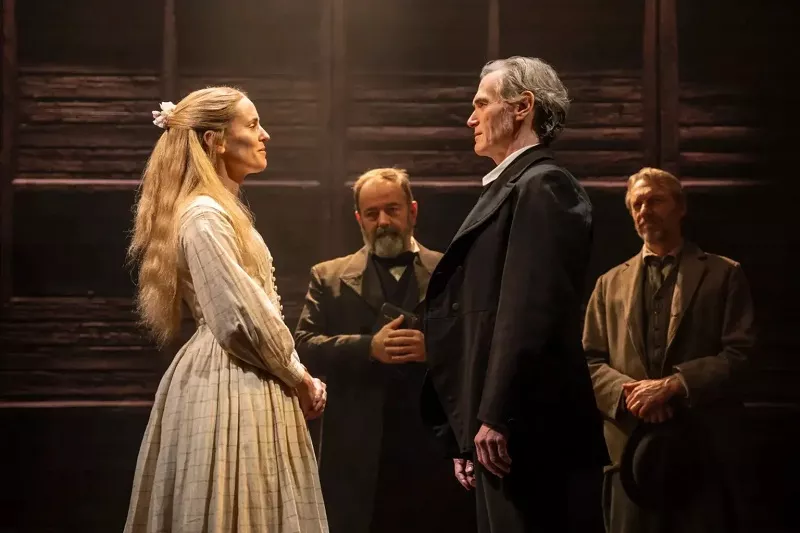
Photo credit: Johan Persson.
Much of the anticipation here rests on a seriously impressive cast list. Billy Crudup garnered recent high praise both on stage (not least through his one-man show Harry Clarke) and screen (for his Emmy-winning role in The Morning Show). So has Denise Gough, stellar as the recovering drug addict in Duncan Macmillan’s People, Places & Things and a ruthless bureaucrat in streaming hit Andor. Then there’s Rosa Salazar who played the title role in the Robert Rodriguez and James Cameron spectacular Alita: Battle Angel and has popped over to make her West End debut. Established screen actor Billy Howle will be well known to the capital’s theatre audiences: in 2024, he was seen both at the National Theatre (Dear Octopus) and the Almeida (Roots, Look Back in Anger).
Surprisingly considering his long history as a Hollywood screenwriter, this is Roth’s first stage production. Oscar-nominated six times and winning for Forrest Gump, his CV ranges from the galactic sci-fi of 2021’s Dune to grounded human dramas like Munich, Ali, and A Star Is Born. High Noon, though, is the first time he has created a script based on an original work that he genuinely likes and that affection shines through, for better and for worse.
His approach to the iconic western wavers between high deference and considered modernizations. The longstanding town marshal Kane is still marrying his beloved Amy but now the age gap between the actors is a mere decade rather than the near-30 years that separated Gary Cooper and Grace Kelly. The hokey country music of Dimitri Tiomkin has been largely abandoned; instead, sung snatches of modern rock from the Bruce Springsteen back catalogue are pressed into service to punch home the underlying themes.

Photo credit: Johan Persson.
Crudup plays Will Kane not as Cooper’s strong-but-silent type famously admired by Tony Soprano but as the strong-but-will-not-shut-up type, a man who can’t resist laying down life lessons and explaining his moral anguish long after we have got the point. He seems perpetually ready to launch into a speech, as if terrified that if he stops talking the audience might realize he is not actually doing very much.
Gough brings her usual flinty intelligence to Kane’s wife Amy Fowler, but she is hemmed in by a script that keeps pushing her to the margins, at least until it remembers at the very end that women exist. Howle does solid, earnest work as the deputy with a grudge, yet the night belongs to Salazar as the cynical saloon owner who wants out of this dusty moral swamp. She is funny, bruised, and ferociously watchable, and she slices through Roth’s grandstanding with a raised eyebrow and a line delivery that suggests she knows exactly how ridiculous all these men look posturing around with their guns.
Tim Hatley’s set design has a few neat party tricks. In the style of Kenrex, minimal props are turned into effective story devices: a table becomes a wagon with the kind of mechanical flourish that makes you smile despite yourself, and a blazing beam of ground-level light announces the arrival of the baddies’ train. Too often, though, it settles into a dull procession of sparse furniture framed by floor-to-ceiling wooden boards, like a rustic waiting room for people about to have existential crises.
For a writer whose film work is so drenched in visual imagination, Roth’s first play is surprisingly flat. He seems content to let his characters pace and pontificate in a box of planks. Even the use of Springsteen songs, meant to give things a folksy, downbeat Americana thrum, feels redundant. The play has already established that Kane is making a brave and (in his eyes, at least) necessary choice to abandon his wife for what looks to everyone, including us, like a suicide mission. You do not need The Boss to underline the obvious.
There is a delicious historical irony hovering over all this. John Wayne famously turned down the offer to star in the original film, deriding it as un-American because it suggested a lawman might need help and that a community might be morally obliged to step up rather than hide. He would have loathed this version even more which spreads its sympathies far beyond the stoic male hero, giving the womenfolk real agency. Adding salt to the wound, the villain Frank Miller (James Doherty) is blasted away not by Kane (as in the film) but by his wife Amy, a peace-loving woman who utterly detests guns and has never handled one before. In Wayne’s world, that would have been heresy. Here, it is one of the few genuinely stirring moments, a rebuke to macho mythmaking that finally lands with some force.
In the end, High Noon on stage feels like a work caught between two stools. It wants to interrogate American legend with modern eyes, yet it keeps slipping back into talky, self-important masculinity. The stars shine, and there are flashes of wit and anger, but Roth’s debut lacks the cinematic sweep you expect from his name and the whole endeavour never truly warrants the luxury casting. Instead you get a wooden corral of ideas, a few sharp, most of them stale, all arguing for attention. Like its hero, it keeps telling us how noble it is to stand alone, when what it really needs is a better sense of timing and a little less bluster.