“English”, Long Wharf Theatre, New Haven
Robert Schneider in Connecticut
★★★★☆
28 January 2026
I thought I knew a lot about teaching and learning a second language, but Sanaz Toossi’s Pulitzer Prize-winning play English filled me in on something very basic. You see, I’ve never regretted a moment of the time I spent in classrooms learning French and German. These languages were an intellectual adventure I freely consented to. They nourished and amused me. I never felt they were replacing my native ability to express myself, only adding to it. French is my wife’s native language; German was my grandfather’s.
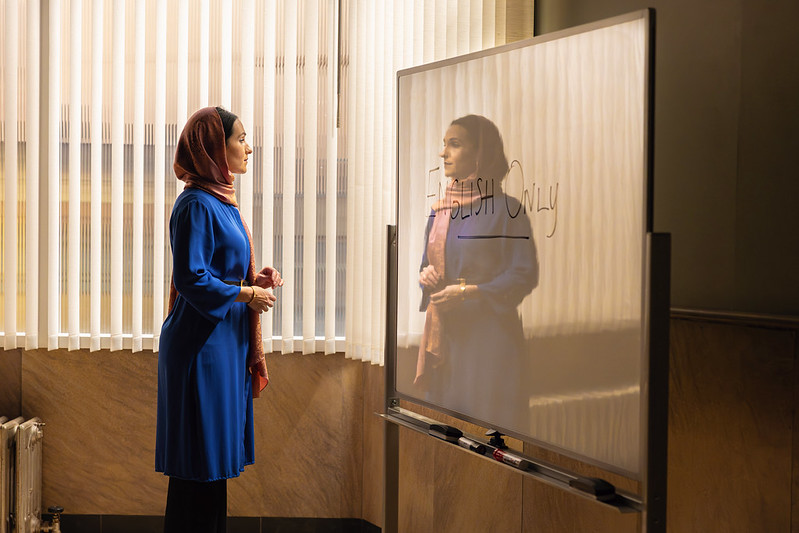
Neagheen Homaifar.
Photo credit: Curtis Brown.
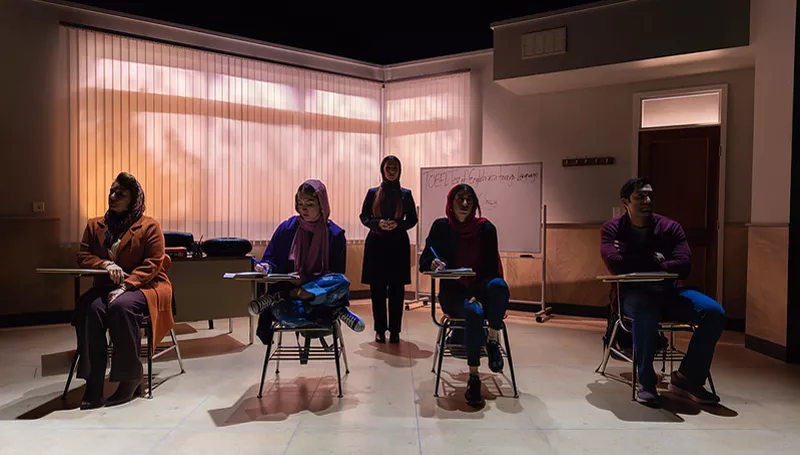
When it fell to me to teach English to foreigners, I worked hard at it and generally had good results. Every funny situation that came up in Toossi’s classroom in the suburbs of Teheran, the setting of her play, reminded me of something similar from my own classroom in the suburbs of Paris. The students were all familiar types: Goli (Aryana Asefirad), the high schooler who needs extra help to pass the TOEFL; Elham (Sahar Milani), the grad student who wants to study gastroenterology in Australia, Omio (Afsheen Misaghi), who doesn’t want to lose the English he once had and Roya (Nina Ameri), the grandmother whose son, exiled in Canada, has decreed that her grandchild with be brought up to speak English only. For her to play any role in the child’s life, Roya will have to learn the language of Shakespeare. Rounding out the cast is the teacher, Marjan (Neagheen Homaifar) who spent ten years in Manchester but came back to Iran for reasons she’s reluctant—and perhaps unable—to explain.
The play is episodic. Toosii follows the screenplay maxim that one should get into each scene as late as possible and get out as early as possible. In her case, this is often before anything comes to a head. So the play proceeds by intriguing wavelets rather than waves. The most exciting moment is a rapid-fire duel between Omio and Elham to see who can name the most objects one might find in a kitchen.
Among the issues that never come to a head is Omio’s flirtation with Marjan. We sense the attraction between them, but perhaps it’s due to their shared knowledge of English rather than purely sexual chemistry. Sharing a language one can’t practice elsewhere is a powerful bond—and Marjan’s husband doesn’t speak English.
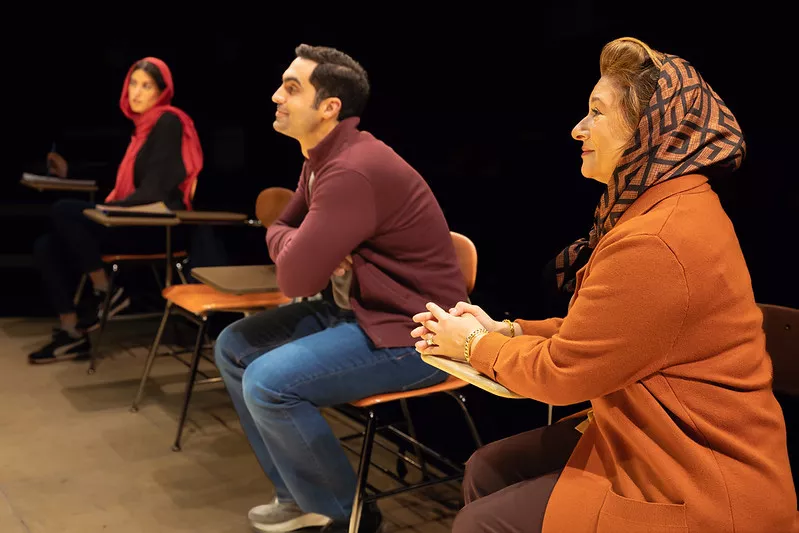
Photo credit: Curtis Brown.
While Marjan urges her students to embrace English and see beauty in the language, she encounters resistance. Like students everywhere, these are reluctant to let go of fluency. She gives than demerits when they speak Farsi, but that doesn’t stop them. In their native language, they have agency. They can express their needs. They can be funny on purpose. In English, they’re lost. It’s too hard, too foreign and too ugly. Elham, especially, rebels. In Farsi, she’s ready to study medicine; in English she’s not good enough to be a teaching assistant. Roya goes further. She denounces English-learning as a betrayal of the students’ cultural identity. She drops the class.
Studying another language inflicts trauma on these people in ways it never did me. I never had to learn a language for administrative or geopolitical reasons. It was never an issue of survival, never the only path forward. I never had to learn a language I hated or one that was totally foreign to my heritage. I never had to learn the language of a country that had colonized my own.
My colleague Tom Bolton, who saw the RSC production at the Kiln Theatre in 2024, put it this way: “Direct colonial rule may be mostly in the past, but the cultural power of the English language remains as powerful as ever. In countries across the world, respect, identity, employment, power are dependent on the favourable perceptions of English speakers.”
So Toosii’s play usefully put me in contact with my privilege. As if to drive home the point, the actors finish the play in Farsi. Up to that point a clever convention prevailed: when actors spoke with an accent, their character was speaking English, with no accent, Farsi. Ingenious, but only a device. When the dialogue shifts into actual Farsi, the audience gets a quick bath of incomprehension, the very thing the characters have complained about from the beginning. I had a chance to speak with director Arya Shahi after the performance, but it didn’t occur to me to ask what the Farsi dialogue was about. He intended me to hit the language barrier at top speed; that was the whole point.
In light of the current political oppression in Iran, English seems quaintly sunny. Those who wish to reform or abolish the regime are being met with lethal force. The currency is nearly worthless. Under these conditions, learning English to get out looks luxurious.