“Dance of Death” at Orange Tree Theatre
Neil Dowden in South-West London
★★★★☆
8 February 2026
August Strindberg’s 1900 psychodrama Dance of Death – a stark portrayal of a “marriage made in hell” – cast a long shadow onto theatre of the next century. Its influence can be seen in plays such as Eugene O’Neill’s Long Day’s Journey into Night, John Osborne’s Look Back in Anger, and Edward Albee’s Who’s Afraid of Virginia Woolf? – not to mention many of Ingmar Bergman’s films. Strindberg’s work bridges 19th-century naturalism and 20th-century modernism, with his later output anticipating expressionist and absurdist drama. This new adaptation of Dance of Death by Richard Eyre, which he also directs, emphasizes the dark humour – often pitch-black – of a play that confronts existential fear of loneliness and death with uncompromising intensity.
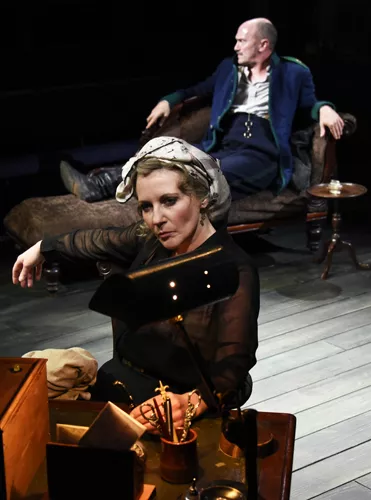
Will Keen and Lisa Dillon.
Photo credit: Nobby Clark.
Edgar and Alice’s 25th wedding anniversary is fast approaching but the atmosphere in their mausoleum-like home is anything but celebratory as the couple seem chained together only by hatred. Whatever love there was at the start has corroded into mutual loathing, as they fight continually. They live on an island off the mainland, where Edgar is artillery captain of the garrison, but they do not socialize with the other personnel, while they are estranged from their adult children. Alice despises Edgar for not gaining promotion, and blames him for depriving her of the success that she believes she would have gone on to have as an actress.
When Alice’s cousin Kurt arrives to break the bitter tedium of their isolation he gets caught up in their vicious game-playing and is used as a weapon in their war. Alice tells Kurt that Edgar had had an affair with his wife and then helped her get custody of the children, as she tries to seduce him into becoming an ally. With Edgar’s dangerous heart condition sometimes making him lose consciousness, Alice plays “Entry March of the Boyars” on the piano to which he feels compelled to dance, as the danse macabre teeters on the edge of oblivion.
Kurt has arrived to run a new quarantine centre on the island – but though infection may be circulating abroad, the real disease is in the hearts of the two protagonists who are tearing each other – and themselves – apart within a toxic marriage. Eyre has updated the play slightly to 1918 and the Spanish influenza epidemic, with shades of our recent Covid-19 pandemic when domestic strife surged.
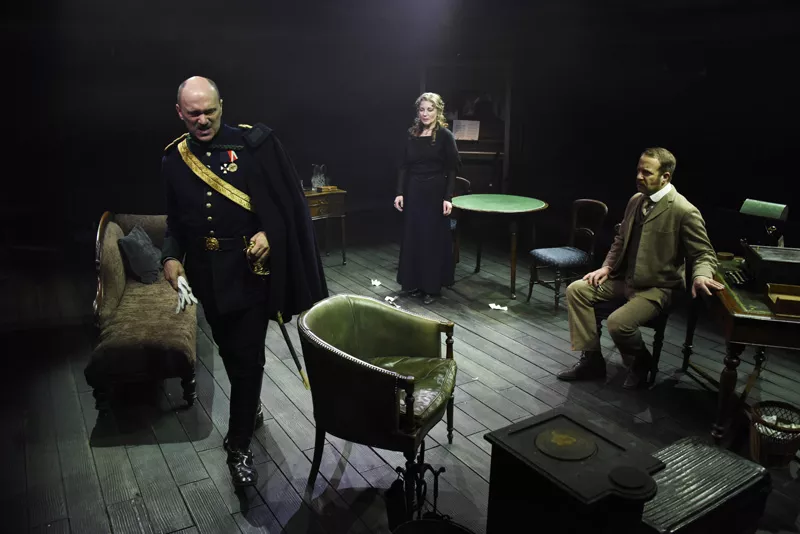
Photo credit: Nobby Clark.
Eyre has previously adapted Ibsen’s Little Eyolf, Ghosts, and Hedda Gabler, so is well attuned to brooding Scandinavian drama. But there is a surprising amount of laughter provoked here, in a battle of the sexes in which each partner gives as good as they get. As usual in Strindberg misogyny raises its ugly head, but Edgar is a martinet who attempts to subdue Alice with military-style discipline, while even the moderate and rational Kurt later succumbs to more animalistic impulses. Eyre’s sometimes earthy version makes explicit Alice’s frustrated sexuality, including her single use of the C word.
Eyre’s production makes good use of the in-the-round staging for claustrophobic effect, with the characters seemingly imprisoned in a fortress of their own making, dragging each other down with their shackles, while occasionally a door spookily blows open in the storm. Ashley Martin-Davis’s set features lots of furniture including a piano, drinks cabinet, card table, and significant telegraph machine for contact with the outside world, while aquamarine seascape images on the balconies and ceiling evoke the coastal setting. Peter Mumford’s murky lighting seems almost ghostly at times, and John Leonard’s sound design of roaring waves and wind, squawking seagulls, and occasional ship horn adds to the bleak atmosphere.
The cast is superb. You can feel the tenseness in the strained muscles and nervous tics of Will Keen’s sweating Edgar, dressed in soldier’s uniform even when off-duty as if he doesn’t exist outside his role, as he spits out his venom while fearing what the oncoming darkness may bring. Lisa Dillon’s contemptuous Alice is more than his match, as she sardonically responds to his barbs, giving him the side-eye and desperately hoping for freedom with his death, though knowing she is economically dependent on men. Geoffrey Streatfeild’s conscientious Christian Kurt (arriving in a surgical mask) starts off a peacemaker but realizes soon he is out of his depth in this hand-to-hand combat in which he is likely to become collateral damage.
Dance of Death concludes the Orange Tree’s “Nordic noir” season which also included Howard Brenton’s version of Strindberg’s Creditors and Tanika Gupta’s new take on Ibsen’s tragedy Hedda. It’s been a compelling if at times uncomfortable delve into the dark origins of modern drama.