“American Psycho” at Almeida Theatre
Neil Dowden in North London
★★★★☆
3 February 2026
The wheel has come full circle for the Almeida Theatre’s artistic director Rupert Goold. He has returned to the first show he directed after taking over there – and one of the many highlights during his reign – the musical American Psycho for his final flourish before leaving to succeed Matthew Warchus at the Old Vic (while Dominic Cooke arrives to head up the Almeida).
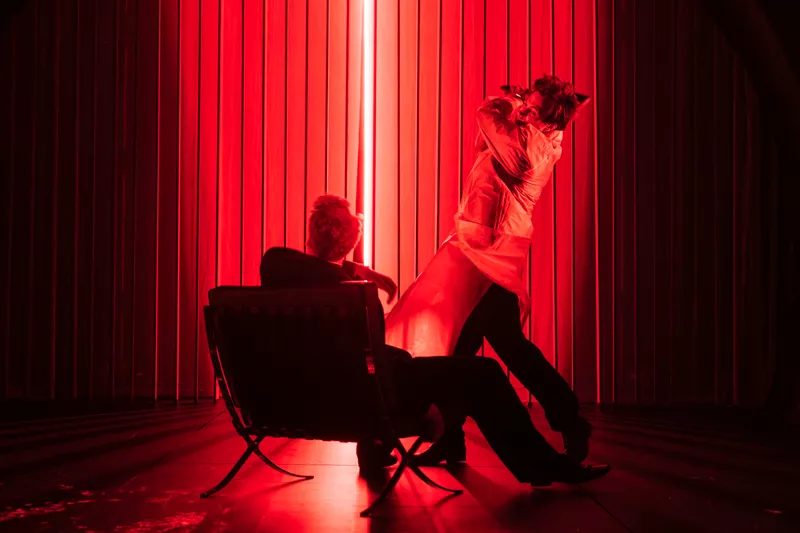
Daniel Bravo and Arty Froushan.
Photo credit: Marc Brenner.
Based on the controversial 1991 novel by Bret Easton Ellis (which was turned into a notorious film in 2000), the work – with music and lyrics by Duncan Sheik and a book by Roberto Aguirre-Sacasa – was given its world premiere by Goold at the Almeida in 2013 (starring Matt Smith) where it received rave reviews, but it flopped on Broadway when it transferred there in 2016 (perhaps a bit too close to home). The eponymous protagonist of this darkly comic satire is Patrick Bateman, a 1980s investment banker on Wall Street who makes multiple killings not only in high finance but in the flesh.
Bateman is the epitome of an unreliable narrator as he tells us his sanguinary story: “And this is what being Patrick Bateman means to me.” His account of how he descends into an orgy of random murders in New York City, following his first unprovoked and brutal killing of a homeless man on the streets of Manhattan, is so extreme and his mental collapse leading to a detachment from reality so complete that we sometimes wonder if it is all going on in his overheated imagination.
At the Pierce & Pierce investment bank on Wall Street where he works, Bateman is silently adored by his secretary Jean, while he envies his rival Paul, who manages the sought-after Fisher account and can get a table at the exclusive Dorsia restaurant. Paul’s humiliating misidentifying him as another colleague seals his fate. Bateman is two-timing his girlfriend Evelyn with her best friend Courtney, whose own boyfriend Luis (another colleague from Pierce & Pierce) also pursues Bateman after mistaking an attempted strangling for a sexual advance. Though he is questioned by Detective Kimball about Paul’s sudden disappearance, it doesn’t deter Bateman from his compulsive bloodletting.
This is the same environment as the films Wall Street and The Wolf on Wall Street, with their cutthroat “greed is good” mantra and hedonistic excess, as well as the novel/film The Bonfire of the Vanities, but in some ways Bateman most resembles Patricia Highsmith’s conman serial killer Tom Ripley (especially in his murder and impersonation of Paul Owen). Bizarrely and disturbingly, Bateman has more recently become a role model for misogynist male groups online – in a modern world that sometimes seems beyond satire.
The body count in Sheik’s musical is on a par with Sondheim’s Sweeney Todd – but the black humour is on point and it has some killer tunes. At the outset, we see Bateman’s shadowy figure emerge from a shower cubicle to drawl his way through “Opening (Morning Routine)”, which interweaves a catalogue of top-range branded consumer products he uses for his body, clothes, and apartment (including the then-new Sony Walkman), with extracts from commercials and a Ronald Reagan speech. “Cards” mocks the competitiveness of office colleagues comparing their business cards, from which they get an almost-erotic thrill. The over-privileged women singing “You Are What You Wear” equally get off on their high-end fashion designer clothes (“There’s nothing ironic / About our love of / Manolo Blahnik”) and pretentious food. “Hardbody” makes fun of male fetishizing of physical appearance in a gym.
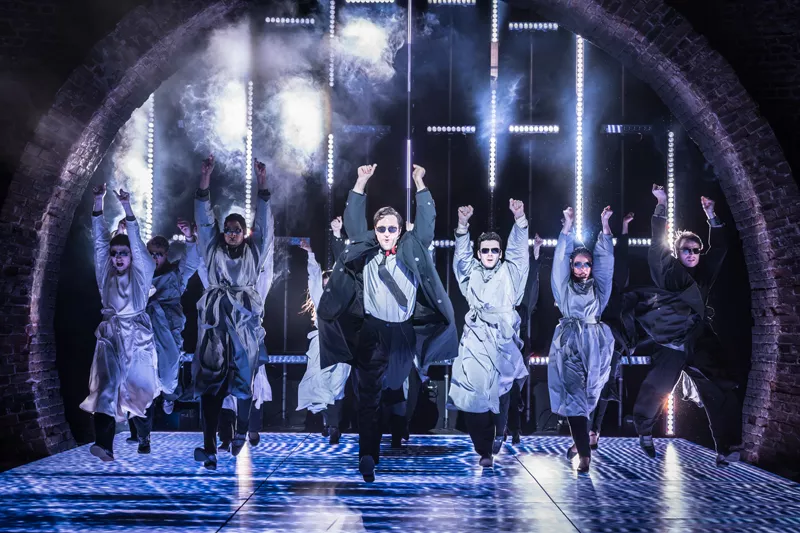
Photo credit: Marc Brenner.
“Killing Time” gives voice to Bateman’s apocalyptic nihilism (“The end of the world, nothing matters”). Although he declares “I’m not a common man” he becomes increasingly afraid that he is in fact a nobody. In the final song “This Is Not an Exit”, he claims, “Even if this story / Is overwrought and gory / It’s not a fable, it’s not an allegory”, but he also suggests he is “just a symptom / Of late capitalism”.
Sheik’s catchy electropop score channels 1980s-style music, and indeed some original pop songs (with very different arrangements) from that period are seamlessly included, including Tears for Fears’ “Everybody Wants to Rule the World”, Phil Collins’ “In the Air Tonight”, and Human League’s “Don’t You Want Me?”. And after seeing this show you may well find it hard not to visualize an axe whenever hearing Huey Lewis and the News’ “Hip to Be Square” again. In a really inventive way, Sheik’s razor-sharp witty song lyrics are often interspersed with snatches of dialogue, propelling Aguirre-Sacasa’s narrative along its bloody course.
Sheik’s multiple award-winning Spring Awakening was also directed by Goold at the Almeida, in 2021, while the same venue staged his musical The Secret Life of Bees a couple of years later. It seems fitting that Goold should bow out at the Almeida by revisiting American Psycho, which sadly in some ways seems even more topical now. There were multiple mentions of Donald Trump and his ghosted book The Art of the Deal in the novel, with the pre-politician playboy billionaire serving as a role model for Bateman, but in this production of the musical he actually makes a brief, sleazy appearance on stage – and a reference to Jeffrey Epstein has been added. Original choreographer Lynne Page – who includes robotic ensemble dancing – and set designer Es Devlin – stylishly conjuring up the glossy milieu – also return to contribute to a slickly entertaining show with a thrust staging.
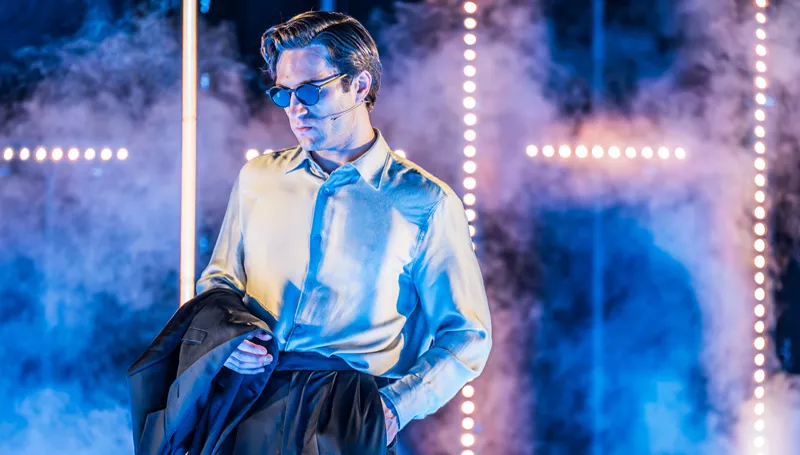
Bateman is given a strong stage presence by Arty Froushan (who was also snorting cocaine in the 1980s in the Almeida’s The Line of Beauty last year), conveying both his surface glamour and inner demons. Although his violent solipsism is without any redeeming features Froushan shows how Bateman is aware of his own empty, shell-like existence and the inequities of modern society even while he lusts after material gains that will never satisfy him. The anger that burns him up inside and leads to his murderous rampage springs from a perverted desire to prove he matters, while his later confession is not due to guilt but an attempt to achieve notoriety.
Emily Barber impresses as the supercilious and superficial Evelyn, while Anastasia Martin provides some real poignancy as the naively innocent Jean. Daniel Bravo is the smoothly entitled Paul, Zheng Xi Yong the sexually ambivalent Luis, and Tanisha Spring the cynically transactional Courtney. Kim Ismay amuses as Mrs Bateman and Joseph Mydell deftly plays the mysterious Detective Kimball.
American Psycho’s pungent satire on corporate capitalism and consumer culture where human beings (especially women) also become commodities still hits the target.