“Akhnaten”, LA Opera
Annie Loui in California
★★★★☆
15 March 2026
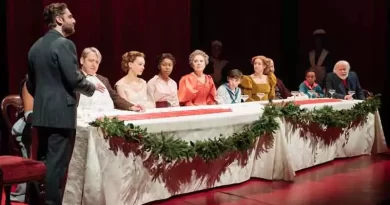
This three-and-a-half-hour-long Philip Glass opera might be daunting you would think, but besides the expected repetitively hypnotic Glass music, I was looking forward to a powerful staging from Phelim McDermott (of Shock Headed Peter fame). I was not disappointed. Ritualistic slowness, gilded bodies and elaborate costumes made for spectacular presentation, and the principals were surrounded by a chorus of movers and singers executing gesture and sound in powerful synchronicity.

Photo credit: Cory Weaver.
The story is simple. In Part One of the three acts, Akhnaten takes over after the entombment of his father, the pharaoh Amenhotep III. In Part Two, Akhnaten, joined by his mother and wife, creates a new mandatory religion. In Part Three, the royal family is overthrown by a mob of supporters of the old religion and yet another new pharaoh is put into place.
McDermott’s staging for Act One takes place on a two-dimensional three-storey-high set where stacked layers of action reveal the simultaneous entombment of Amenhotep III, a linear line of seated gesturing gods with animal heads, and a chorus of Egyptians ushering in the new pharaoh, Akhnaten. In Robert Wilson-channeled slowness, a naked Akhnaten ritualistically shows himself to the masses and is carefully dressed in a sumptuous golden robe. And then he begins to sing, the voice being ethereal, high and questionably male. He is a countertenor and the somewhat jarring juxtaposition of gender and sound further accentuates the sense of the Egyptian supernatural. The audience is clearly locked in a world of cosmic revelation.

Photo credit: Cory Weaver.
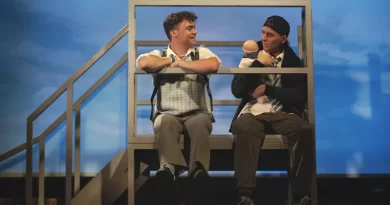
Synchronized gestures and hieroglyphic-inspired tableaux invoke the power and period mystery. The only flaw in the unfolding action is the repeated device of unison juggling. Though occasionally effective (juggling pins were thrown dramatically close to the high priest during the dismantling of the old religion), it is somewhat jarring and takes me away from ritualistic grandeur. As expected in a minimalist opera of this scale and vision, the singers are exquisite; especially So Young Park as Queen Tye in duet with John Holiday as Akhnaten. McDermott has the tall and powerful Zachary James singing Amenhotep III also narrate the occasional spoken text and finally play a modern-day professor relaying history to indifferent students. His performance is informed with the pathos of a dead father witnessing his son’s idealism and errors. James has great physical presence and acts as an effective guide to the story.
The tableau at the climax of Act Two is particularly effective with an enormous, suspended disc radiating colour. Changing rays of light portrayed through manipulated neon sticks match the intensity of the music, as a backlit Akhnaten climbs a set of stairs to reach the sun.
An audience member leaving after the final curtain said, “Tedious!” Not from where I was sitting and I was joined by most of the audience who stood with a spontaneity that suggested true appreciation. The final moments of Act Three still resonate, as Akhnaten and his family die and seem to visibly calcify while the movement chorus in a slow relentless procession cross the stage unhurriedly flowing around and beyond the singers.
Camels? I don’t know, and don’t care. The sands of time proceed without haste, and former glories now remain inscrutable as static symbols. It’s worth the length and slow unfolding. While less varied than Glass’s epic opera Einstein on the Beach, it proved to me that Glass’s music usually conveys beauty, awe and catharsis effectively. It evokes staging that matches his pace and power. To me, that is good opera.