“NOAH”, Sight & Sound Theatres, Lancaster, Pennsylvania and Branson, Missouri
Adam Sacks
21 December 2025
★★★★☆
Thirty years after the event is a good occasion to revisit one of America’s most spectacular and overlooked sites for theatre. Sight & Sound Theatres have been excelling at “Broadway meets the Bible” for just as long, and to celebrate they have returned to their roots with a production of NOAH which was their very first offering in 1976.
There are two venues, a theatre at the edge of the Bible Belt in Branford, Missouri, and another in the heart of Amish country in Lancaster, PA. This brings a rare monumental and immersive quality to the work that is still largely reliant on old-fashioned human ingenuity.
NOAH is of course the story of the rebirth of humanity, or according to biblical lore, the beginning of humanity. For Sight & Sound Theatres, NOAH marks indeed the company’s humble beginnings of transforming the biblically epic into the domestic everyday.
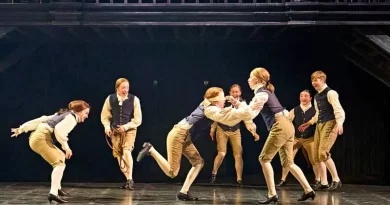
The company’s vast stage equates to at least three of those you would see on Broadway with two full wings along which much also transpires. Most of the scenes are ensemble, peppered with domestic banter and occasionally punctuated by a song and dance number or a sacred hymn. While only vaguely foreshadowing the towering achievements of later productions on stage (settings and subjects have included the palaces of Babylon and Philistine giants), NOAH offers more than enough in terms of old fashioned in-person immersion.
A consistent feature of the company’s work is the use of live animals that arrive up and down the aisles, these range from pigs to lamas to horses and donkeys. (At the production I attended, one promptly attended to its bathroom needs just after arriving on stage.) Despite possible political resonance from such use, the animals undeniably impart a sense of joyous raucousness to proceedings.
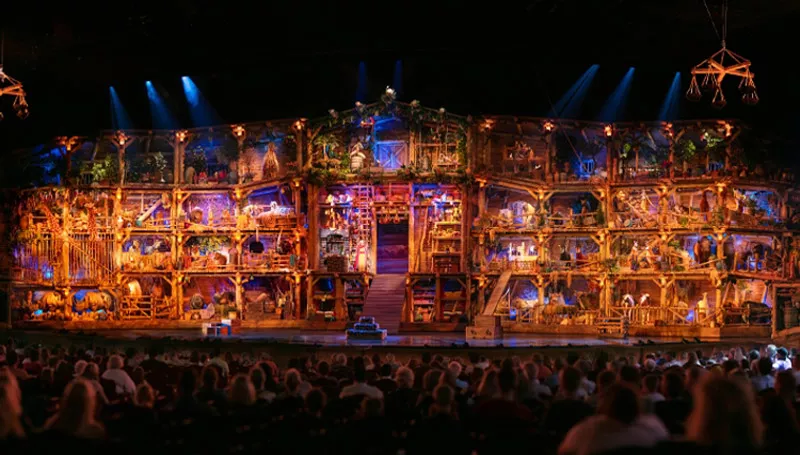
As this production formed something like the training wheels stage of the overall endeavour, there is no depiction of the Ark on the seas or the giants over the land. The audience is instead treated, at the start of the second act, to a breath-taking interior wraparound of the whole Ark filled with the planetary zoo three storeys high.
Despite the apex predators and others being enlivened through animatronics, their movements are surprisingly touching and lifelike without being too technically affected. The theatrical mission is broad, developing from the theological to the civilizational if you will. At the end, the remains of the Ark are transformed into a cross out of which the Saviour makes a brief cameo. Such “prefiguration” is another mainstay of the company which in later iterations takes ever more ingenious forms.
Nevertheless, the primary catharsis is not one dogmatic element but rather an ethos of love in all human and social interaction that is conveyed well by the warmth and humour of the ensemble cast. Strange as it may seem, the real heir to what was once known as the “American Tribal Love Rock” of the 60s hippie moment can be found a lot closer to the Bible Belt than the Great White Way.