
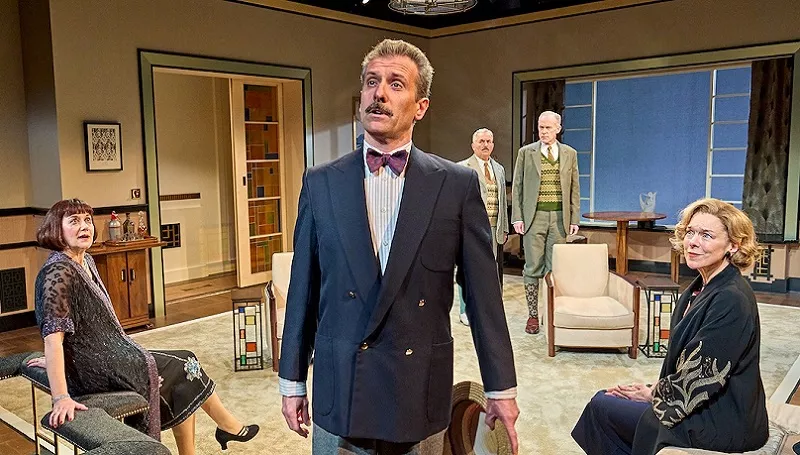
“Fallen Angels”, Menier Chocolate Factory
Jeremy Malies on the South Bank
8 December 2025
★★★☆☆
There is a well-executed running gag in Fallen Angels to the effect that down-on-her-luck serving maid Saunders (played by Sarah Twomey) is better educated and more accomplished than her employers. While lecturing mistress Julia (Janie Dee), Saunders says that mistakenly flattening a single note in a piano solo always spells disaster for the piece. And there is barely a note or element out of place here in Christopher Luscombe’s revival of Noël Coward’s (daring and risqué for the time) 1925 play.
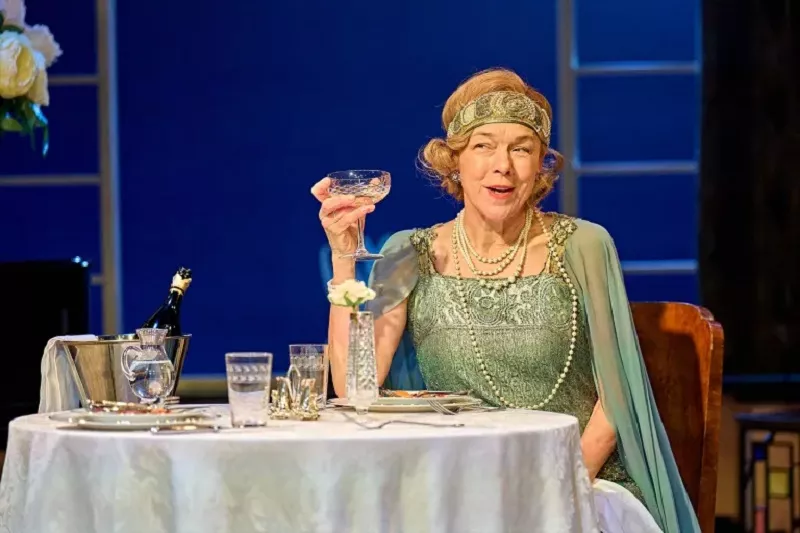
Janie Dee as Julia.
Photo credit: Manuel Harlan.
The structure is similar to Private Lives which would premiere four years later, with Julia forming a search party with Bill (played by Christopher Hollis) who is the husband from the other couple. They go in search of Bill’s wife Jane (played by Alexandra Gilbreath) who is on a bender and pursuing heart-throb Frenchman Maurice played here by Graham Vick. Jane does not hook up with her former flame and spends the night (anticlimactically in every sense) on her own in a Bayswater hotel.
Gilbreath’s acting – even when her character is poleaxed by drink – is closely observed. She is comedic with little effort and teeters between realistic movement and broader gestures that (in the right sense) suggest gurning. Dee feeds off Gilbreath well and, while presenting her character as less drunk, manages to be convincingly maudlin and edgy over Maurice’s arrival. (Not knowing the play and having ignored the programme notes, I even thought that Maurice might be a Godot figure.) Both women are throbbing with excitement.
A Coward watchword from Hay Fever is, “Wit ought to be a glorious treat like caviar; never spread it about like marmalade.” Despite the quick-fire gags and aphorisms, there is a discipline to Luscombe’s direction suggesting that his cast have been drilled on all the plot mechanics that make the piece work. These include a deft sequence in which the longed-for lothario is thought to be knocking on the door, but the visit turns out to be by an (unseen) plumber.
Luscombe subliminally sets the tone of the period such that, even for us, the scene in which both women confess to pre-marital sex is mildly shocking when it could have been yawn-inducing. More interesting is that the women have knowingly shared this man. Creating period flavour so well is an achievement since apart from touristy clichés about Italian cities being a comic playground for Brits, there is no reference to the world outside. Luscombe gives the play some room to breathe here, reducing the helter-skelter pace as the women are almost lyrical while remembering their trysts in Italy.
Simon Higlett’s Art Deco set vies with cast members to be the star of the show. It’s given in detail from the chevrons and sunbursts in stained glass to props such as ziggurat lampshades. Oliver Fenwick’s lighting design even shows dawn hours through the glass as Bill arrives at his golfing buddy’s London flat having caught the first train up from their trip to Sussex. Adam Cork’s sound design has its moment when (it must take considerable artifice) he makes us think that sounds of lovemaking are coming from upstairs in the flat which the predatory Maurice has rented.
Any criticisms? I could never quite see Richard Teverson (he plays the other husband Fred) and Dee as a couple, even one for whom passion has withered on the vine. Perhaps trying to be all of a piece with the lines of a chair, Dee came within a whisker of falling off it on press night when delivering her first speech. The poise returned, but I never managed to put this near mishap out of my mind. And does the much-awaited arrival of Maurice set enough hearts aflutter? Possibly but, by contrast with the sports coats and plus-fours of the golfers as well as the wonderful cocktail dresses of the women (costumes by Fotini Dimou), his blazer and slacks look off-the-peg.
As the omnicompetent uppity servant (I wonder if such a species ever existed outside this kind of drama and Wodehouse books) Twomey is the standout whether she is doing a tongue-in-cheek plié ballet move or illustrating how a former employer concert pianist fine-tuned her own playing. I believed in each of her areas of excellence.
All the inherent sheen of Coward’s writing is present here. There is indeed the odd duff note but the mixture of premeditated insult and crushing repartee is delivered expertly.


