“All My Sons”, Wyndham’s Theatre
Jeremy Malies in the West End
★★★★★
25 November 2025
Playing Joe Keller, the father figure and World War II industrialist in Arthur Miller’s 1947 play, Bryan Cranston has the resonant line, “A little man makes a mistake and they hang him by the thumbs; the big ones become ambassadors.” I can’t have been the only person to chuckle at this when thinking of Peter Mandelson who was at least given the sack promptly as a result of his friendship with Jeffrey Epstein.
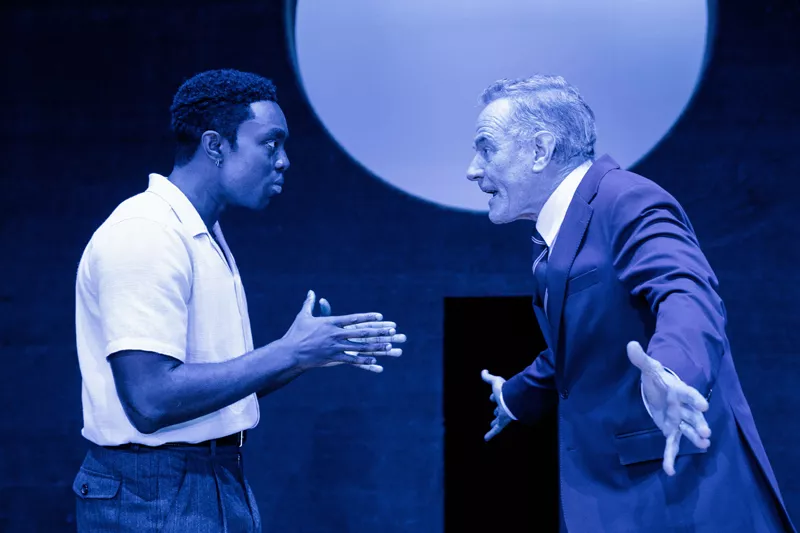
Paapa Essiedu and Bryan Cranston.
Photo credit: Jan Versweyveld.
Miller has been clairvoyant in many ways with this script concerning the fallout in every sense of Keller consciously allowing cracked cylinder heads for P40 military aircraft to leave his Ohio factory. In 2023, a US Air Force Osprey plane crashed in Japan killing all eight airmen on board with two investigations now ongoing into what is acknowledged by all parties to be a steel components failure.
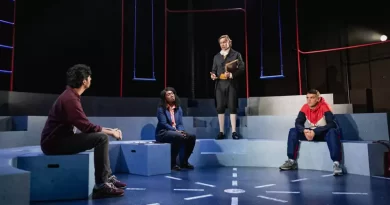
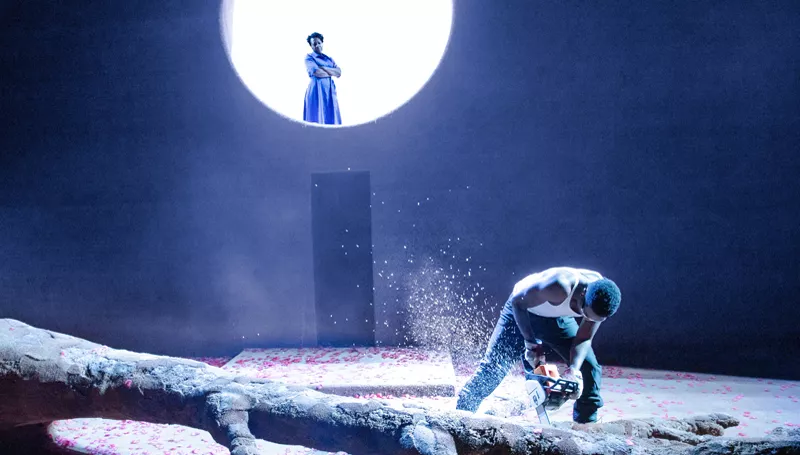
Director Ivo van Hove and scenic designer Jan Versweyveld opt for simple geometrical shapes on their two-tier set. An enormous circle has been hollowed out at the rear. I imagined that I was staring through the propellers of the plane in which unseen but pivotal Larry Keller, brother of Chris played by Paapa Essiedu, has crashed to his death in Australia.
Unusually for van Hove, there is not a scrap of live video and, indeed, no video or even stills projection of any kind. Director trusts material as written implicitly, no doubt knowing that his extraordinary cast will deliver with minimal artifice in one of the purest and most overpowering productions I have seen all year.
Tom Glynn-Carney enthrals as George, the lawyer son of Keller’s unseen imprisoned business partner, Steve. It’s made clear that Steve has the same amount of blood on his hands (21 pilots have died) as Keller Snr but has perhaps been less weaselly at trial. Glynn-Carney plays George as intoxicated (drugs not alcohol) which goes beyond Miller’s direction of being “on the edge of his self-restraint”.
But the effect is exhilarating as he teeters between possible reconciliation with the Kellers and disgust at their duplicity. It’s always a standout moment but actor cements empathy with his character as George reflects on the spurned open goal of marriage to near neighbour Lydia played by Aliyah Odoffin. The simplest embrace between the pair projected tremors throughout the theatre as it’s revealed (achingly) that Lydia has three children by fool of an astrologist husband Frank played with just the right buffoonery and seemingly improvised gags by Zach Wyatt.
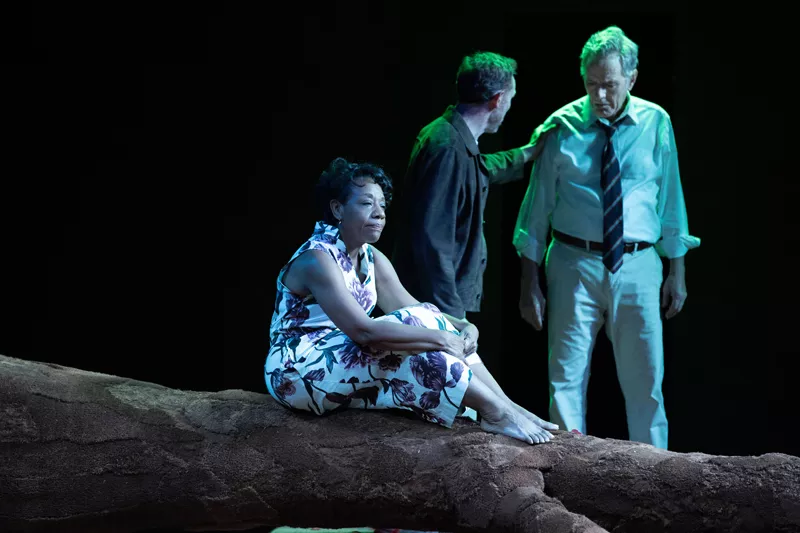
Marianne Jean-Baptiste, Richard Hansell, and Bryan Cranston.
Photo credit: Jan Versweyveld.
What of Essiedu in this cast that bats down to number eleven? He is magnificent in the physical confrontations with Cranston and when conveying what is surely the playwright’s own distaste (it was an abiding theme) for materialism which he shared with Ibsen who he obsessed over and adapted. Essiedu is affecting when his character remembers small acts of solidarity between servicemen and in his conclusion that it was the truly brave who never made it back from the war. It’s exactly the kind of camaraderie that Tennessee Williams taps into as Stanley and his poker buddies reminisce about conflict in A Streetcar Named Desire which also premiered on Broadway in 1947.
With Versweyveld’s set being largely abstract, I found it odd that in a slightly laboured scene, Essiedu has to trim (for real – he has a chainsaw, and you see wood chips flying) the tree that has crashed in a storm during the opening moments. I wondered if the trunk will last the whole run.
Costume designer An D’Huys excels when the group prepare to go out for dinner. Even with an outfit as simple as slacks and blazer she is able to indicate Keller’s vast wealth (the factory now makes consumer electricals) and tolerably good taste. There is no attempt at realism and D’Huys puts Glynn-Carney in an anachronistic hoodie. Essiedu summons up his dead brother by going to his untouched wardrobe and donning a leather bomber jacket that D’Huys has chosen well. Period is summed up with small deft touches; we know that this is Harry Truman’s America and van Hove leaves in the quip by Frank that as a haberdasher he too may rise to be president.
Marianne Jean-Baptiste plays Kate who is mother to the two brothers and husband of Joe. She is adept when conveying the subtlety of her character’s warped logic that has her think if she admits that Larry is dead, she must also acknowledge Joe’s culpability. Jean-Baptiste uses nervous tics to show the pathetic mindset that has the character keep Larry’s shoes polished ready for his return. Playing Ann, Hayley Squires shows a shrewd young woman employing true logic to work through her qualms about marrying the brother of a onetime fiancé while considering what it means in the family dynamic and how it might be perceived more widely.
At two hours five minutes with no interval this was quite a feat of endurance for the audience, but attention seemed focused throughout the stalls on press night. And yet I had an “Out of the mouths of babes” moment when eavesdropping on a drama student scuttling towards Leicester Square afterwards. She said, “We see Kate lying down on the fallen tree about midway. Bring the curtain down! Interval! Simple!”
Cranston is wonderful as he shows Joe’s bluster coming apart layer by layer until the character makes a naked confession that the cracked plane components received a shoddy cosmetic makeover with soft metal that might as well have been soldering flux. They were dispatched as being fit for purpose so sending young men to their deaths. Cranston draws on all his technical skills to show Joe shedding a carapace and revealing himself as a sociopath who might just about be loyal to immediate family but shuns any wider commitments. I thought of the profiteer in Oh, What a Lovely War! taking pride in having sold barbed wire to both sides. Tension between social and corporate responsibilities continues to motivate dramatists and has been prominent in the work of Lucy Prebble and David Hare.
I can’t think of a better example of the title of a play being so seamlessly placed into a pivotal speech as Cranston reflects on the airmen and the fate (there is a twist involving a letter) of his own boy. We grasp what the title means and how a son perceived his father’s crime. “In some ways, they were all my sons.” In its current incarnation this wonderful play – easily Miller’s best and I wonder why there is ever any argument – pulls off the feat of being both elegiac and topical at the same time. Outstanding.