“When We Are Married” at Donmar Warehouse
Neil Dowden in the West End
★★★★☆
21 December 2025
J.B. Priestley’s 1938 play When We Are Married is a very different animal from either his mysterious “time plays” or his socialist political dramas. Subtitled “A Yorkshire Farcical Comedy”, it does what it says on the tin. With broad humour, Priestley mildly satirizes snobbery and sanctimoniousness among the middle classes of Edwardian Yorkshire, as well as gently probing the nature of marriage and gender relations. It may set up a quietly subversive scenario yet – unlike, say, An Inspector Calls which is set in a similar milieu but ends with the protagonists facing public disgrace – all is smoothed over by close of play. Tim Sheader’s revival at Donmar Warehouse is a fun-filled, warm-hearted delight for Christmas.
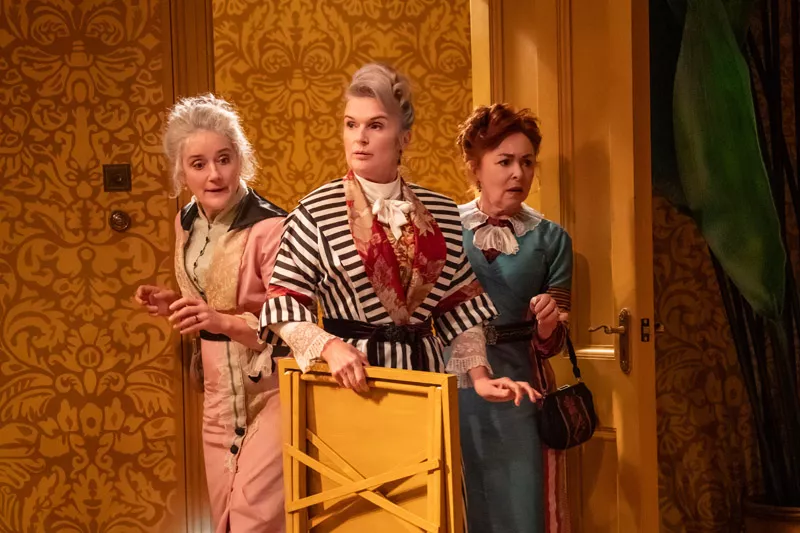
Sophie Thompson, Siobhan Finneran and Samantha Spiro.
Photo credit: Johan Persson.
When three prosperous couples – Alderman Joseph Helliwell and his wife Maria, Councillor Albert and Annie Parker, and Herbert and Clara Soppitt – get together in the Helliwells’ house for a slap-up meal to celebrate their joint silver wedding anniversaries they ooze bourgeois self-congratulatory complacency. But the men almost choke on their port and cigars when the new chapel organist – whom they threaten to sack if he doesn’t stop his dalliance with an unknown young woman – tells them that, due to a clerical error (pun intended), they are not legally married themselves. Living in sin is one thing, but if news got out public scandal would be much worse.
Their wives are equally shocked when they break the news to them, but the bombshell highlights the tensions already seen in their respective – and outwardly respectable – “marriages”. The Helliwells’ seemingly successful partnership is brittle (and we find out later Joseph has a roving eye), the egotistical windbag Albert dominates the long-suffering Annie, while the meek-mannered Herbert is under the thumb of the overbearing Clara. The news makes them reassess their relationships, with Maria confronting Joseph about his love for her, while Annie and Herbert stand up to their partners for the first time and start to rekindle their early, unarticulated mutual attraction. Perhaps this is an opportunity rather than a threat.
Priestley has great fun in ridiculing the pretensions and hypocrisies of these nouveaux riches who have prospered from the flourishing local wool industry but now look down on the lower classes from where they started themselves. The men are not only wealthy mill owners and municipal bigwigs, but hold sway over the nonconformist chapel as they enforce moral strictures that make them feel superior. Their pomposity is well and truly punctured. But the play is a light comedy that does not penetrate deeply into social inequality, revelling in a certain amount of irreverence and innuendo with northern-style colloquial humour.
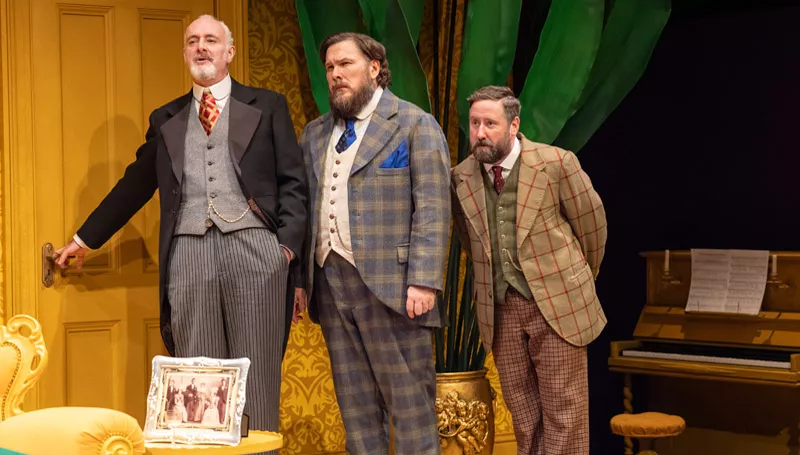
Sheader’s deft production is thoroughly entertaining from start to finish, including the brilliant idea of having a music-hall-style song at the beginning of each half, respectively “The Biggest Aspidistra in the World (originally sung by Lancashire lass Gracie Fields) and Marie Lloyd’s “A Little of What You Fancy Does You Good”. Peter McIntosh’s golden-toned set suggests a posh drawing room, featuring a huge aspidistra and a framed sepia photograph of the triple wedding, while Anna Fleischle’s costumes evoke Edwardian fashions of women’s colourful, belted, long-skirted dresses and men’s woollen, checked three-piece suits with pocket watches signalling their affluence.
The cast make a fine comic ensemble. John Hodgkinson and Siobhan Finneran are well-matched as the gracious hosts the Helliwells whose dignified veneer masks an uneasy alliance. Marc Wootton is very amusing as the “stingy”, dogmatic Albert who cannot abide “la-di-da” southerners, with Sophie Thompson making the most of the fun-starved Annie’s ironic comments. Jim Howick shows the diffident Herbert growing in confidence, while Samantha Spiro’s battle-axe Clara is blunted. Ron Cook does some fine physical comedy as the increasingly inebriated local newspaper photographer who has come to record the anniversary, and Janice Connolly is a hoot as the Helliwells’ eavesdropping domestic servant who delights in showing her lack of deference towards her “betters”.