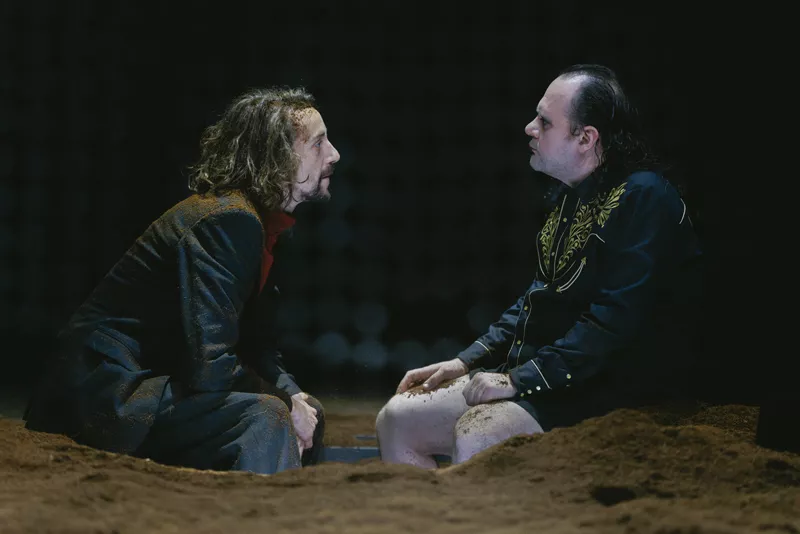
“Ukrainomania – Revue of a Life” at Volkstheater
Dana Rufolo in Vienna
★★★☆☆
19 January 2026
A woman, the emcee, Solomiya Kyrylova is shouting from the stage, another woman Sofiia Melnyk, struggles to climb up to her from the audience carrying a computer and papers and pen – she is responsible for the illustrations and surtitles. “Turn off your mobiles but take all the photos you want during the show,” Kyrylova tells us. She’s stressed – it took her 27 hours to get to the theatre from Ukraine what with all the border controls these days – and we are reminded that this show is a co-production with the Vienna Volkstheater and the Maria Zankovetska Theater in Lviv, Ukraine. She tells us to post the photos on Instagram; after all, no other war has enjoyed such extensive visual coverage. The QR code is projected onto the stage curtain.
The curtain opens, and we see a refrigerator which functions as a safe – during the war in Ukraine, you have to hide your valuables, and the fridge is their hiding place; it contains books by Joseph Roth. A looming rectangle is open on stage; it is a grave site. Kyrylova, the shouting emcee woman (so tall, so spindly; is she really a woman, has she been a woman her whole life long?) is next to the grave site. Now she is a gravedigger. Earth is dug out and flung about, not energetically. We are enveloped in a whirl of gestures and languages thrown at us like mudballs (with surtitles for the needy): German, Ukrainian, Bulgarian. Occasionally, English. Why Bulgarian? Because there is also now a gravedigger, an energetic man, the actor Samouil Stoyanov, and he is Bulgarian. Kyrylova is a Ukrainian actress, and she understands Bulgarian it seems, for the two gravediggers shout and reply each in their own language. They exchange angry words. Half the audience understands Ukrainian. The remainder understand German. They can read the Bulgarian surtitles. Different sections of the audience burst into laughter at different times, like a peeled orange sectioned into two halves.
A pastiche of dialogue, jokes, video, music (live band Philipp & Ensemble) triples on, leading us to wonder if Ukainomania is a wild evening of improvisation. But no. It’s been developed by director Jan-Christoph Gockel to look like an improvisation. There are three acts – the first is entitled “The Funeral”, it is Jospeh Roth’s funeral and he is angry because Stefan Zweig, a fellow famous Austrian author (also long dead) didn’t come to the funeral (in Paris). But Jospeh Roth hoists himself out of his grave (spoiler … it is really an actor). He disappears. Where is Joseph Roth?
Part Two is entitled “The Trip to Lviv” (“Reise Nach Lviv”). The Austrian author Joseph Roth was born Jewish in the Galician town now a part of Ukraine called Lviv, presently war-torn. The cast take a train to Lviv to look for Joseph Roth, and on the way, they meet a female conductor who said she started her shift on 22 February, 2022 – two days before the war in Ukraine started, and continued without relief, because the train was initially requisitioned to transport civilians out of war zones.
In Lviv, the search for Roth is on. He is found, possibly in the author’s favourite café, the Cafe Atlas, talking to people around him, getting sozzled. We see him in a video telling his Ukrainian translator Jurko Prochasko that he is Joseph Roth, returned, and we see the bemused expression on the translator’s face. Here, video and onstage action are mixed together.
We also meet Joseph Roth onstage, seeing for ourselves how his alcoholism led to an early death in 1939 when he was a few months short of 45. He became an impoverished and rootless Wandering Jew when Hitler took power in Germany. Nowadays, his books like the 1936 Confession of a Murderer (Beichte eines Mörders), which reflect on the loss of a European identity and the destruction of democracy, are seen as prescient.
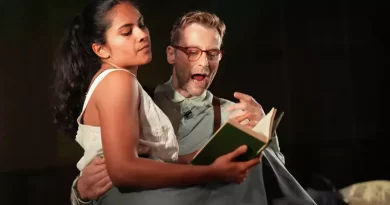
Gockel chose to present Ukainomania at a rapid pace. That is a challenge. It challenges us to keep fast to our principles, the red line that runs through the narrative, the truth line. It challenges us to keep up, run the pace without outdistancing our thoughts. That is the challenge, to keep thinking while running away from terror. Supposedly, this terror is embodied in Joseph Roth himself. He has come back to life. He is the person who rises from the grave. He is the actor Bernardo Arias Porras. He addresses his characters. Worst terror of all, we see him wrapped in a sheet he has gotten at a Lviv café where his wife Friedl dances and sings (Alicia Aumüller). Roth descends from the stage and wanders through the audience – among us – weeping. He has debts. He can’t go on. “I am Joseph Roth. I come from Ukraine. I need money please. I work every day for six to eight hours.” He shares a drink with an audience member. He pleads, he begs. The audience members he approaches appear to be genuine, not actors. None of them gives him a cent. (I suppose if they had given him money, he would have had a reply ready to deliver.)
Part Three also feels like improvisation. The gravediggers are dressed up as drones, and they shoot a missile into the grave pit that is still on stage. The final words are, “Attention, the air alert is over. “And then, “May the force be with you.” The air raid siren used is Luke Skywalker’s voice.
In the final analysis, Ukrainomania is truncated. We are not given enough information about Joseph Roth to understand his imaginative life. He just seems a drunk, and that is not the full truth about him certainly. When Porras is talking to people as Joseph Roth, he doesn’t discuss his regret for the changes that time has wrought on political reality. We are never told how deeply Roth was rooted in a fondness for the Austrian monarchy. But perhaps the director wanted to avoid this uncomfortable truth.
Sure, it raised a hearty laugh to hear how Roth’s home town’s name switches back and forth from Lemberg, Lwow, L’viv to Lviv. And no laughter when the subject is raised of how many bodies are needed before one terms a burial site a mass grave. We recognize something uncanny about Roth the author having been displaced and made homeless by a war in a city that is experiencing war again. We know the “play” is joking around with a deadly subject, and that knowledge hits us hard. But when it is over, we feel as if Ukainomania has hardly begun.
Photo used as header image and thumbnail – credit: Marcella Ruiz Cruz.