“The Unlikely Pilgrimage of Harold Fry” at Theatre Royal Haymarket
Franco Milazzo in the West End
★★★☆☆
11 February 2026
There is something quietly audacious about The Unlikely Pilgrimage of Harold Fry at the Theatre Royal Haymarket. A musical about walking should on paper feel pedestrian. Instead, this production moves with assurance, spectacle, and no small amount of emotional heft, helped immeasurably by a creative team operating at the top of their game.
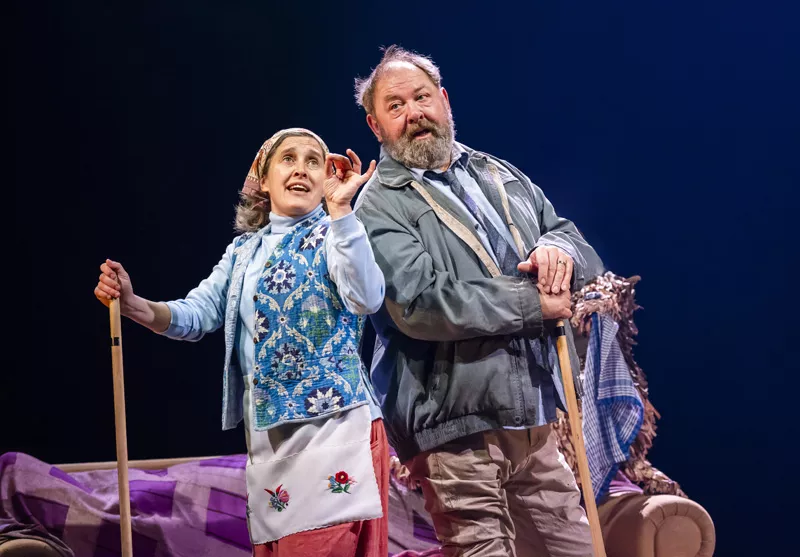
Madeleine Worrall and Mark Addy.
Photo credit: Tristram Kenton.
Transferring from a successful run at Chichester Festival, Katy Rudd’s production is the latest adaptation of Rachel Joyce’s 2012 novel about the eponymous character’s journey from south Devon to Berwick-upon-Tweed to see his old friend Queenie who is dying in a hospice. The 2023 film version starred Jim Broadbent as the man on a marathon mission, but for this stage musical version (with a book by Joyce herself) Mark Addy returns to step into Fry’s yachting shoes.
The first thing that strikes you is just how good this show looks and sounds. Paule Constable’s lighting is, once again, doing the heavy lifting that lesser musicals outsource to sentiment. Roads stretch, weather turns, memories bleed into the present. It is atmospheric without being showy, painterly without feeling indulgent. Combined with the clean clarity of the sound design by Ian Dickinson & Gareth Tucker for Autograph and Samuel Wyer’s unfussy but evocative set, the result is a production that understands scale without ever overwhelming its intimacy.
Passenger’s score is another pleasant surprise. These are tunes a clear notch above the forgettable dross normally doled out along Shaftesbury Avenue, songs that make direct grabs for the heart if not always the head. The melodies are insistent, emotionally legible, and unashamedly earnest. You may not hum them on the way home, but you feel them while they are happening, and that counts for something in a genre too often addicted to pastiche and bombast.
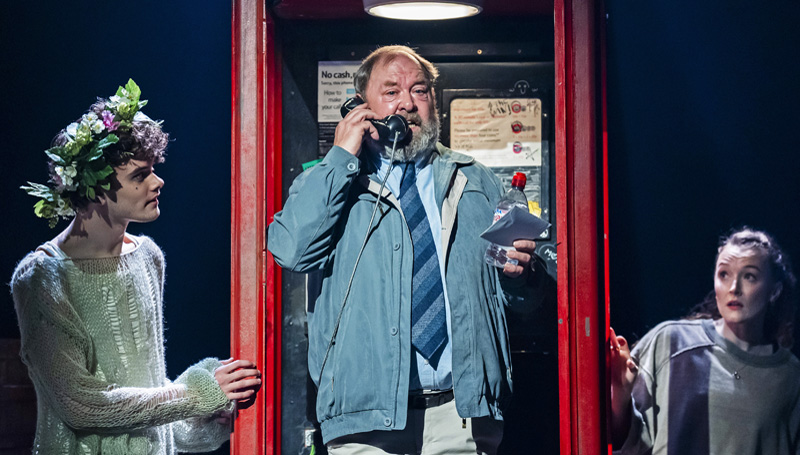
At the centre of it all is Addy, an actor whose own professional travels have included award-winning roles in The Full Monty and Game of Thrones as well as Hollywood flop The Flintstones in Viva Rock Vegas. Here, though, it is hard to imagine anyone better suited to retired brewery rep Harold Fry. Addy gives us a troubled everyman, closed-off, guilt-ridden, determined to reconcile himself with his own history even if he cannot articulate why. His performance is all weight and gravity, a perpetual emotion machine driven ever onward by his inner demons. He makes stillness dramatic. He makes walking feel like penance. When Harold commits to the journey, Addy sells it not as whimsy but as necessity.
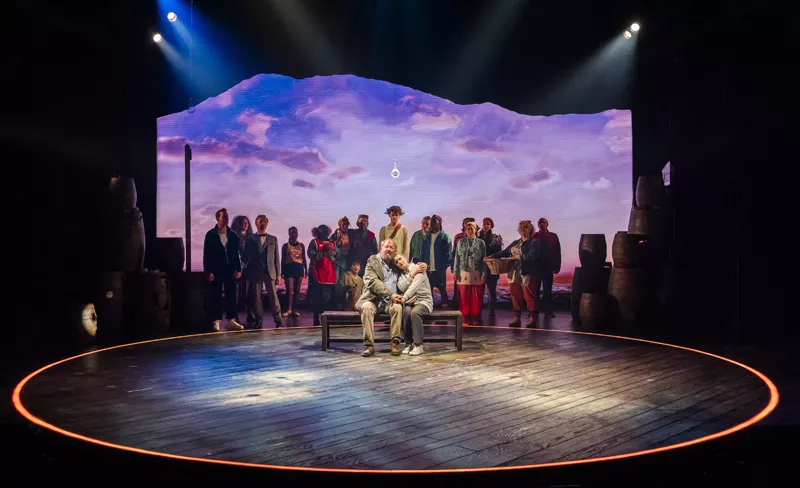
Set by Samuel Wyer.
Photo credit: Tristram Kenton.
The writing around fathers and sons has, admittedly, nothing new to say. Regret. Distance. Things unsaid calcifying over time. Memories of mistakes turned over and over for fresh rounds of self-flagellation. We have heard all this before. But Addy’s acting adds such dramatic ballast that the clichés land heavier on the ear than they have any right to. He drags familiar ideas into fresh emotional territory simply by committing to them so fully.
Less well served is Jenna Russell, a performer whose talents feel frankly wasted here as Fry’s wife Maureen. This queen of British musical theatre (specializing in Sondheim and winner of the 2007 Olivier Award for Best Actress in a Musical for Sunday in the Park with George) barely registers above the hubbub for much of the evening. The role gives her little to do beyond react, wait, and ache quietly. It is not that Russell is poor. It is that the material refuses to meet her halfway.
There is, however, some genuinely excellent puppet work, particularly the dog, operated by Timo Tatzber with such charm and specificity that it nearly steals the show. The skill is evident, the characterization immediate. One leaves the theatre wishing, quite sincerely, that one could have taken the dog home.
Structurally, the musical stumbles midway through when Rudd loses confidence in telling her story through strong lyrics, witty exchanges, and nuanced dialogue and decides to pull mercilessly at the heartstrings at every given opportunity. Those allergic to gloopy plot shifts that can be seen from any passing comet may need to pack an EpiPen or two.
Worse is the awkward tonal shift: before the interval, Harold is risking life, limbs, and his marriage to get to Queenie in time while after – with nothing tangible by way of explanation other than an apparent vision – he now only has his son (Noah Mullins) in his sights. This leads the overall narrative to lose its way just as Harold finds his. A show that starts off smelling pleasantly of Homer’s Odyssey soon reeks of Death of a Salesman before rich wafts of Next to Normal fill the nostrils.
More troubling is how sketchily the characters are drawn. Motivations are asserted but never earned. Like Forrest Gump running across America, Harold gains a following the further he goes along but these “pilgrims” disappear almost as soon as they arrive and are hardly more than a name and a quirk. Harold himself trudges across England in hopeless footwear for an ex-colleague that he thinks ghosted him two decades ago and, when first hearing of her impending death, he can barely manage more than curt written courtesies. Queenie risks her career and her professional reputation for a friendship that seems to largely consist of a stationery cupboard pep talk and a few car journeys. And for a woman who claims to cherish intimate chats with her son, Maureen never actually has one on stage and only calls out into the distance.
Would I walk 500 miles to see it again? I wouldn’t, and I suspect even The Proclaimers might hesitate. This is a far from flawless pilgrimage but, at its core, it is a moving one, elevated by craft, conviction, and a central performance that refuses to let the journey feel trivial.