“The Tempest” at Sam Wanamaker Playhouse
David Wootton on the Southbank
★★★☆☆
2 February 2026
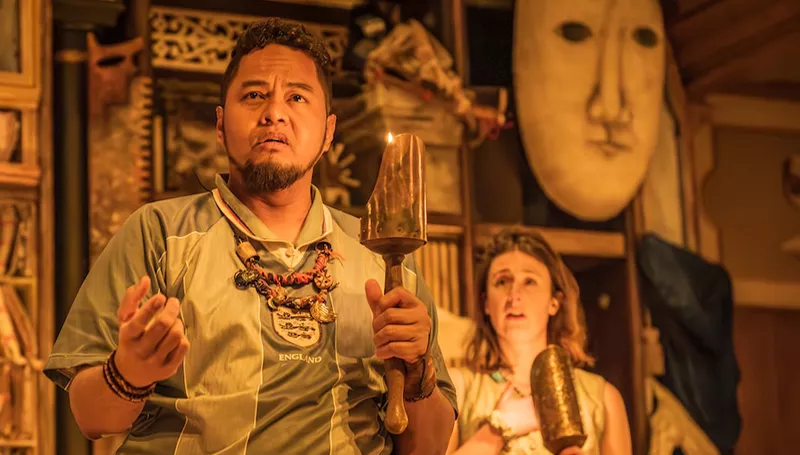
Tim Crouch’s modern-dress reimagining of Shakespeare’s The Tempest begins not with a bang but with a whimper. It dispenses with the violent sea storm of the title that usually opens the play and that maroons Alonso, King of Naples, Antonia, Duchess of Milan (Duke Antonio in the original), and others on an island. Instead, it presents the four inhabitants of that island together on stage in the act of retelling their story. And, with one brief exception, all four remain on stage throughout the performance.
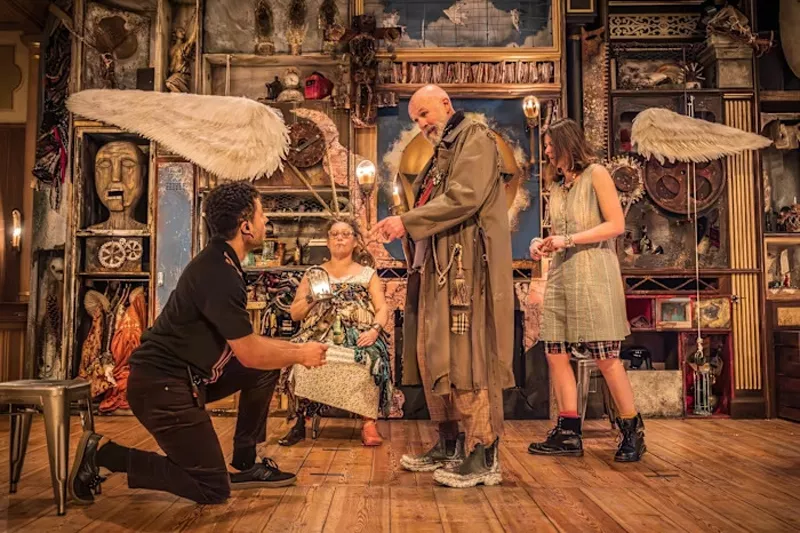
Photo credit: Marc Brenner.
Through this story, we learn that, 12 years earlier, Prospero, the rightful Duke of Milan and a gifted sorcerer, was usurped by his own sister and cast out to sea with Miranda, his three-year-old daughter. They were then shipwrecked on the island, where Prospero met and made servants of an airy spirit, Ariel, and the supposedly subhuman Caliban. Now, he is drawing those who caused his downfall into his power.
While this story is usually told by Prospero in a long speech to Miranda, who hears its contents for the very first time, here the words are familiar to all four characters and are shared equally between them. The effect seems more an example of communal storytelling than of fully enacted drama, and, despite some emphatic delivery, the atmosphere is subdued and the power of the language diluted.
Only when other characters are conjured into being does the production come alive. This is achieved by seating actors in the intimate auditorium of the Sam Wanamaker Playhouse, and presenting them, for the most part, as members of the audience, who then take on the roles of Alonso and his circle. So, Jo Stone-Fewings, as Alonso, enters by raising himself from a seat in the lower gallery, and, dressed as a cyclist, with a helmet hanging from his belt, lowers himself into the pit. Apologising to those in the row below, he then makes his way onto the stage, and, once his scene has ended, returns to his seat by swinging back up to the gallery.
It is an arresting conceit that, repeated in various ways, has variable results. Perhaps most successful is the entrance of the King’s jester, Trinculo, and his drunken butler, Stephano, who are hilariously played by Mercè Ribot and Patricia Rodriguez as disruptive Spanish tourists. More gratuitous is the moment when Amanda Hadingue slips out of her role as Antonia and back into that of a haughty theatrical patron when she takes a call on her mobile from her husband, “Charles”.
The actors sustain their roles as audience members even in the interval by mingling in the foyer. Then, at the end of the play, and despite the revenge and reconciliation that Prospero has engineered, they all depart the auditorium, leaving the four inhabitants of the island to tell their story once again.
Crouch has made his name with a series of highly innovative theatrical works that break the imaginary barrier between stage and auditorium, and directly engage and involve members of the audience. It is not a complete surprise therefore that he should wish to adapt and direct The Tempest, and to play Prospero. It is a role that is often considered to be autobiographical, equating the power of an aristocratic magician with the various activities of Shakespeare himself as playwright, manager, and actor.
What is a surprise is that he should choose to present Prospero as such a diminished figure, with many of his lines given to his daughter and his servants, and those that he retains delivered in a muted voice. The import of Prospero’s usual valediction and its line, “I must be here confined by you”, resonates throughout. And that, one takes it, is Crouch’s point. The performers are trapped within the repetition of the production’s run, a cycle of retelling.
Crouch’s unusual approach not only offers a new way of looking at the play as a whole, but also provides many insights and delights along the way. In limiting Prospero’s power, Miranda, Ariel, and Caliban all gain greater individual agency. Miranda (Sophie Steer) is gauche but forthright. Ariel (Naomi Wirthner) is caring, even maternal, returning in quieter moments to her knitting. Caliban (Faizal Abdullah) often asserts his dignity, as when he chooses to speak in Singaporean Malay.
Of the visitors to the island, Alonso is affecting in expressing what he believes to be the death of his son, Ferdinand, while his loyal councillor, Gonzalo (Tyrone Huggins), exudes sympathy. The burgeoning relationship between Ferdinand (Joshua Griffin) and Miranda is portrayed with an especially winning combination of tenderness and humour.
Visually and aurally, Prospero’s island is brought evocatively to life. The designer, Rachana Jadhav, has produced a complex backdrop of shelves that are filled with suggestive objects, and these are illuminated or utilized as aids to memory and narrative. For instance, in a striking ceremony, lamps are employed to represent the various characters, with Ferdinand appearing as a fizzing Roman candle. At the centre of the shelves, a model ship spins on an axis within a gilded hemisphere whenever the storm is invoked. Late in the play, during the masque, a coup de théâtre is achieved when the entire shelving unit lights up, and items such as wings are set in motion.
Music is equally significant for an isle that is, in Caliban’s words, “full of noises / Sounds and sweet airs, that give delight and hurt not”. The composer, Orlando Gough, has created an inventive a cappella score, which is exquisitely executed by Emma Bonnici and Victoria Couper. As with all contributors, they make great use of the unique space of the Sam Wanamaker Playhouse, which, in its candlelit beauty, is the ideal venue for Tim Crouch’s distinctive theatrical exploration. At its best and most moving, his production embraces the audience and emphasizes our humanity, notably when Miranda steps down into the auditorium and declares, “O, brave new world / That has such people in’t”.