“The Gambler” at the Coronet Theatre
Jeremy Malies in West London
★★☆☆☆
11 February 2026
Only five years after Dostoevsky had published Crime and Punishment in 1866, he was approached by Princess Varvara Obolenskaya who asked if she could turn the novel into a play. Ever courteous and reflective, he replied by letter saying, “Of course I give permission, and as a rule I have never interfered with such efforts. But I must tell you that almost all such efforts have failed, at least as a whole.”
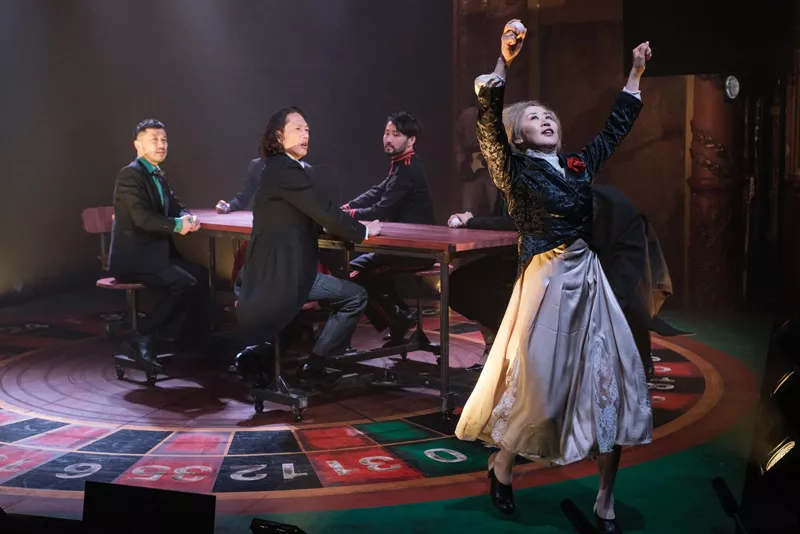
Photo credit: Dimitri Djuric.
Kyoto-based company Chiten Theatre’s current project sees them take fragments of Dostoevsky’s The Gambler and assemble them as a collage which is performed in Japanese with an English translation on screens. It too is a failure.
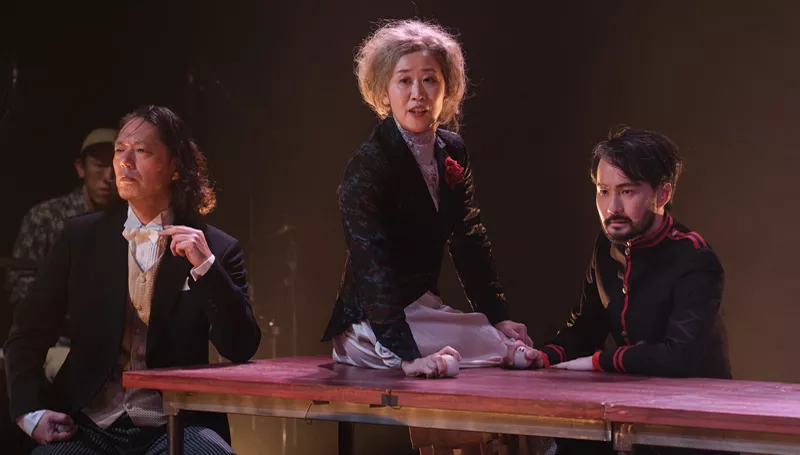
Director Motoi Miura begins the evening with gorgeous incidental stride piano. As somebody who does occasionally go to casinos, if only as a hanger-on, the set design by Itaru Sugiyama – even if broad brush – made me feel I was indeed watching a gaming room right down to all the nervous tics, superstitions, and stylized movements of those at the table. Yasuhiro Fujiwara’s lighting design illuminates red and white vertical strands above the stage that reinforce the idea of roulette, and Sugiyama sketches the betting pockets of the wheel on the stage floor.
Inevitably (although it is in no way gratuitous) there is much use of the stage revolve as the seven-strong cast are caught up in a spiral of betting (sometimes using the ludicrous so-called “system” of repeatedly doubling their bet) as they try to borrow money from each other. An aristocrat pleading desperately with other high flyers to borrow money. Now, where else am I reading about that?
There are aspects to admire here as a spectacle, but things soon go wrong. Within minutes the jazz piano is replaced by a live three-piece band, this being Kukangendai, an experimental trio (drums and two guitars) who play jittery, minimalist rock throughout.
Brian Friel would on occasion show us how communication can transcend literal words. Chiten claim that they, “employ an original linguistic style … [in which] … cadence and rhythm of language are delayed to expose the raw sound of the words liberated from their meanings”. Of course this may all be succeeding on the night in Japanese (fewer than 5 per cent of the audience were Japanese) and it might just work for highly inflected English poetry. But for prose, I would question what is left after it is put through the Chiten process. And I don’t accept the company’s point of departure as valid.
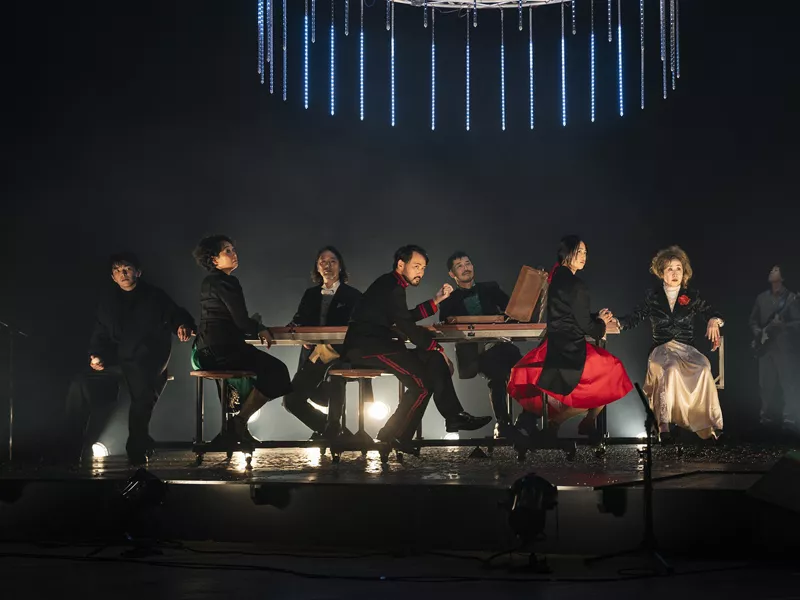
Photo credit: Shotaro Ichihashi.
The Coronet’s revolve is sent into overdrive to suggest the roulette table, and the incantatory and propulsive rhythm never lets up. The revolve is pushed by protagonist Alexei (played by Takahide Akimoto) who is a young tutor from a lower social class than his Russian employers who form the bulk of the characters. His wallet may not be as capacious as those of the aristocrats, but his gambling addiction is just as strong.
There are no moments of introspection, treading water or allowing the text to breathe other than a snatch of Elgar which (amazingly) fuses with the story. The febrile tone may be appropriate as a representation of compulsive gambling beyond one’s means, but across 90 minutes it palls. Add to this the fact that before every single utterance, the cast rap the wooden table with pool balls, and it becomes a cacophonous evening. You would not want to be in the stalls with tinnitus or a similar complaint.
“Chiten” means “locus” or “point” in Japanese, the idea being that the company’s reassembled portions of classic Western texts get to the point of the narrative or the essence of the author’s intention. That is a hubristic mission statement from the off, and I felt this treatment was wide of the mark. Other texts have included Brecht, Chekhov, and Shakespeare. With the cast using frequent asides to the audience – indeed, they rarely speak to each other – Brecht with his famed alienation technique might be well served. Shakespeare and Chekhov texts would surely fare less well though they of course were written for the stage unlike the Dostoevsky source material here. Dostoevsky chose not to write any plays but was unarguably a man of the theatre, writing reviews and appearing in amateur productions including drama performed by prison inmates. I contend that his novel is poorly served here.
Had I not been on a reviewer’s ticket, I should assuredly have left midway. There was additional anti-climax in that twice we thought the evening was over and began to applaud only for an actor to gesture to the effect that there was more to come. That is surely a failure in basic stagecraft, a factor that is independent of language or even culture. I felt up against the eight-ball almost from the off and soon wanted to cash in my chips.