“Our American Queen”, Bridewell Theatre
Jeremy Malies
★★★★☆
17 January 2026
By remarkable coincidence this month sees three plays running in London set during the Abraham Lincoln presidency. Cole Escola’s comedy Oh Mary! is on at Trafalgar Theatre, John Ransom Phillips’s Mrs President returns to Charing Cross Theatre (after transferring from the Edinburgh Festival Fringe), and the american vicarious’s production of Our American Queen has just opened at Bridewell Theatre. The latter is an extraordinary piece by Thomas Klingenstein, a philanthropist, public speaker, and Republican Party donor.
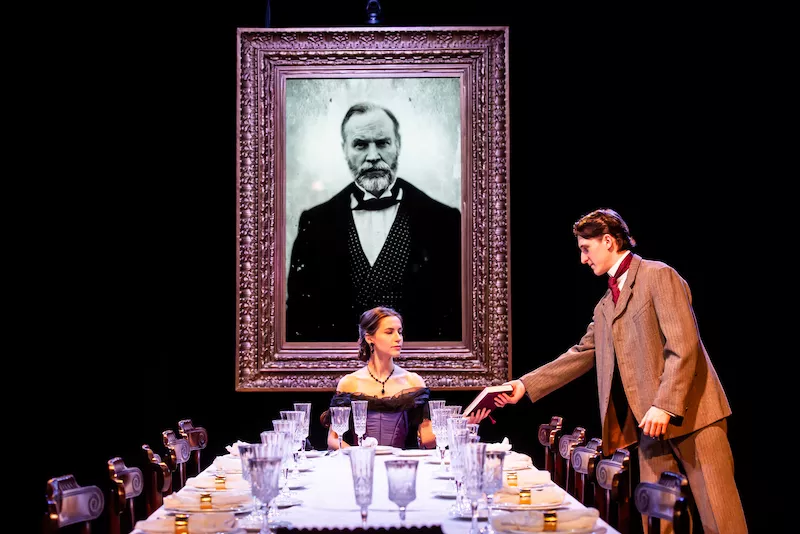
Wallis Currie-Wood and Tom Victor.
Photo credit: Lidia Crisafulli.
So is it a surprise that funding (for nomination at a convention) should be a fulcrum of the plot here? Perhaps not. The year is 1863 and Lincoln faces a possible challenge at the following year’s convention from Salmon P. Chase who is Secretary of the Treasury and a former governor of Ohio. He is portrayed with conviction, resourcefulness, and good judgement here by Darrell Brockis. The titular character is Chase’s daughter Kate (played by Juilliard graduate Wallis Currie-Wood), who is introduced to us at the age of 22. She is portrayed as an intellectual, devourer and good judge of British fiction, party hostess, heartbreaker, and would-be First Lady if her widower father (he has buried three wives) is elected.
Kate and Chase receive visits both formal and social from one of Lincoln’s preternaturally gifted young secretaries, John Hay (played by Tom Victor). He is a Walt Whitman aficionado but cannot persuade Kate to read poetry and the conversations stick to Dickens, Balzac, and George Eliot. I’ve seldom wanted a hyper-intelligent would-be couple created for the stage to get it on so much. Perhaps they are only bettered by Thomasina and Septimus in Arcadia? Comparing his creations (reimagined but not fictitious of course) to Stoppard writing at his best is the biggest compliment I can pay Klingenstein.
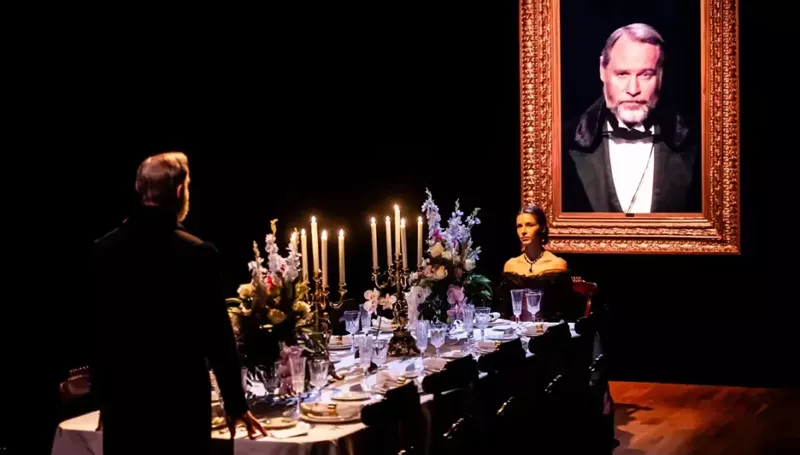
Direction by Christopher McElroen is unobtrusive; there is no artifice and a huge gilt frame containing a projected painting of Chase’s first wife is occasionally swapped for period posters or billboards as a simple means of exposition (designer Neal Wilkinson). It worked and I wondered if there could have been more of it by way of context and information on the future fates of the characters.
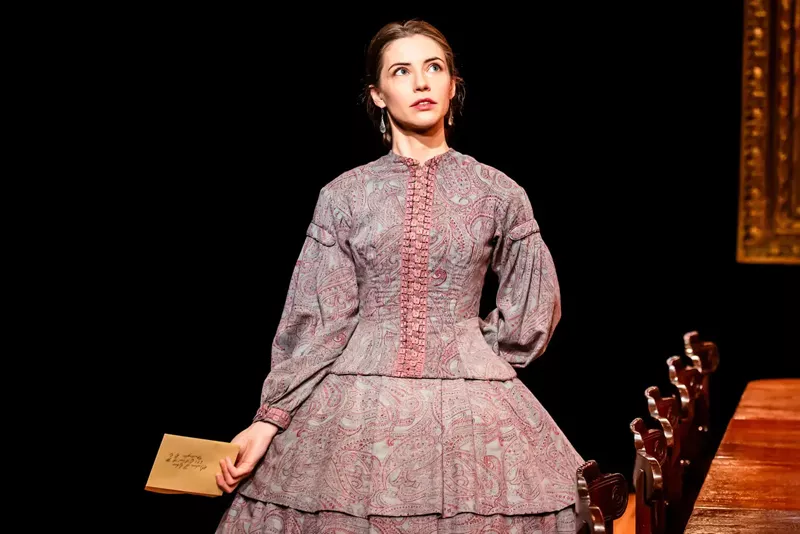
Wallis Currie-Wood.
Photo credit: Lidia Crisafulli.
There is much reflection (never simply thrown in) on one of the questions of the hour: should Black soldiers be involved in the Civil War and carry arms? None of this is didactic or formulaic; Klingenstein’s stagecraft and flair as a writer mean that his piece is the opposite of the death-by-dramatized-Wikipedia that now bedevils theatre festivals.
Perhaps some of the subtleties would only appear at a second viewing or reading it off the page as I did later, but I believe there are subtle digs at the Clintons. In terms of skulduggery over nominations, I was transported forward (or back if you like) to Gore Vidal’s excellent 1960 play The Best Man which became relevant when Hillary Clinton and Obama were facing off and was revived for a UK tour. I mention these parallels to stress the contemporary relevance of Our American Queen. It is much more than a period piece and is certainly not set in aspic.None of us know how the American elite political circle spoke in the 1860s. And there would have been a medley of regional accents anyway. There is no voice coach credited so McElroen will have worked with the cast to convey the slight formality and occasional archaic inflections that were credible, at least for me. Twice characters imitate Lincoln, sounding exactly like Daniel Day-Lewis’s multi-geared tenor in the film but don’t go to that for help on background since it begins in Lincoln’s second term.
As Kate tells Hay that his outfit (he has swapped frock coat for Union uniform) becomes him, I pondered the splendour of costumes by Elivia Bovenzi Blitz. I can make no comments about the garments of the women, but Bovenzi Blitz also excels with the uniform of General George B. McClellan played by Haydn Hoskins. He has courted Kate before leaving for West Point and there is a powerful sequence in which she berates him for not pursuing what she thinks would have been certain victory over Robert E. Lee’s poorly equipped forces after the Battle of Antietam during the Maryland Campaign.
Any cavils? There is one stage effect – almost a coup de théâtre – best left under wraps that is carried off skilfully but for me was unnecessary and even distracting. The research will have been exhaustive so perhaps I’m wrong to question this, but two strands of conversation stuck in my craw. Chase suggests to Kate that the English did not abolish slavery because it was the innately right thing to do, but to make it easier to taunt their American cousins. He even goes on to speculate that Britain might yet enter the war on the side of the South so creating two unbalanced countries in order to play them off against each other in classic divide and rule mode. I just wondered if the views of people who were clearly Anglophile in all matters cultural could be quite so negative and cynical.
Amid all the warmth and literary sensibilities, Kate Chase has moments of alarming realpolitik. When she says that a continuance of the Civil War will weaken Lincoln and increase her father’s chances of gaining power, I thought of Nixon and Kissinger manipulating the outcome of Vietnam for domestic political gain. But I chuckled when Chase tells Kate that Queen Victoria’s favourite Lord Richard Lyons is only a minister and the British will not deign to have a full ambassador in the United States. Since then we have sent them Peter Mandelson!
Klingenstein’s style is supremely witty and almost Wildean with the same delight in inversion but is never imitative. The scope here is vast and yet by no means over-ambitious. For a work that references Walt Whitman, this outstanding play does indeed contain multitudes.
Next month the american vicarious will bring back to London their reimagining of the historic 1965 Cambridge Union debate between James Baldwin and William F. Buckley Jr., Debate: Baldwin vs. Buckley, at Wilton’s Music Hall.