“Indian Ink” at Hampstead Theatre
Jeremy Malies in North London
★★☆☆☆
20 December 2025
Playing a resident of Gujarat, Mark Carlisle strides onto the veranda of an ex-pat club reciting an A.E. Housman poem. You could be excused for thinking that this is Tom Stoppard’s The Invention of Love written in 1997. But in Indian Ink we are in different, inferior territory from two years earlier.
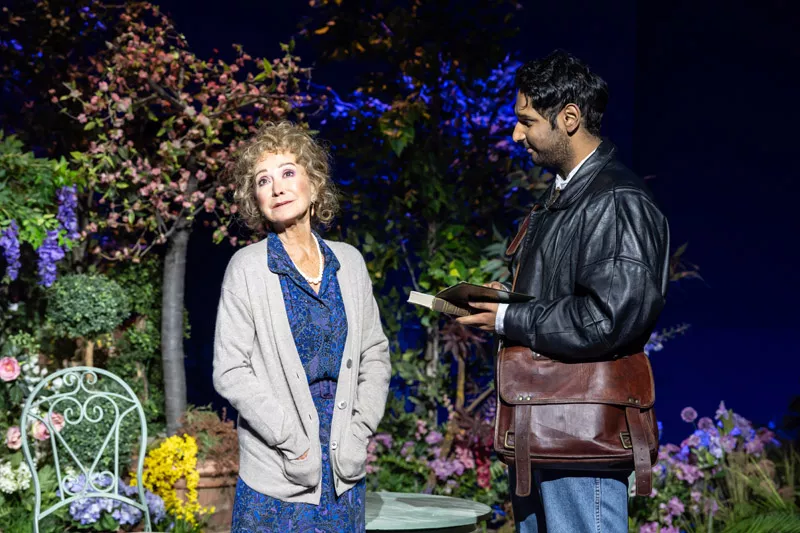
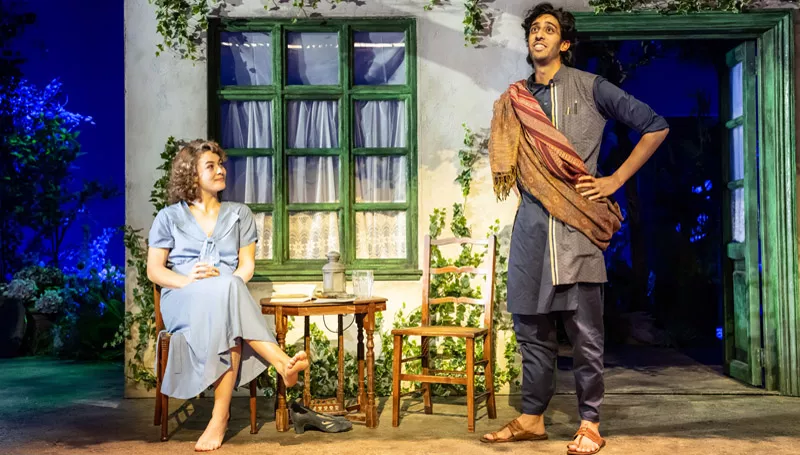
Felicity Kendal and Aaron Gill.
Photo credit: Johan Persson.
A sitar buzzes in Kuljit Bhamra’s original compositions with the year being 1930 for the first of two interleaved time schemes. It’s Stoppard’s intention that the times (the second is 1984) should coalesce in our minds but such synergy is only fitful. Poet and supposed wild child Flora Crewe (Ruby Ashbourne Serkis) is touring India in the first setting and spends a month in Jummapur. Here she has her likeness painted by Nirad, a professional artist and political activist played by Gavi Singh Chera. In the later time scheme, Nirad’s son Anish (Aaron Gill) seeks out Flora’s sister Eleanor, who is played by Felicity Kendal. Eleanor reads her sister’s letters to him.
For the first press night, Kendal was performing on the day of Sir Tom’s funeral in front of many of his friends. She was his romantic partner and muse for eight years and the role of Flora was written for her. So it’s quite an ask for Ashbourne Serkis to take a role opposite the woman for whom her own part was created 30 years ago. Ashbourne Serkis fails while Kendal succeeds. The production founders not on intricacy of form but in the playwright’s litany of marginal cultural figures – the piece is awash with them. You can have enough of art about art, and this demonstrates many of the excesses that bedevil recent work by Alan Bennett.
At two hours 45 minutes it seems a long night. Just as you think that director Jonathan Kent might fillet a scene, you realize that it has a parallel in the other time frame and can’t be touched for the sake of symmetry. Ashbourne Serkis could usefully acquire another gear; she is supposed to have come to India after an obscenity case that saw her rush away from Bow Street Magistrates Court in a Rolls-Royce and pose nude for Modigliani days later. Only in an exclamation of surprise that Nirad too has painted Flora naked (perhaps using his imagination) does the actor come anywhere near embodying her character. And on this treatment of Stoppard’s dialogue – it’s far from his witty naturalistic best – I wouldn’t want to read Flora’s poetry.
Kendal by contrast (she has an easier task) succeeds with an elegiac portrayal of this product of British India who is far more subtle than any of the stereotypical shorthand we associate with the Raj. Stoppard is at pains to tell us that the scenes in 1930 show a region that was a “princely state” with genuine autonomy and its own judicial system. Indeed, we see Irvine Iqbal playing the rajah as he attempts to seduce Flora. How Kent could not find his way to editing an interminable scene in which the rajah’s fleet of motor cars is paraded across the fourth wall only for Flora to identify every vehicle is beyond me.
Positives? Stoppard balances things finely when occasionally skewering characters but also giving them self-awareness as they discuss works such as E.M. Forster’s A Passage to India which prompts them to take a closer look at themselves. Reminiscences about the Partition of 1947 are credible and thought-provoking, with the exchanges forming some of the best dialogue.
There are other great gags such as residents saying that the small-town political strife here will be enough to set Gandhi off on another of his innumerable fasts. I felt I was learning about Indian history without being lectured to and was happy to follow the off-stage Gandhi on his famed Salt March just as I was in Anupama Chandrasekhar’s The Father and the Assassin.
Anish is also a painter. Kendal and Gill combine well as they negotiate dense speeches that touch on art criticism, asking what makes one painting end up in a prestigious gallery while others are consigned to being reproduced on biscuit tins. Gill is another stand-out, projecting a charisma that allows Kendal to show her widowed character yearning for contact with interesting men and remembering time in India fondly. You can see Stoppard recycling ideas that had come to dazzling fruition in Arcadia two years earlier in 1993. He is also remodelling themes on a broad scope from his earlier radio work In the Native State on which this play is based.
Donald Sage Mackay is Eldon, the stupefyingly boring American literary sleuth who is writing about Flora and quizzing Eleanor intently. (Think Bernard Nightingale from Arcadia without the libido.) I get it that he is supposed to be grating but the point seems laboured. Again, Kent who comes out of this badly might have leavened matters by giving the actor more comic detail to work with.
The set by Leslie Travers does much to rescue things. Eleanor’s garden might be easy to pull off but Flora’s mini-bungalow, the club, and the grounds of a palace are more difficult tasks. Terracotta arches showing Mughal influences in the grounds of the rajah’s home give us glimpses of a vast estate. Travers makes much use of the theatre’s vertical flies to haul scenery in and out. You believe in the tracts of teak forest that Nirad crosses for his meetings (trysts?) with Flora as lit by Peter Mumford.
This production is not a tribute to Sir Tom – it was scheduled long before his death. I’m surprised that the play has been revived. And so what of Indian ink as per the title? In early holy books, Hindu gods were represented as stylized lithographs using a soot-based blue-black ink. Nirad and Anish use it extensively to do outlines for their paintings and praise it for not bleeding. But this project was similarly short on colour for me. I question the wisdom of the revival.