“Generation After 9”, Teatr Nowy, Warsaw, 4–6 September 2025
Sasho Ognenovski in Poland
“It is not the theatre that is essential, but something else entirely. The crossing of boundaries between you and me.” This is one of the watchwords of Polish theatre artist, theorist and thinker Jerzy Grotowski. Grotowski, Kantor, Jarocki, Grzegorzewski, Szajna, and now Krzysztof Warlikowski are theatre artists whose standard-setting work has often changed the direction of European theatre.
Brave, radical, and revolutionary, these artists have done unique things by bringing new ideas to theatre expression as well as the very essence of theatrical thought. The showcase of Teatr Nowy, working under the leadership of Warlikowski, with the simple title “Generation After 9” offered new ways of thinking that were exciting, occasionally mysterious and yet consistently radical and bold. This showcase impressed not only with sheer numbers (18 pieces) but also through exceptional engagement with current world events.
In introductory publicity material for the showcase I noted the sentence, “Border theatre leaks out of us, fences, walls, borders…” Aimlessness and fear are the biggest clinical symptoms of societies across a world that is presently overshadowed by the threat of war from all sides. In the desert created by shell casings and human corpses, aimlessness is the biggest threat. The Polish showcase boldly entered the realm of theatrical analysis of these anxieties for international audiences, offering performances with diametrically different ways of thinking and modes of expression.
During these three magical days of theatre, we entered a different field of theatrical art, following the line of theatre philosophy that is, in a sense, a continuation of the re-composition and reshaping of theatrical expression developed by the great Polish theatre artists. Alongside Teatr Nowy, visitors could also see performances at Studio Gallery where Józef Szajna and Jerzy Grzegorzewski once created their pieces as well as at many intriguing spaces throughout Warsaw in which theatre found a home for the expression of messages that spoke of both warnings and provocations.
I give as a footnote here a complete list of the offerings.
These performances, which were remarkable for sheer volume alone, experimented with theatrical space in many ways using expressive techniques that I began to realize were boundless. Thus, we witnessed performances that said a great deal in just 40 minutes. There were pieces that reached us through personal confessions as well as productions that (intriguingly) sought to combine choreography with physical action to convey a life philosophy or perhaps an experience of the social and political tragedies of the twenty-first century.
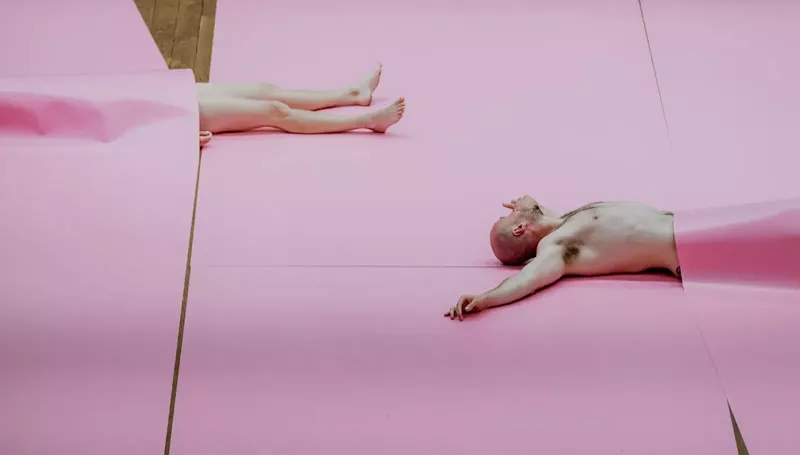
One of the most interesting and innovative projects was Don’t Teach Me! by Wojciech Grudziński and Maria Magdalena Kozłowska, a play with dance constructed by the performers’ naked bodies and a minimalist approach exploiting taste, touch, strange stains, mirrors, and broken breath. This 70-minute presentation is a spring of emotions visualized by two performers who, sinking into and emerging from a plastic covering, attempt to articulate the rage of a student toward a professor, generalizing and broadening the theme of the destruction of personality and the struggle for integrity. The two performers use their naked bodies almost as costumes and, to their last onstage breath, perform, dance and contextualize their rebellion. This rebellion slowly transforms into revolutionary fervor. Grudziński and Kozłowska speak in an entirely different theatrical language, taking Grotowski’s “Poor Theatre” as their foundation and expanding it with emotions compressed into a vocabulary of movement. The performance asked many questions of spectators – almost opening up dilemmas – while also pushing at the boundaries of how actors communicate.
Aleksandra Jakubczak and Rob Wasiewicz, in their performance Worst Case Scenario, use storytelling theatre to lead us into a world of anxiety and disorder. This is an autobiographical piece by Jakubczak which is rooted in her experience with anxiety. It is in fact an attempt to transform the stage into a space for examining anxiety as either an escape or as fuel for creative potential. The performance is full of confession, memory, recollection, dilemmas and commentary that awakens us and gently urges us to confront what we suppress deep within ourselves: anger and despair.
A performance that fascinated me was I Love Ballet by Ramona Nagabczyńska, a hybrid of classical ballet and contemporary dance. The four female dancers (Ramona Nagabczyńska, Aleksandra Boris, Karolina Kraczkowska and Iza Szostak) at one moment transform the ballet into anger, rebellion, distortion and inconsistency. Attempting to survive their own inconsistency in terms of identity, they perform their philosophical dance macabre around a hill of worn-out pointe shoes so entering the range of tragic misunderstanding. This performance captivates with its perfect harmony of classical ballet and contemporary dance that ultimately defies the discipline in which it is working while constructing a narrative that is not only controversial but expressively innovative.
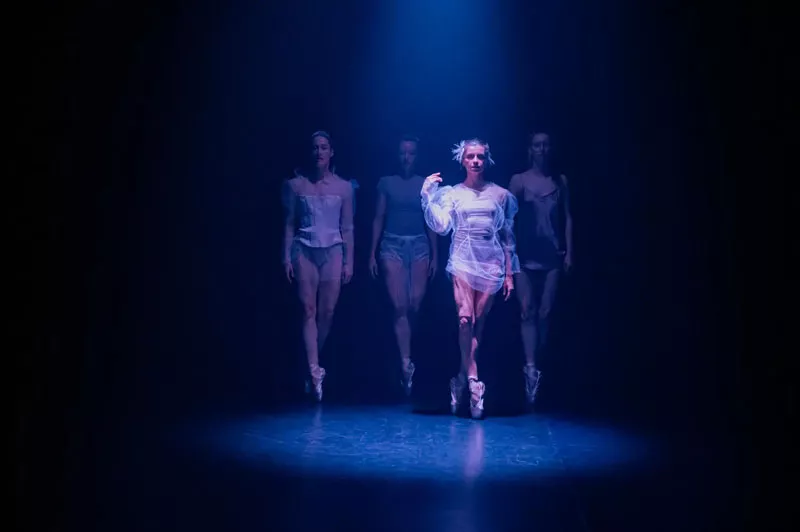
“I Love Ballet”.
Photo credit: Pat Mic.
A performance that stayed with me was The Unwavering Love of Eve Adams by Olga Ciężkowska, produced by the National Stary Teatr of Kraków. It recounts the heartrending story of Polish Jewish woman Chawa Zloczewer, the first anarchist who, at 19, left for New York to work as a tailor but also opened a pioneering lesbian club while changing her name to Eve Adams. As a Queer activist, she was expelled from the conservative United States and returned to Paris. She was deported from Paris with her partner to Auschwitz-Birkenau and died there. This compelling performance raises questions about Queer activism and politics. It speculates on how intimacy and orientation can collide, and how deeply politics infiltrates the pores of intimacy. Olga Ciężkowska constructs a two-hour performance dense with commentary and narrative theatre, expressing its unease through confessional forms and through superb visualizations including documentary elements about Eve Adams.
I return once to Jerzy Grotowski and his maxim, “It is important to use the role as a trampoline, a chance to learn and to play with what hides behind our masks. Creativity, especially in acting, is boundless sincerity, but also disciplined.”
The showcase of Teatr Nowy from Warsaw embodied this idea: theatre of immense sincerity, boundless courage, enormous discipline, and unstoppable artistry that captivated and inspired, reminding us that among these predominantly young artists there perhaps hides a new Grotowski, a new Kantor, a new Jarocki, a new Szajna …
~~~
Performances included: Journey, Journey, Lemon Journey by Bogusława Schubert; The Feminist Killjoy Handbook, directed by Mina Manka and produced by Teraz Poliz; The Cosmic Home by Linas Lapelytė produced by TR Warszawa; Don’t Teach Me! by Wojciech Grudziński and Maria Magdalena Kozłowska, produced by Zodiac, Centre for New Dance, Wojciech Grudziński, and Teatr Nowy from Warsaw; the stand-up performance Will You Marry Me? by Igor Shugalev; Helena by Magdalena Dabrowska, produced by Aleksander Zelwerowicz Theatre Academy in Warsaw, Białystok Department; Winding by Kamil Białaszek, produced by the Ester Rachel and Ida Kamińska Jewish Theatre, Jewish Culture Centre; The Endless Box by Hana Umeda and Sada Hanasaki; Worst Case Scenario by Aleksandra Jakubczak, produced by Pavilions Poznań; Organca by Lesbian Pensioners, produced by TR Warszawa; Essence by Edmund Krępiński and Jakub Dylewski, produced by TR Warszawa; Mimesis by Natalia Sakowicz, produced by TR Warszawa; Tiki Taka by Marcin Miętus, produced by Komuna Warszawa; I Love Ballet by Ramona Nagabczyńska, produced by Theatre Komuna; I’m Fine (Everything’s Sweet with Me) by Cezary Tomaszewski, produced by Studio Theatre Gallery; She Stands in the Middle of the Battlefield by Magda Szpecht, produced by EFEKT, Prague’s Bazaar Festival, and the Gustaw Holoubek Drama Theatre; The Unwavering Love of Eve Adams by Olga Ciężkowska, produced by Helena Modrzejewska and the National Stary Theatre in Kraków; and Call Me Jay by Agata Maszkiewicz, produced by the Choreography Association in coproduction with Komuna Theatre of Warsaw, Manufacture CDCN, and others.