“Man and Boy” at the Dorfman, National Theatre
Neil Dowden on the South Bank
★★☆☆☆
12 February 2026
National Theatre artistic director Indhu Rubasingham’s first programmed show in the Dorfman is Terence Rattigan’s Man and Boy. A flop on its premiere in 1963 (when Rattigan’s previous stellar status in British theatre had dimmed in the aftermath of the Angry Young Men/Kitchen Sink new wave of drama), it has been revived only once in the UK since then (in a 2001 West End production starring David Suchet) after Rattigan’s “rehabilitation”. His reassessment has included the disinterring of several plays that have not seen the light of day for decades, including last year In Praise of Love at the Orange Tree. Unfortunately, Anthony Lau’s boldly non-naturalistic treatment of Man and Boy does not do it any favours.
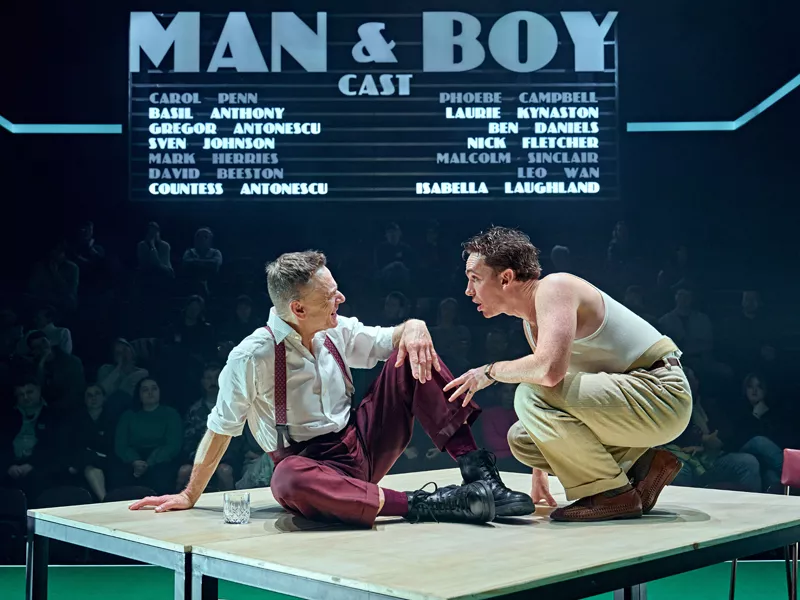
Ben Daniels and Laurie Kynaston.
Photo credit: Manuel Harlan.
Set in 1934, the play centres on the relationship between the Machiavellian figure of Gregor Antonescu, a Romanian financier with a vast business empire on the verge of bankruptcy with international percussions, and his estranged son now calling himself Basil Anthony, a struggling nightclub pianist in New York. Five years on from when they last met, unexpectedly Antonescu arrives at the modest Greenwich Village basement flat that Basil shares with his actress girlfriend Carol. But it soon transpires business not reconciliation is Antonescu’s motive. He wants one final roll of the dice to persuade American Electric CEO Mark Herries to agree to a merger that will restore his liquidity – and Basil is an essential part of this transaction.
Herries’ assiduous accountant David Beeston shows that Antonescu has cooked the books, but with the help of his staunch fixer Sven Johnson, Antonescu makes up an excuse and diverts Herries’ attention towards Basil, whom he uses as sexual bait for the closeted CEO whose double life he has found out. Antonescu also gets handouts from his wife – a former typist he has made a fake Countess to front his charitable foundation that he exploits – when she turns up. But with news breaking that the police have a warrant for his arrest on charges of fraud, will anyone stand by this amoral conman or is it the end of the road?
With all the recent news of the sleazy connections between the rich and influential elites, Man and Boy seems bang on the money in some ways. But the shadow of the Great Depression hangs over the play, with so many big businesses going bust after the Wall Street Crash in 1929. Antonescu is partly based on the Swedish “Match King” Ivan Kreuger (who is actually namechecked twice in the play) and the Anglo-American electricity magnate Samuel Insull, two extremely powerful billionaires whose business empires crumbled in the 1930s amidst corruption allegations. But the character is probably also inspired by Rattigan’s own scandalously philandering diplomat father, with whom the playwright had a strained relationship, like Basil.
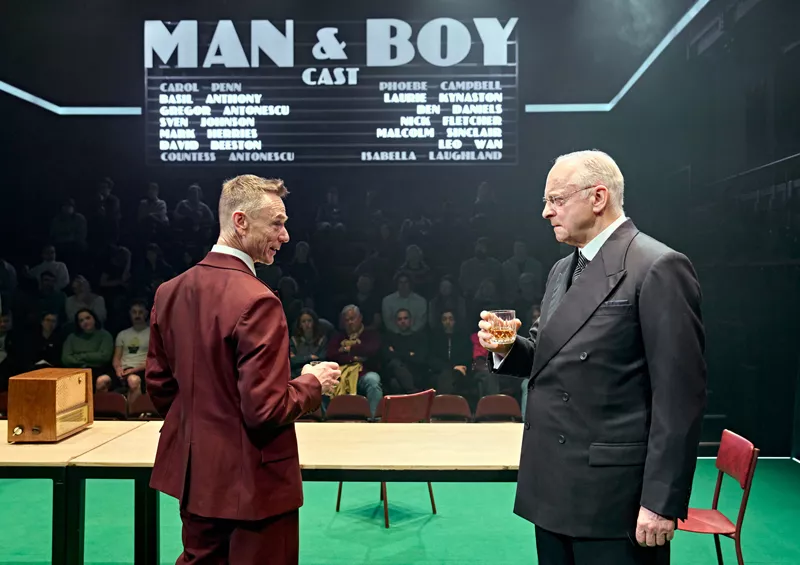
Ben Daniels and Malcolm Sinclair.
Photo credit: Manuel Harlan.
While Basil’s estrangement from his father is partly on principle – a rejection of the unscrupulous capitalism that Antonescu embodies – it is mainly personal. After his mother – a dancer in a Berlin strip bar – died when he was two, he feels his father has never reciprocated his own love. But though this yearning for affection convinces, it stretches credulity that Basil’s neediness should make him stay loyal to Antonescu even after he has, in effect, pimped him to a business associate. And the intimate heart of the play that does make an impact is somewhat dwarfed by the grand machinations of the corporate world.
The production itself is distancing too. Lau (making his National Theatre debut) has essayed an audacious new approach to Rattigan that is stylized and indeed meta-theatrical, but sadly it comes across as over-the-top and bombastic, ultimately working against Rattigan’s understated emotional subtext. The in-the-round staging works well as a sort of arena. Actors stay on stage when not in a scene but in different parts of the apartment, while there is a clothes rail at the side for quick costume changes. There is a lot of clambering on and off chairs and Formica-like tables that are pushed around the stage, with much posturing and striking of attitudes (movement director/choreographer Aline David). Antonescu and Sven howl like wolves at the end of the first act when it looks like their last-ditch scam has succeeded.
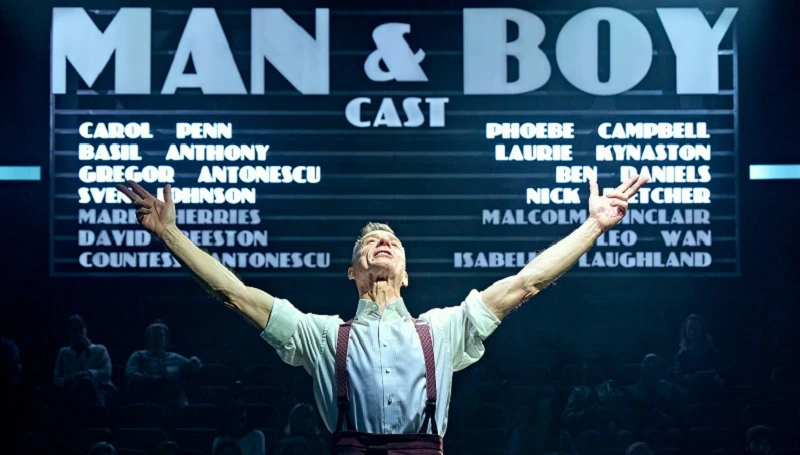
Though costumes are in 1930s vogue, the set design by Georgia Lowe has only a few pointers to the period such as a wireless and telephone. The visuals are larger than life, boasting an Art Deco cinema frontage with the names of characters and cast illuminated when on stage, while each time someone rings the doorbell, lights and a “knock knock” sign flash as they enter. With Elliot Griggs’s full-on, dazzling lighting the characters almost seem to be performing in a film studio. The show opens with a Hollywood-style movie intro from composer Angus MacRae, while live off-stage drumming and trumpet-playing give the show a jazzy suspense.
Ben Daniels gives a grandstanding performance as the charismatic crook Antonescu, more showman than conman perhaps, who alternates between persuasive charm and icy ruthlessness. Later he seems to become aware that his sense of invulnerability is in fact an inability to love as he runs out of time. Interestingly, Daniels won an Olivier Award for Best Supporting Actor for playing a son at odds with his father in the National’s 2001 production of Arthur Miller’s All My Sons, and Laurie Kynaston – who plays Basil – recently did the same in Eugene O’Neill’s Long Day’s Journey into Night. Here, Kynaston movingly plays the “conscience” of Antonescu, who loathes what he represents but cannot let him go.
There is good support from the rest of the cast. Malcolm Sinclair suggests the furtive longings behind Herries’ public persona, with Leo Wan the conscientious Beeston who is out of his depth amidst executive power. In rather underwritten female roles, Phoebe Campbell plays the sympathetic Carol and Isabella Laughland the materialistic Countess. And Nick Fletcher is the reliable aide Sven who has seen it all but who makes sure he is in the clear when the game’s up.