Hrvatsko narodno kazalište U Zagrebu
Jeremy Malies at a theatre showcase in Zagreb
16–20 November 2025
Much of the year had been hectic for Emperor Franz Joseph, his main concerns being to suppress Turkish territorial ambition in the Balkans and South Slav nationalism. He had arrived in Zagreb by train on 14 October 1895 to find the city humid and soon regretted a choice of Hungarian dress uniform involving fur.
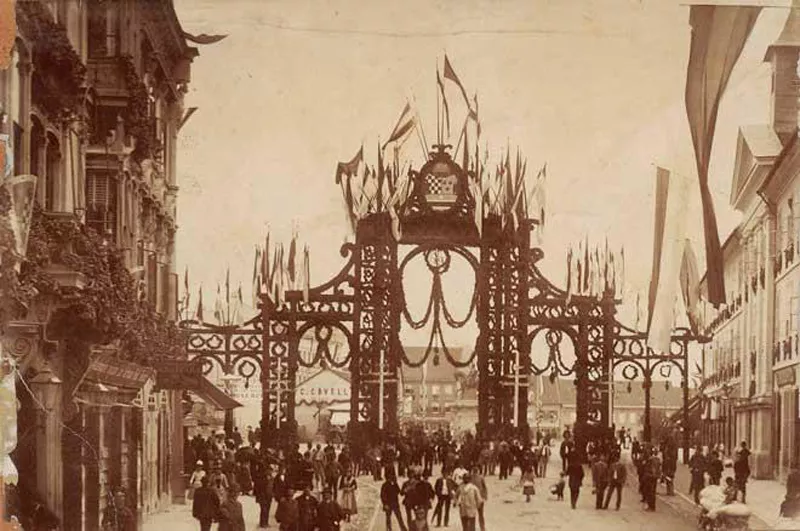
Hungarian flag on triumphal arch, Zagreb, 1895.
Creative Commons – Wikipedia.
The view from the balcony of the National Theatre today is still neo-Baroque facades with few signs of modernism and it approximates to what the emperor would have seen despite a cluster bomb attack by the Army of Serbian Krajina in 1995. I’m under the guidance of Ivana Ivković, the senior producer here, and she ushers me to the spot where the emperor (a considerable linguist) made addresses to agitated crowds. He had opened the theatre by tapping the railing of the balcony with a silver hammer.
The interior (there are alarming fissures across the prosc arch from an earthquake six years ago) suggests Frank Matcham on class A drugs with a touch of Rococo and no budgetary restraints. A technical team is testing sightlines for a production of the Nureyev version of The Nutcracker and they remonstrate with me for so much as reaching for the lens cap of my camera. Ivana explains that photo rights in the ballet world are tighter than in any performing genre.
Another earthquake (1880) had prompted the refurbishment process that saw Franz Joseph come here for the opening. I’ve researched his attitude to the arts and interaction with artists. From the 1870s he is known to have supported young painters but only those working to traditional methods; anything that smacked of impressionism was dismissed as “daubing”. The emperor had a good understanding of sculpture and strident views about it. His taste in theatre is harder to fathom though he was fond of the Galician burlesque actor Heinrich Eisenbach. Often required to put on as many as five costumes in a single day for ceremonial duties, he would express empathy for actors who must make the same kind of tiresome changes.
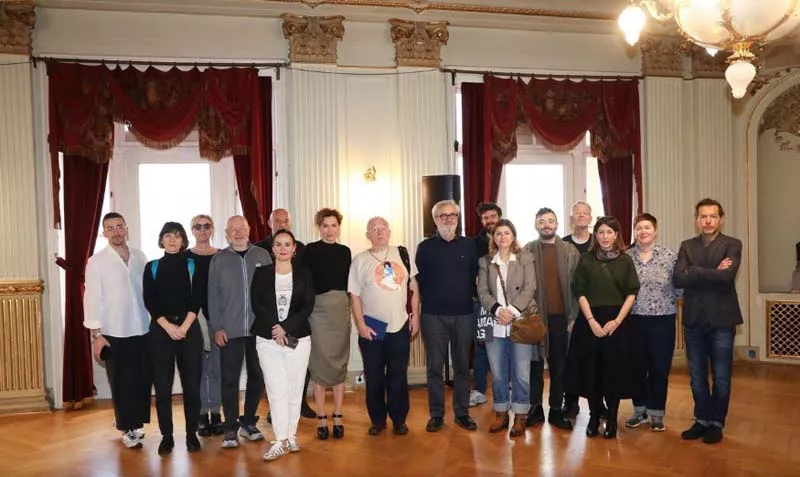
Photo credit: HNK Zagreb.
Franz Joseph’s main exposure to the theatre was through his friendship with the Austrian actress Katharina Schratt. She was his confidante on all matters; they wrote to each other daily when apart with intensity, and he would even pay her gambling debts. But it’s almost certain that the relationship was platonic. Early in 1895 he confesses to her that he has slept through parts of Die Walküre in Vienna. No fan of Wagner, he was also suspicious of Schiller, telling Katharina that he feels for her when she is cast for the umpteenth time as the court actress in Don Carlos.
The emperor’s speech did not go down well though the crowd seem to have been set against him from the off. His letters include, “My stay pleased me greatly and was disturbed only at the end by a very disagreeable – but very much exaggerated by the newspapers – outrage by some student loafers.” “Loafers” is an intriguing choice but a German former proprietor of this magazine assures me that the translator has found an idiomatic rendering of “Gassenbuben-Studenten”.
Corinthian columns manage to retain a symmetry amid the ornate flourishes as Ivana leads me to a staircase featuring silver swans on the balustrades. She mentions that having grown up in a Croatia that was part of Yugoslavia, she is now on her second country and fourth currency. Ivana is a sophisticated interpreter of geopolitics. She is also a close observer of a field that is vital for everybody here; the grant-issuing bodies within the EU. The swans relate to a production of Ero the Joker by Jakov Gotovac. Born in the year of Franz Joseph’s visit here and in Austro-Hungarian Dalmatia, Gotovac’s comic folk opera is his best known work and, indeed, by far the best known Croatian opera. It premiered here in 1935 and there are pop-up exhibition displays about it in alcoves on the staircase. I’m in unfamiliar territory and any groping for parallels is tentative but a comparison with Peer Gynt would not be far off.
~~~
This is the first showcase of its kind and begins, for me, with the slightly Beckettian (think Endgame) two-hander Truthiness by polymath Tomislav Šoban who is also a graphic artist and documentary film maker. The text is a collaboration with Marin Lisjak and is performed in the Sound Hall, a space that doubles up as a studio venue but usually serves as a recording studio. Imagine the lobby of Senate House or any Orwellian interior that comes to mind done out totally in wood.
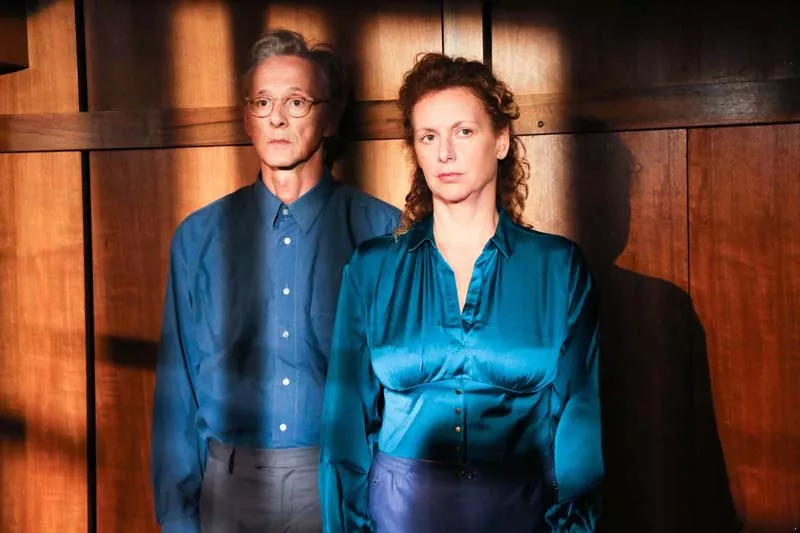
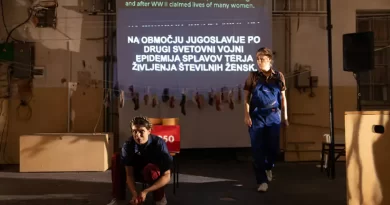
Livio Badurina and Nina Violić in Truthiness.
The play’s starting point is the experiments of Richard Feynman which is fitting; students at Cornell would remark on the theatricality of his lectures and he was a regular for Broadway first nights. Music by Miro Manojlović has an improvised and hallucinatory quality as the performers, Livio Badurina and Nina Violić, bicker and scuttle around. There is close physical work but no sexual tension between the characters. Violić is best known as host of the Croatian equivalent of The Weakest Link.
The duo remind us that experiments can underline a theory if, to within close parameters, they throw up the same results time after time. Theatre, particularly devised and improvised forms, is valued if it always gives different results and there is a sense of edginess and risk. “I would love to know what happens at the place where I know what I want to say …” is a line given to Nina. “Truthiness is slower than an image …” she continues. This chimes with Manojlović’s current exhibition at MQ Schauräume in Vienna where he has mused on the work of English photographer Eadweard Muybridge who pioneered shutter speeds down to 2/1000th of a second so creating a forerunner of cinema.
~~~
The next play takes me to the Trešnjevka neighbourhood of the city and the new CNT 2 stage unveiled earlier this month [November 2025] just to the north of the Kranjčevićeva Stadium which is being refurbished. The theatre capacity is 310 with a wide Lyttelton-type stage, and the marketing team will target younger audiences than at the principal theatre. The repertoire will encompass a sensible amount of risk and be innovative generally. The site dates right back to an Austro-Hungarian army facility whose structure was also damaged by the 2020 earthquake. There were emergency pro tem renovation measures before architects Arhing Studio could envision a €19m development from a European Union Solidarity Fund and state budget. The stage is the same size as the main building, and the budget including ancillary buildings is in the region of €45m.
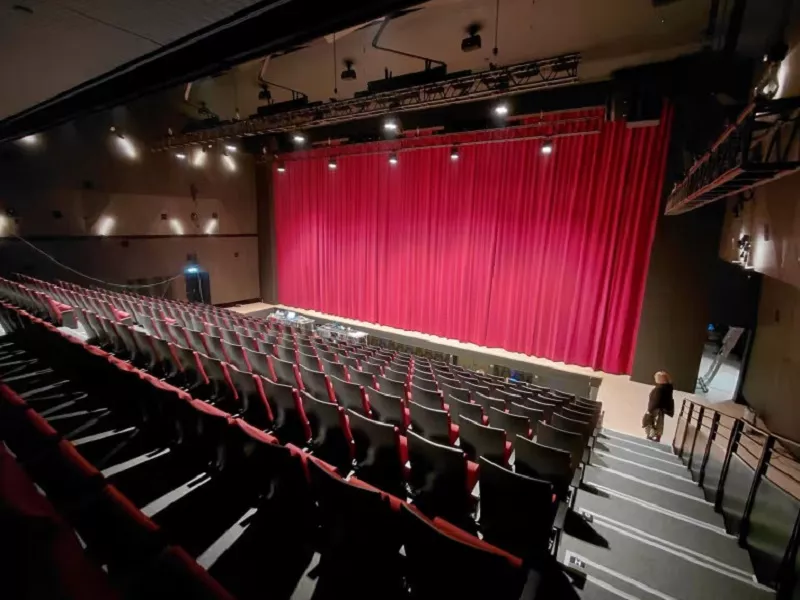
The CNT 2 stage.
Lui Giaschi, project manager, is fond of detailing the 550 spotlights, 93 speakers and 123 microphones. Repertoire will widen and artists will enjoy better working conditions. Operas will no longer be restricted to the main theatre but works here will be of the chamber variety on account of a medium-size orchestra pit. Walk through the main building at ground level and you have the impression that you are on the deck of a ship with a lattice of walkways above you. Visitors will watch craftspeople give workshop demonstrations on every aspect of stage performance from upper galleries. Mayor Tomašević has declared that the CNT 2 (HNK2) space will revitalise the Trešnjevka district.
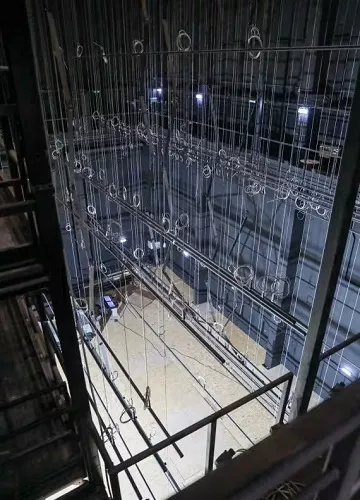
The CNT 2 galleries.
CNT 2 is a fulcrum of the showcase and my first play here is Sorry by Bobo Jelčić. It reminds me of Our Town but that is hardly a criticism; Thornton Wilder might remain the best example but dramatists should continue to use fictional small communities in order to show how everyday interactions can underline broader truths and trends nationwide. Parental relationships, fractured marriages, and the perils of first loves don’t change that much across decades or the globe.
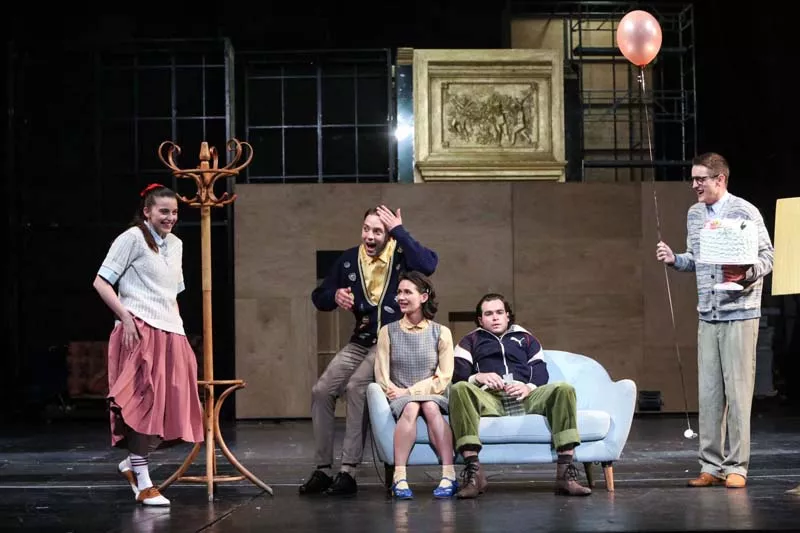
Sorry by Bobo Jelčić.
Without reducing the impact of his focus on a microcosm, Jelčić allows one character, a school principal played by Marko Makovičić, to travel in from outside. The author also peels off Pirandellian layers; characters don’t come out of the plot and plead for engagement elsewhere but the story is periodically broken by a theatre manager who is encouraging us to look in at the community. Core members of the Croatian National Theatre appear alongside new drama academy graduates.
I was impressed with the way in which Jelčić (bearing in mind the presence of many young people on their first professional engagement) toys with the possible glamour but also the unvarnished mundanity of life in the acting profession. Gaiety was to the fore though when the cast were kind enough to invite me to a backstage bar after the performance, this time at the main theatre. Glamour trumped anything prosaic.
There was a spontaneity to the play that underlined the collaborative creating process for which Jelčić is known. A jaunty pianist (Karlo Hubak) sits stage left playing stride and ragtime, and occasionally enters the action so creating another layer. The project was co-produced with Prospero – Extended Theatre, a project co-funded by the Creative Europe programme of the European Union. Jelčić also directs which can so often be a pitfall but he exerts rigour over the project throughout.
~~~
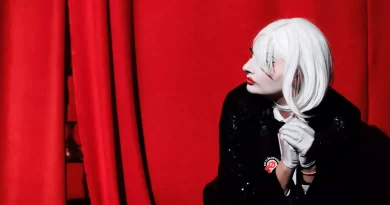
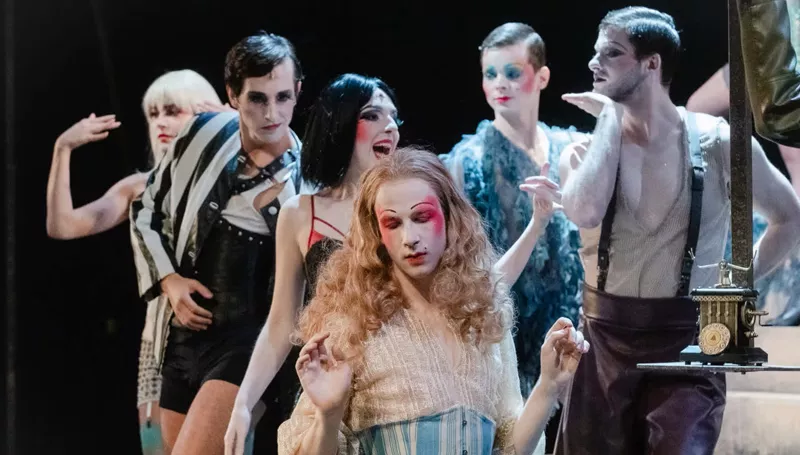
My final night saw me at Cabaret also in CNT 2. In an era of despotic leaders either teetering on fascism or fully deserving of the label, you hardly need to be a political analyst to find Christopher Isherwood’s stories of 1930s Weimar Republic Berlin resonant. And yet, to be true to the intentions of the originators, the sense of approaching calamity should be rumbling below the surface of the entire piece without overpowering it.
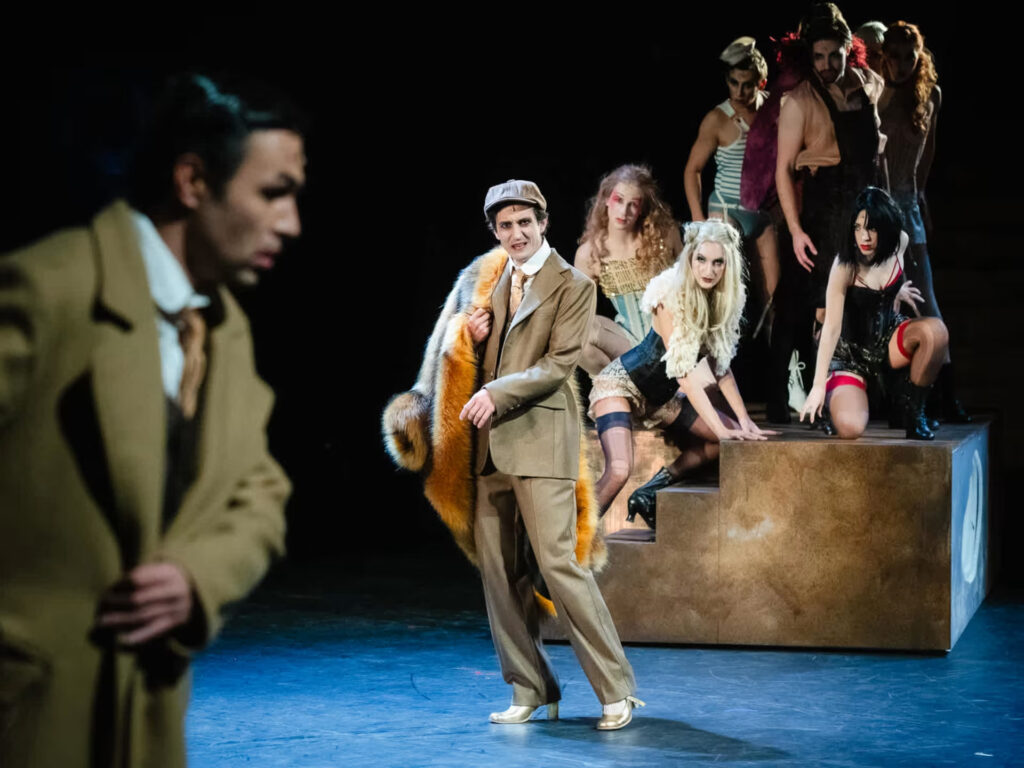
Cabaret.
John Kander’s music gets a respectful though not over reverential outing from conductor and song adaptor Ivan Josip Skender, and choreography by Leo Mujić (he also directs) is sexually charged but mindful of likely curriculum or certainly college audiences. I get it that the demographic here means the version cannot be boundary-pushing. Stefano Katunar’s set has just the right levels of tawdriness; you can almost smell the dank lodgings and rackety club. Costumes (Manuela Paladin Šabanović) seem accurate right down to the cut of a garter belt or corset.
The toughest task within this project must be to render the lyrics of Fred Ebb into an idiomatic Croatian translation. Sadly, that is not something I can comment on. I imagine the book is somewhat easier, and scenes such as Cliff (Marin Klišmanić) giving lessons in English to Ernst Ludwig (Damir Markovina) and taking pleasure in its relatively simple conjugations compared with German would have been an open goal. I did wonder if Klišmanić came across as over-confident when Cliff should have elements of little boy lost.
The galleries at CN 2 had come into their own before curtain-up with the gender-fluid club artistes parading along them or leering down at us. The standard configuration of the theatre meant that cabaret tables were not viable. This is so modish now that their absence was almost a relief. As Sally Bowles, Lana Ujević Telenta nails her main (the title) number and leaves us in no doubt that this is a woman intent on self-sabotage.
“Leave your troubles outside” is one of the first pieces of advice from the Emcee played by Fabijan Komljenović. I did, though there were few troubles at this excellent initial showcase in Zagreb.
A second showcase is planned for September 2026.