
“Woman in Mind” at Duke of York’s Theatre
Neil Dowden in the West End
★★★☆☆
9 January 2026
When Alan Ayckbourn’s dark comedy Woman in Mind was first staged in 1985 it broke new ground for the prolific and popular playwright in its boldly non-naturalistic approach to the subject of mental breakdown. For this revival at Duke of York’s, Sheridan Smith returns to the same West End theatre to give another terrific performance as an unhappily married woman who longs to escape, following on from her starring solo role three years ago in Willy Russell’s Shirley Valentine (which premiered one year later). To some extent, both plays show their age in terms of sexual politics, but after a sluggish start Ayckbourn’s psychological drama accelerates into a powerful portrayal of female isolation.
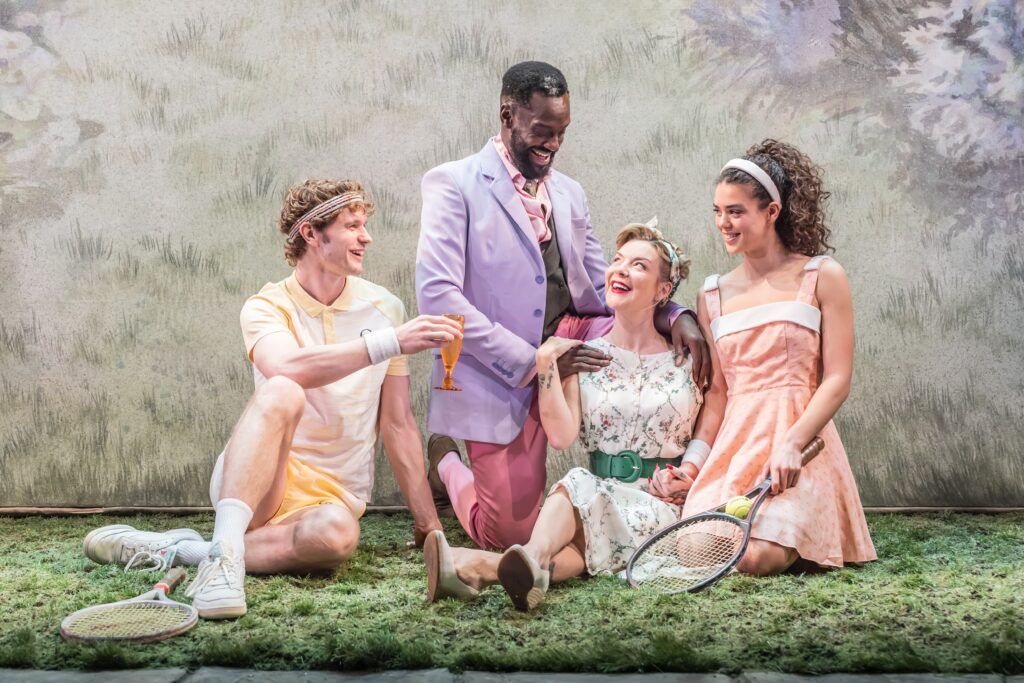
Photo credit: Marc Brenner.
It focuses on the lack of focus in the mind of Susan who, after banging her head on a rake she has trodden on, alternates in a split consciousness between her unhappy domestic life and a fulfilling fantasy of her imagination. Her marriage to boring vicar Gerald lacks any warmth, she has to put her up with the awful cooking of his widowed sister Muriel who lives with them, and her estranged son Rick hasn’t spoken to them since joining a sect in Hemel Hempstead. In contrast, her make-believe, substitute family adore her: romantic husband Andy oozes passion for her, daughter Lucy confides that she has met someone she wants to marry, and sporty brother Tony comes hotfoot from tennis to bring her glasses of champagne.
The family’s doctor Bill, who finds Susan stretched out on the lawn, tries to help her but – unhappily married himself – his motives are complicated by his own lonely needs. By the following day it becomes clear that this is not just a matter of simple concussion but reflects Susan’s longstanding and deep-seated need to flee from unbearable pain into a daydream – which in the second act turns into a nightmare. She loses all control as she cannot get rid of her imaginary family who have become sinisterly possessive and her two worlds merge.
Woman in Mind starts off as an awkward comedy of manners in the style of a suburban sitcom – like so many of Ayckbourn’s plays it deals humorously with dissatisfactions in middle-aged, middle-class marital relations. But it transforms into something much more disturbing and surreal as the protagonist’s grip on reality loosens. The shift is not entirely convincing, but it’s an interesting theatrical take on subjectivity as we share Susan’s dual perspective and at times it becomes tricky to know what is real and what isn’t.
In fact, to some extent the other “real” characters are also delusional. Gerald is immersed in writing a 600-year history of his parish which for some reason he thinks people will want to read – and perhaps his religious beliefs are wishful thinking. Muriel is haunted by her dead husband at night-time, implying sexual frustration. Rick may have left his cult but he is emigrating to Thailand with his new bride without a clue what he will do there. And Bill doesn’t seem to realize his wife is having an affair with his colleague. But they seem rather thinly drawn compared to Susan who stays on stage the whole time.
This revival of Woman in Mind – incredibly Ayckbourn’s 32nd play out of the 90-plus he has written – marks his first return to the West End since 2016, though despite now being in his late 80s he has continued to produce at least one new play a year at Scarborough. In fact, his first major success Relatively Speaking was also staged at Duke of York’s, in 1967, and he was ever-present in the West End (often with more than one play running at the same time) for the next three decades. Woman in Mind is one of his most personal works, as it is likely influenced by his own mother’s nervous breakdown in the 1950s. Indeed, Susan’s predicament – an empty-nester trapped inside a loveless marriage without apparently any other resources or outlets – seems a tad old-fashioned even for the 80s let alone now. But Ayckbourn keeps us engaged with his typically innovative stagecraft.
Former Donmar Warehouse artistic director Michael Longhurst’s production is a bit tame in the first act but intensifies after the interval as the action becomes more manic, and reaches a spectacular, hallucinatory circus-like finale. Soutra Gilmour’s set design includes the metatheatrical use of a half-suspended flowery “Stage Curtain” in Act One suggesting the division in Susan’s mind, while it disappears in Act Two as her illusion takes over to reveal the whole stage and a much larger, wilder garden with her fake family emerging through long grass. Gilmour’s costumes neatly distinguish between the drably dressed mundane world and the colourful elegance of the fantasy alternative. Andrzej Goulding’s psychedelic video projections mimic Susan’s mental fluctuations, while Lee Curran’s lighting creates an increasingly garish ambience and Paul Arditti’s distorted, echoing sound discombobulates.
Sheridan Smith holds our attention throughout, conveying Susan’s ever-more fragile mental state interspersed with shafts of subversive humour – and by the end we feel her essential aloneness. Tim McMullan’s Gerald is an amusingly smug portrait of emotional illiteracy, Louise Brealey gets laughs out of Muriel’s martyr-like self-pity, while Taylor Uttley plays the underwritten part of unprodigal son Rick. Comedian Romesh Ranganathan does well in his stage acting debut as the clumsily well-meaning and accident-prone Bill, though he slightly overdoes the nervous tics. And Sule Rimi (Andy), Safia Oakley-Green (Lucy), and Chris Jenks (Tony) portray idealized figments of Susan’s imagination who during the show become more assertive as they start to take over her mind.
After its West End run, Woman in Mind will transfer to Sunderland and Glasgow in March.