“The Rivals”, Orange Tree Theatre
Jeremy Malies in South-West London
★★★★☆
4 January 2025
Two years on and it’s Sheridan’s The Rivals that has a makeover for its two hundred and fiftieth anniversary just as Goldsmith’s She Stoops to Conquer was performed at the Orange Tree to celebrate the same landmark.

Joelle Brabban, Jim Findley, Dylan Corbett-Bader.
Photo credit: Ellie Kurttz.
In perceptive programme notes, artistic director Tom Littler says that his chosen setting (1927) is about the most recent period that makes sense for a plot that hinges on Lydia (Zoe Brough) wanting romance with somebody outside her social class so that the torrid romantic fiction she is devouring becomes a lived experience.
As with the Goldsmith, the creative team sprinkles the plot with Wodehouse to the point of renaming a servant Jeeves/Gieves. A little Wodehouse and, indeed, a little of Mrs Malaprop usually go a long way for me but I was soon seduced by this in contrast with Richard Bean’s adaptation at The National which left me cold. Here are the perpendiculars.
Matters start with Lucy, a wheeler-dealer servant played by Joëlle Brabban, belting out a nightclub jazz number to the accompaniment of growling trombones in the somewhat incongruous context of a rackety nightclub in genteel Bath which is the original setting. The locale is reinforced for us (you could almost miss it depending on your seat position) by a deft monochrome street map across the stage which is the work of joint designers Anett Black and Neil Irish.
The plot is set in motion as Lucy deceives American fortune hunter Sir Lucius O’Trigger (Colm Gormley) into paying her as a letter courier to Lydia when she in fact delivers the letters to Mrs Malaprop. In a huge fur-collared coat and with extravagant vowels, Gormley could have leapt out of Damon Runyon but might usefully find a few extra gears in his delivery as the plot develops. (Voice and dialect coach Nick Trumble could have helped him more.) But Gormley’s acting becomes more detailed as he recoils from the prospect of entanglement with Mrs Malaprop.
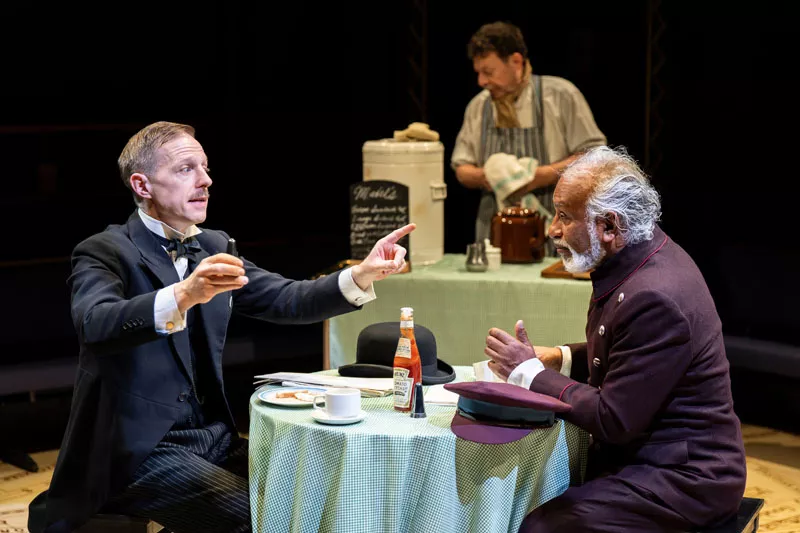
Pete Ashmore, Robert Maskell, Jim Findley.
Photo credit Ellie Kurttz.
Patricia Hodge has the task of playing Malaprop. She dances around the ludicrous speech errors without overegging them and is helped by the skill with which other cast members tease her by making their own deliberate verbal slip-ups. Littler’s direction is witty and precise here, and underlines that Malaprop is not using language but rather it is using her.
I didn’t quite believe in Kit Young (Jack/Beverley) and sensed little chemistry between him and Brough. There are laboured set pieces in which Young takes a bath on stage and performs a galumphing Lindy Hop dance. Brough, by contrast, nails the role from her first scene in which she bemoans the fact that the lending library is all out of the racy novels that she craves and wishes to emulate in her own life. Young is helped considerably by Robert Bathurst as his father, Sir Anthony. Bathurst is another element in this production that I usually prefer to take as a small dose but here he is fluent and spontaneous in the many rows with Jack and even a fleeting hint that he might court Lydia himself.
Technically, the best acting of the night is from Pete Ashmore as Jeeves/Gieves who is manservant to Jack. Littler has fun with a scene in which Ashmore chews the fat with another gentleman to a gentleman played by Jim Findley with the sequence smacking of the Junior Ganymede Club depicted in Wodehouse novels.
A highlight is the extended scene in which Jack and Bob Acres (another of Lydia’s suitors played by Dylan Corbett-Bader) are fitted for new outfits. By this time, the costumes – also the work of Black and Irish – are a core feature as the men wear gorgeous boating blazers. Indeed, James Sheldon as Faulty Faulkland comes on whistling a snatch from the Eton Boating Song. They are the sort of outfits that make you want to go and thrash your own credit card in Jermyn Street.
Despite exquisite moments there are low points. Brabban has some distinctly flat phrases in her songs, and I cringed when Hodge and Young (in separate scenes) shuffle along the already crowded bench seating to join the audience for some eavesdropping. It was unnecessary and clunky as was a reference to the current TV reality show The Traitors.
Overall this is a success and a relief from Christmas shows. Littler is proved right to pick 1927 as a setting and there are well-chosen dashes of Evelyn Waugh in addition to the liberal helpings of Wodehouse. The physical comedy of the abortive duel can often pall but movement director Leah Harris ensures that it is sprightly. Littler allows the plot room to breathe in a sequence at Bath Abbey during which we are eased through some exposition with Ashmore excelling.
Eighteenth-century comedies of manners are not always easily digested. Indeed, they can be “as bad as algebra” as one of the servants says of the quadrille dances performed by the upper classes in the original. Littler has a sharp eye for the conflict between rural and urban values that is central to both Sheridan and Goldsmith. He is making these plays relevant again and it’s a notable achievement for which he deserves credit.