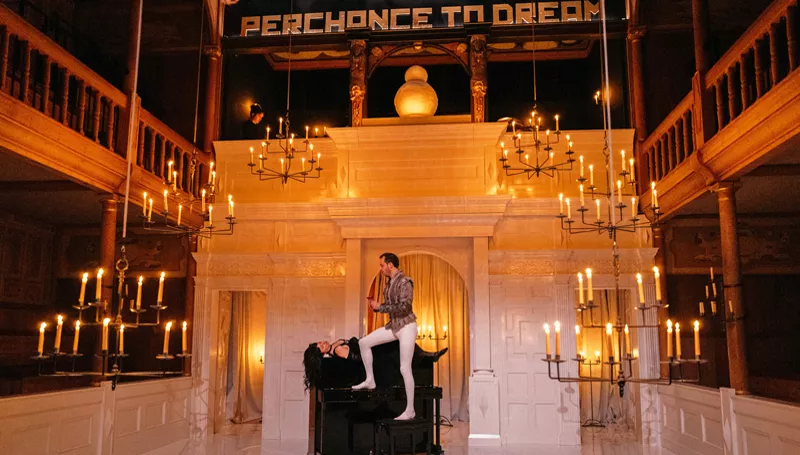
“A Midsummer Night’s Dream” at Sam Wanamaker Playhouse
Neil Dowden on the South Bank
★★★★☆
1 December 2025
A co-production by Shakespeare’s Globe and Headlong (with Bristol Old Vic and Leeds Playhouse), this is the first time that A Midsummer Night’s Dream has been staged at the Globe’s candlelit, indoor theatre the Sam Wanamaker Playhouse. This is partly because Shakespeare’s later plays are usually performed in this Jacobean-style theatre and also because this piece is usually done in the summer. Here, though, the season has exercised a chilly influence as the magical romantic comedy becomes more of a dark gothic fairy tale that could be called “A Midwinter Nightmare”.
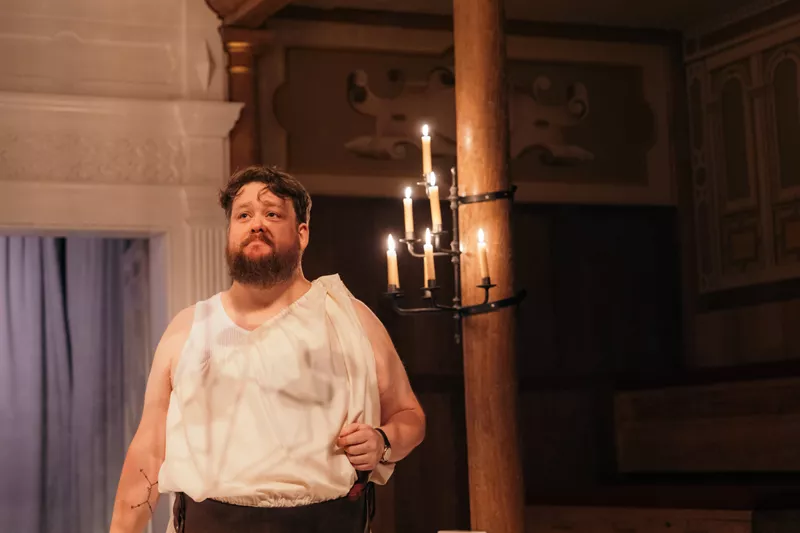
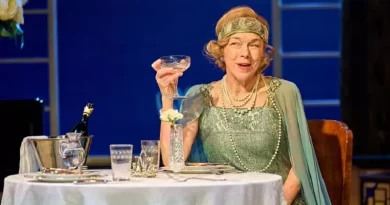
Danny Kirrane as Bottom.
Photo credit: Helen Murray.
The shiny, cold white marble-like design by Max Johns sets the tone, with a long dining table covered in a white tablecloth brought on for stiffly formal court scenes, while in the gallery next to the musicians a snowman appears and snowflakes later descend. There is no attempt to evoke a sylvan playland, with the words “PERCHANCE TO DREAM” (borrowed from Hamlet) displayed at the top like an advertising slogan. Nicola T. Chang’s syncopated, sometimes discordant score conveys a feeling of growing disquiet.
Holly Race Roughan’s imaginatively alternative production (co-directed by Naeem Hayat) uses a text cut by dramaturg Frank Peschler to last only two hours and 15 minutes (with the Rude Mechanicals’ performance of “Pyramus and Thisbe” trimmed in particular, perhaps no bad thing as it is often laboured). There are notable changes, especially in the role of Puck and in the ending which subverts the traditional triple wedding celebration into a horror show.
Puck not only ends the show as usual (with an epilogue) but also starts it, as if he is in charge, knowing what is to come and manipulating events like a sinister MC. Whitefaced, dressed in a white tutu and tights, with one black, elbow-length glove and a black DJ over a bare chest, Puck comes on stage and makes us wait while he slowly eats a banana while eyeballing us before he gets things moving. This sense of uneasy comedy runs through a show that foregrounds the play’s darker elements with a dreamlike – or nightmarish – surreal ambience, and more toxic masculinity than real romantic interest.
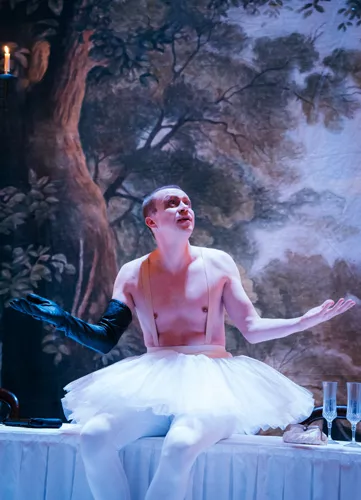
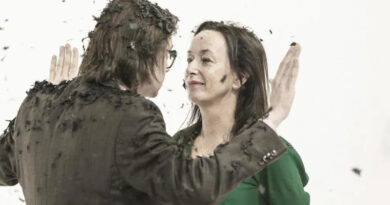
Sergo Vares as Puck.
Photo credit: Helen Murray.
There is certainly no sexual frisson between Theseus and Hippolyta in an abusive relationship which is all about the Duke – his uniform adorned with medals – trying to exert power over his fiery, captured Amazonian bride. They fight on the table, as she raises a knife to his neck but he pulls out a revolver. Later, ahead of the nuptials, they are both carrying rifles after hunting, but it is clear this is a shotgun wedding as he points his rifle at her.
The battle between the sexes is mirrored in the stand-off in the fairy kingdom between Oberon and Titania, if not in such a poisonous way. Here, the changeling they are fighting over – like a custody battle – is a girl, and it is clear that she is being used as a weapon in a power struggle between them. But there is a genuine warmth in the scenes between the drugged-up Titania and the ass-like Bottom, who rather than wearing large furry ears is given high-heeled boots. The four lusty young lovers are also at loggerheads – partly due to Puck’s (deliberate?) misuse of the love drug – though their differences are eventually amicably resolved, but their erotic entanglements have less impact than usual.
The mechanicals – who are here providing hospitality to the court rather than being artisans – are stripped down to three, with Quince as maître d’, Bottom as executive chef, and Flute as a waitress. Puck inveigles his way in by pretending to be the sommelier Starveling, as he continually pops up out of nowhere to startle them as they are rehearsing their play. Early on we see the upper-class Theseus taunt his servants with sadistic relish before throwing Bottom’s suckling pig on the floor. And we have a nasty feeling that their public performance to the court is not going to end well.
This is the third show at Sam Wanamaker directed by Roughan (Headlong’s Artistic Director), following a touring production of Henry V (also co-produced with Headlong) and Metamorphoses (with the Ovid poem one of the Dream’s sources). It’s a highly inventive take on a perennially popular classic – Shakespeare as if reframed by the Brothers Grimm –which goes a bit over the top in its violent finale. The production makes good use of the auditorium with the cast entering and exiting the stage in multiple directions to sometimes disconcerting effect.
The cast all double effectively apart from the actors playing Puck and Bottom. Sergo Vares is spooky as a deadpan, subversive Puck, whose closing words – “If we shadows have offended” – are delivered with sardonic irony. Danny Kirrane is both amusing and touching as the overconfident Bottom who wants to play every role but becomes a victim of his own success. Michael Marcus’s psychotic, authoritarian Theseus is contrasted with his milder, lovesick Oberon, while Hedydd Dylan plays the feisty warrior Hippolyta and the goth-like romantic Titania. Jack Humphrey also impresses in his variant portrayals of the angrily patriarchal Egeus and diplomatic director Quince, with Pia Kalsi as the bewildered Child and gentle Flute playing Thisbe. Tara Tijani, Tiwa Lade, Lou Jackson, and David Olaniregun double as the ardent lovers and ballerina-style fairies where reality and fantasy overlap.