“Twelfth Night” at the Barbican Theatre
David Wootton in central London
★★★☆☆
20 December 2025
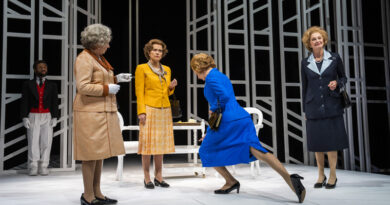
In Shakespeare’s The Winter’s Tale, the young prince, Mamillius, states that “a sad tale’s best for winter”. However, humour is to the fore in the RSC’s latest production – first seen at Stratford a year ago – of Twelfth Night, the most profound of his romantic comedies, which may have premiered during the Christmas season of 1601–2. While that humour sometimes sharpens the melancholic and even tragic notes in the play, it more often undercuts them. It is a particular brand of humour that, wedded to costumes suggestive of the early 20th century, may be described as vaudeville or slapstick, and its physicality is often redolent of silent film comedies. There is a chase sequence, and officers dressed like Keystone Cops, and, more theatrically, some audience participation. It is not quite pantomime, but it has many festive trimmings.
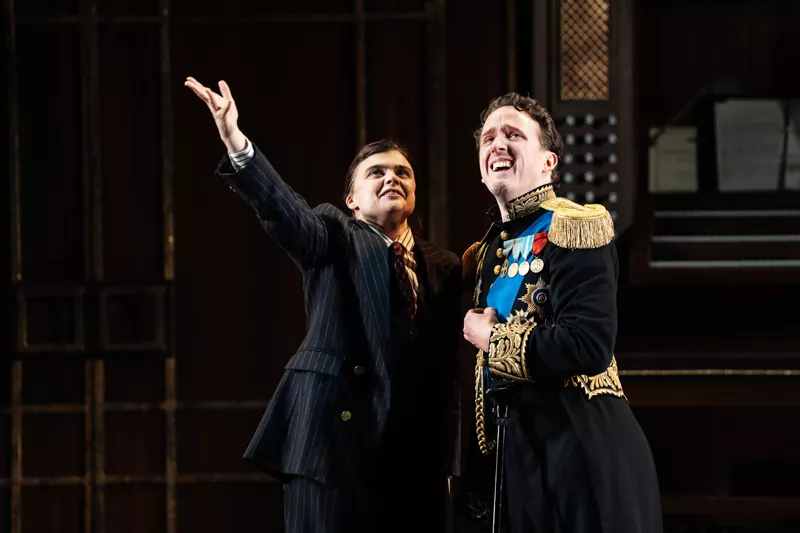
Photo credit: Helen Murray.
The presiding presence in this production is that of Feste, the jester who roams between the households of Count Orsino and Lady Olivia, the two most socially prominent figures in Illyria. As played by the engaging and energetic Michael Grady-Hall, he is no longer the shadowy soul that he so often seems in presentations of the play. Rather, he is robust and irrepressible and, partly through extended comic business that is not always linked to the plot, he often steals the show. Indeed, he makes his first appearance singing a song while being lowered from above on a wire, and sporting a distinctive shock of hair that marks him out as being halfway between Stan Laurel and Morrissey. This seems fitting, as the refined score has been composed by Matt Maltese, who, known for his mournful and dramatic indie love songs, has been compared to the lead singer of The Smiths.
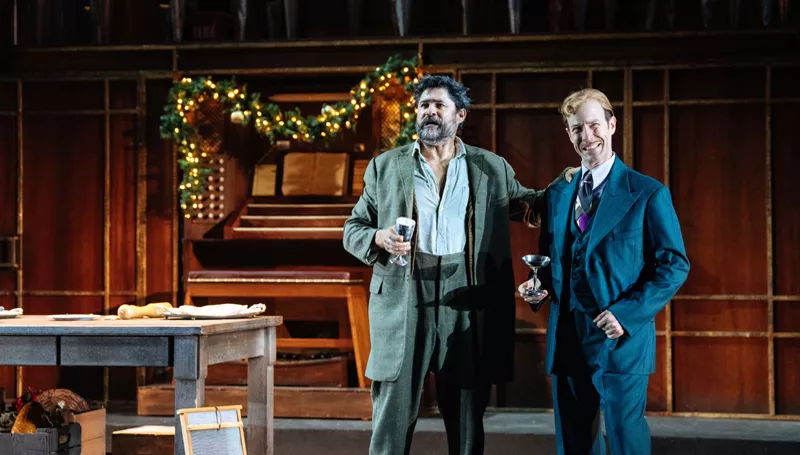
Of course, as Orsino suggests in his opening speech, music is the food of love, and music has an especially significant role in this production, visually as well as aurally. Orsino’s court is characterized by a grand piano, which is played to accompany the – all-male – servants, who dance in couples. Olivia’s court, on the other hand, is dominated by a huge organ, which, whether or not it is intended to imply a sexual pun, is employed to great effect. It provides music in a variety of modes, from the entertaining to the solemn, and is also intrinsic to the action. For instance, its forest of pipes affords places in which Olivia’s uncle Sir Toby Belch and his confederates can secretly watch her puritanical steward Malvolio be tricked by them into thinking that he is the object of Olivia’s love.
Piano and organ also symbolize the contrasting characters of the two courts. That of Orsino is quieter and more sophisticated, and Orsino himself (as sensitively played by Daniel Monks) is an introvert who, dressed for much of the play in pyjamas, clearly does not get out much. That of Olivia is loud and lively, and she (in Freema Agyeman’s winning portrayal) soon shows herself to be forthright and sexually confident. Her employment of a strait-laced steward seems as much a way of restraining herself as controlling the behaviour of others.
In any event, Malvolio is fighting a losing battle against a particularly boorish Sir Toby (a convincing Joplin Sibtain), a surprisingly sprightly Sir Andrew Aguecheek (Demetri Goritsas), a sparky Maria (Danielle Henry), and a combative Fabian (Daniel Millar). As Malvolio, Samuel West well articulates the changes to his personality as he responds to his shifting fortunes, from strict servant through deluded and over-enthusiastic lover to victim of persecution. However, the broad approach to the comedy, though very funny and expertly played, does have the danger of weakening the potential to make Malvolio a moving or even tragic figure. Having said that, there is something chilling about him implicating the entire audience with his final words, “I’ll be revenged on the whole pack of you.”
The palette of James Cotterill’s striking designs is inspired by Malvolio’s costume, both his habitual black and the yellow stockings that he dons to woo Olivia, despite it being a colour “she abhors”. As the play opens, a servant is repainting a yellow wall in black to conform to Olivia’s initial mood, as she mourns for her dead brother. However, yellow accents keep appearing throughout the performance, and most noticeably in a spectacular clown suit that Feste sports, in which ruff-like stripes of black and yellow give him the appearance of an Elizabethan bee, all be it one with a banana for a codpiece!
Into this zany world step Viola (Gwyneth Keyworth) and her brother Sebastian (Rhys Rusbatch), though they do so separately, each in the belief that the other has drowned at sea. Disguised as a young man (or, more precisely, a “eunuch”), Viola becomes a servant to Orsino, and then woos Olivia on his behalf. As a result, she – the play’s heroine – sparks much of the emotional complexity and sexual ambiguity that fuel the action and sustain interest. In this key role, Keyworth is charming but a little underpowered, and, as a go-between, she seems constantly to be overshadowed by Feste and his frolics. However, while the production, directed by the multi-talented Prasanna Puwanarajah, may ultimately fail to reveal the true heart of the play, it does provide a highly diverting experience, and brings warmth and colour to the coldest and darkest nights of the year.