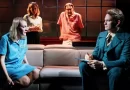
“The Holy Rosenbergs” at Menier Chocolate Factory
Neil Dowden on the Southbank
★★★★☆
13 March 2026
Ryan Craig’s play The Holy Rosenbergs was searingly topical when first staged at the National Theatre in 2011. A drama about the divided loyalties of and conflicts within a Jewish family and their local community in north London, it is set during the First Gaza War of 2008–9, a three-week conflict between Israel Defence Forces and Hamas which saw the deaths of about 1500 Palestinians and 13 Israelis. Tragic though that was, the two-year-plus offensive that the IDF started after Hamas’s massacre and kidnapping of over a 1000 Israelis on 7 October 2014, in which about 75,000 Palestinians have been killed so far, lends the play an even more horrific relevance. Lindsay Posner’s taut revival brings home the urgency.

Nitai Levi and Alex Zur.
Photo credit: Manuel Harlan.
The Rosenberg family is in crisis. The eldest son Danny has recently been killed after travelling to Israel to fight in the Israeli Air Force against Hamas. Ahead of his memorial in Edgware both the local rabbi and the chair of the synagogue warn that Danny’s sister Ruth should stay away as she is involved in contributing to a UN report on war crimes by Israeli as well as Hamas combatants and there are likely to be protests against her from the Jewish community. Meanwhile the youngest son Jonny gets embroiled in drunken brawls and refuses to help in his father David’s catering business which is struggling after generations run by the Rosenbergs, as the mother Lesley vainly tries to keep her family together.
Despite the shadow of Danny’s death, the play begins with a certain amount of comedy with the cynical Jonny making fun of his father to Rabbi Simon: “You must have heard him banging on about the long line of Rosenbergs, stretching back to the Bible. He reckons some ancient relative catered the Last Supper.” And in almost Friday Night Dinner style, the over-solicitous Lesley practically force feeds tea and marble cake to the poor rabbi.
But the serious splits within the family become more evident. While Danny volunteered to go and fight in a war that “wasn’t his”, Ruth has volunteered to seek out human rights abuses there (including possibly her own brother’s) and Jonny seems to have opted out altogether as a layabout with no seeming issue in the matter. None of them have prioritized the middle-of-the road, middle-class life of their parents. But their mother and father are at loggerheads too, with Lesley lambasting David’s deluded business plans after he has refused a job with her brother in Croydon where she wants to move.

Tracy-Ann Oberman as Lesley Rosenberg.
Photo credit: Manuel Harlan.
David wants to save the longstanding family name but he overinflates his status as a Rosenberg in their community. His hopes of a comeback rest on his old doctor friend Saul signing the catering contract for his daughter’s wedding, but as chair of the synagogue he doesn’t want to be tainted by association with Ruth, who unlike the “hero” Danny is regarded by many as a “traitor”.
Craig has wisely refrained from updating the text though it has been “tightened and focussed”. The play powerfully explores the impacts of domestic and community conflict, as well as divisions between generations, secular versus religious Judaism, and Jewish British/Israeli loyalties. There is much cogent examination of the nature of Jewish identity, which is a theme that runs through Craig’s work, though he does slightly overstuff The Holy Rosenburgs with ideas, especially when Ruth’s boss Sir Stephen Crossley later arrives to cue a debate on the rights and wrongs in time of war.
Craig is a self-proclaimed admirer of Arthur Miller, also drawn to probing ethical and political dilemmas, though here he is overly influenced by All My Sons (albeit this was deliberately written as a “non-Jewish” play), with a late, already signalled revelation failing to convince. There’s also an interesting comparison with Sam Grabiner’s Christmas Day recently staged at the Almeida Theatre, with which there are considerable overlaps.
The Holy Rosenbergs could be seen as a follow-up to Craig’s What We Did to Weinstein (premiered at the Menier Chocolate Factory in 2005 as one of their earliest productions), which covers similar territory though focusing on possible war crimes in the West Bank. It was Posner’s idea to revive the play with the current conflict in Gaza (now of course a regional war after Iran’s retaliation to the US and Israel’s bombing of their country), having directed Craig’s forceful adaptation of George Orwell’s 1984 for Theatre Royal Bath and a subsequent tour. Posner’s compelling production is well served by Tim Shortall’s impressively detailed design of a comfortable but old-fashioned living room/dining room with family memorabilia and a view of suburban houses through the window.
The cast is excellent. Nicholas Woodeson persuasively portrays David’s mix of stubborn pride and pathetic desperation, while Tracy-Ann Oberman makes the most of the humour in Lesley as hostess as well as showing the emotional toll of all the stress. Dorothea Myer-Bennett also does well as the high-principled lawyer Ruth who doesn’t consider the full effects of her actions on her family, contrasting with Nitai Levi’s slacker Jonny who’s acutely aware that he’s not valued as much as his late older brother. Alex Zur plays the go-between Rabbi Simon caught up in the Rosenbergs’ in-fighting, Dan Fredenburgh is the embarrassed but resolute Saul, and Adrian Lukis the urbanely judicious Sir Stephen who believes following international law is essential for civilization.