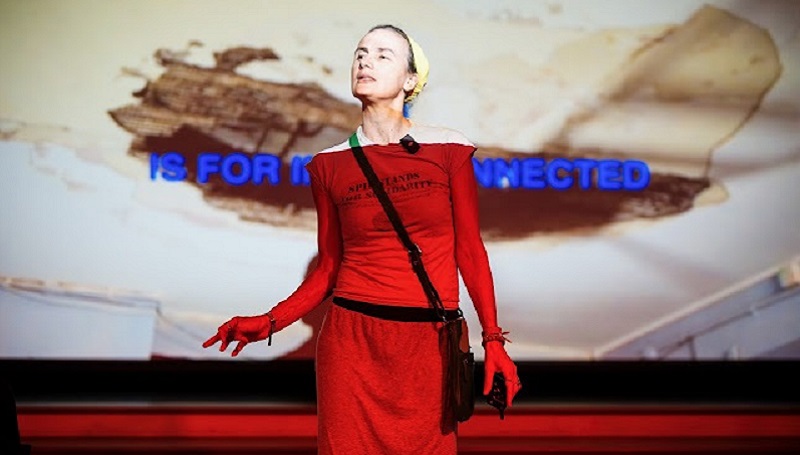
Interview with Helena Thompson of SPID
Jeremy Malies
January 2026
Helena Thompson is artistic director of SPID, a theatre company based at Kensal House in Ladbroke Grove. The development is a flagship (broadly modernist) pioneering social housing estate dating from 1937.
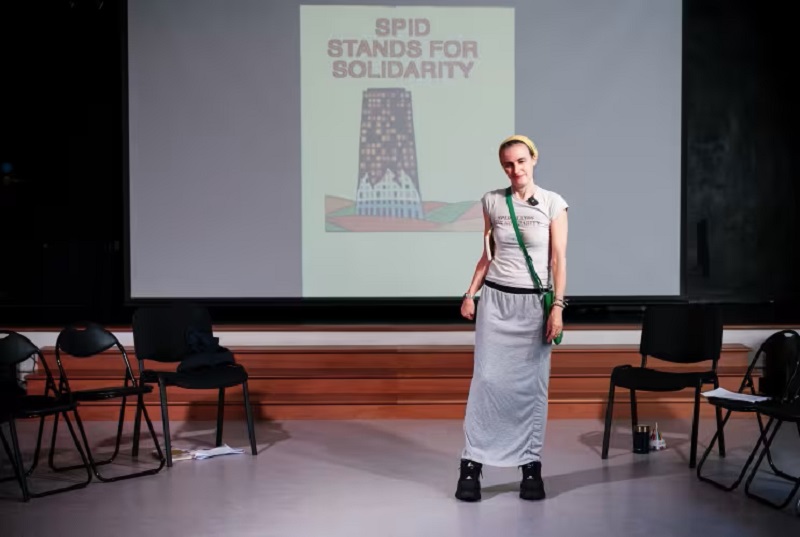
Photo credit: Alex Brenner.
Travelling a few stops east on the tube from Hammersmith for the meeting, I’ve seen the remains of Grenfell Tower in North Kensington shrouded in plastic and emblazoned with “In our hearts for ever.” Early in the conversation, Helena reminds me that Aristotle defined tragedy as that which is surprising but inevitable. It’s a good starting point for a conversation in which Grenfell will be a topic.
SPID (Social Progressive Interconnected Diverse) creates community theatre for council estates with many of the scripts being interactive, participatory or immersive. They work from a community room and stage space in the undercroft of Kensal Tower.
Late last year, I saw the participatory show Artivist’s Handbook, developed by Helena over the seven-year refurbishment of the Grade II-listed theatre here. The piece was a celebration of the charity’s twentieth birthday complete with cake, party hats and leaving gifts for visitors. It showed us how the charity raised £4m to restore the neglected performing space and scale up their free drama and heritage programme – while working with residents to make the council invest in bringing the whole Grade II* listed estate up to standard. The funds came from 12 donors and grant issuers, with the biggest being The National Lottery Heritage Fund, The National Lottery Community Fund and the Mayor’s Fund for London. The Big Issue has been and remains a significant supporter. The MacEwan Award-nominated refurbishment involved access and safety improvements including a lift (for which the logistical challenge was immense) and sloping corridor.
Helena tells me that a revival of her Bluebeard’s Wives based on the French folktale is upcoming at the Riverside Studios in Hammersmith, having premiered at the Institute of Contemporary Arts on The Mall and the Edinburgh Festival Fringe. But staying with the Greeks, she hopes to create a version of Medea, perhaps for radio initially, and then bring a rewrite to the stage.
“Soft on people hard on systems” is a slogan quoted by Helena though she always expects people to make the most of their abilities and be resilient. “Judging other people is just a distraction, really. We take encouragement from and in people by their positive actions.”
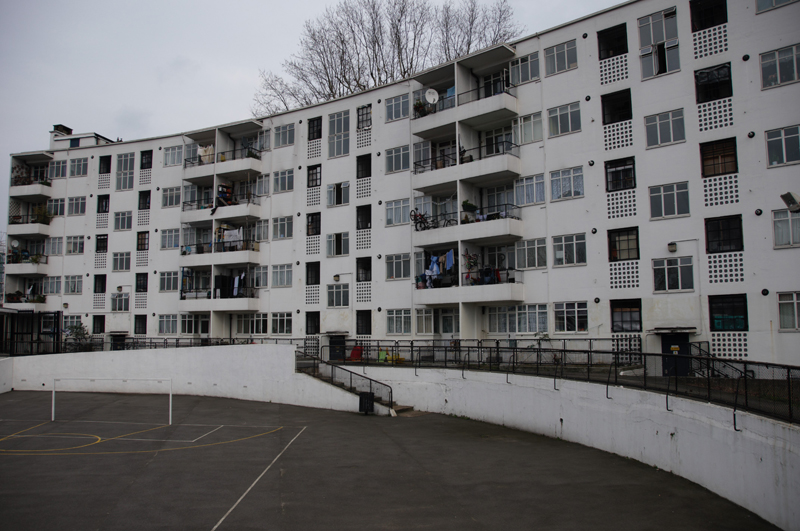
Kensal House.
Photo credit: Rob Marshall.
Notable students
Nurturing the innate talent of students who come under its wing is something of which SPID can be proud. I ask about young people who have worked with Helena and gone on to good things, not necessarily in the arts world but through finding purpose and discipline after programmes at Kensal House.
Helena mentions Olivia Polglase. “Olivia went through our Estate Endz project focusing on social housing heritage and community engagement. It teaches young people between 13 and 25 about the history and culture of social housing. Olivia was so engaged, talented, and passionate about the work here that we hired her as a youth assistant. She worked with SPID for almost 10 years becoming our head of marketing and outreach. Olivia is now at Stage One, a charity that supports theatre producers, and is thriving there. Stage One are valued partners of SPID.”
Another former participant in Estate Endz who came back to work at SPID and continues to flourish – appropriately enough in the world of architecture – is Feysa ‘Fey’ Poetry. Feysa is close to completing her PhD in architectural practice at The Bartlett School of Architecture. Her thesis has involved creating a museum at a port town in Java. An alumna of this kind helps SPID to reach out to The Bartlett School, RIBA, and The Twentieth Century Society (C20).
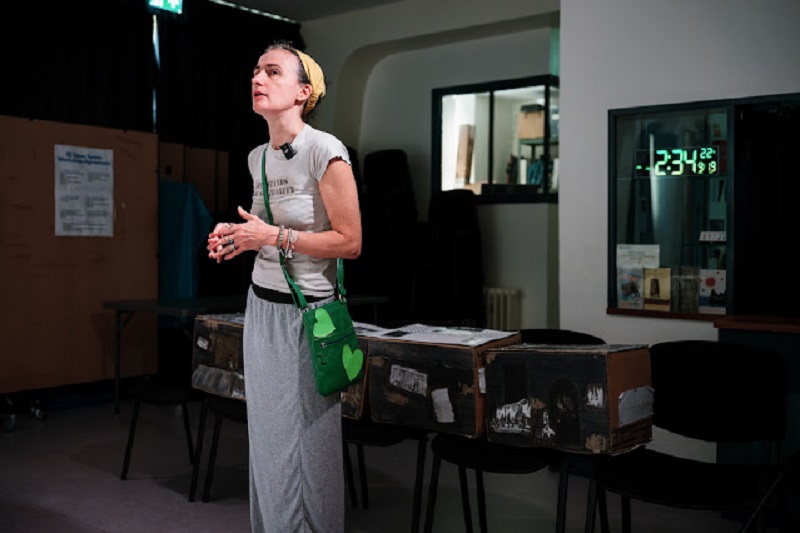
Photo credit: Alex Brenner.
Social mobility
“Neither terrible nor brilliant” is the fence-sitting and mangled conclusion of the Social Mobility Commission on how fluid UK society proved in 2025. Helena is impassioned about diversity and social mobility. She says, “Diversity is always a strength – and I don’t just mean in terms of class but across ethnicity, gender, and age. Young people always have the potential to raise each other up, but we live in a time of division and hatred. Almost any identity is at risk of being polarized but society in general is increasingly aware of what a hard time young people are having. Nobody is going to avoid the cycles of abuse that hatred can perpetuate unless they reach across divides in a dynamic, practical sense.”
Adolescence
The conversation about portrayals of young people in drama widens and we discuss the 2025 Netflix television series Adolescence. A four-parter written by Jack Thorne with Stephen Graham, it is set in Doncaster and documents the fictional murder of a 13-year-old schoolgirl who has spurned the romantic advances of the protagonist, a boy of her own age played by Owen Cooper. The girl initiates cyber bullying after rejecting the boy. The episodes, all done in one take from a single camera, examine how far down in terms of age the “manosphere” has penetrated in terms of warped thinking and social media activity around involuntary celibacy.
Helena says, “Jack Thorne is always extremely eloquent – a really good writer. The cast were magnificent. At SPID we often reference the 1966 Ken Loach and Jeremy Sandford TV play about homelessness, Cathy Come Home. The idea of a living documentary that combines scripted work with elements of improvisation from adolescents is really strong. Sandford’s work was an inspiration to me and its influence can be seen in what I’ve done in radio and stage projects.
“The creative team behind Cathy Come Home were the first to use the approach of going out to plausible locations for the narrative with handheld cameras, employing surround sound, and layering that over visuals.”
Helena continues, “Staying with Adolescence, at SPID we believe of course that boys also deserve empathy. They too are being hurt by spiralling algorithms. We work with many young offenders and think carefully about legislative and prosecution systems.”
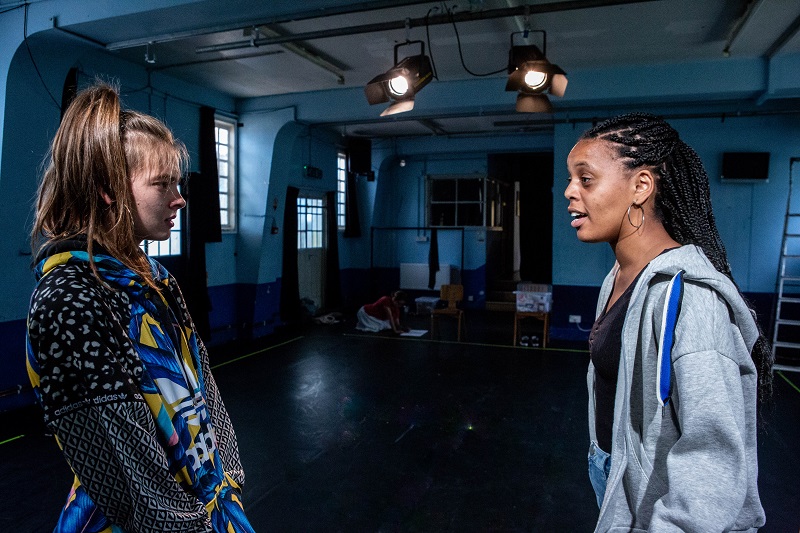
Alice Franziska and Bianca Stephens in The Burning Tower.
Photo credit: Ali Wright.
Social housing
The conversation returns to social housing, and Helena mentions Henry Mayhew. Mayhew (1812-1887) was a combination of sociologist (perhaps before the term was coined), shoe-leather beat news reporter, playwright, and satirist. He exposed conditions endured by London’s working classes in vivid reportage often with a Marxist flavour and was among the first to make cogent demands for social housing. Mayhew’s spirit can be seen in the buildings around us, and it suffuses Helena’s work.
The plays written and improvised through collaborative processes at Kensal House have broadened from the issue of social housing to the whole case for a welfare state, race justice, youth justice, and addressing the climate emergency. Helena sees them as being interconnected.
She says, “Free trade – I’m thinking of oil and rare metals particularly – should not be destroying the planet. Earth is literally burning up so it’s not so much of a conceptual leap from that to Grenfell. It’s not a coincidence that so many of the Grenfell victims were young people of colour. Grenfell turned the focus to race justice and housing.”
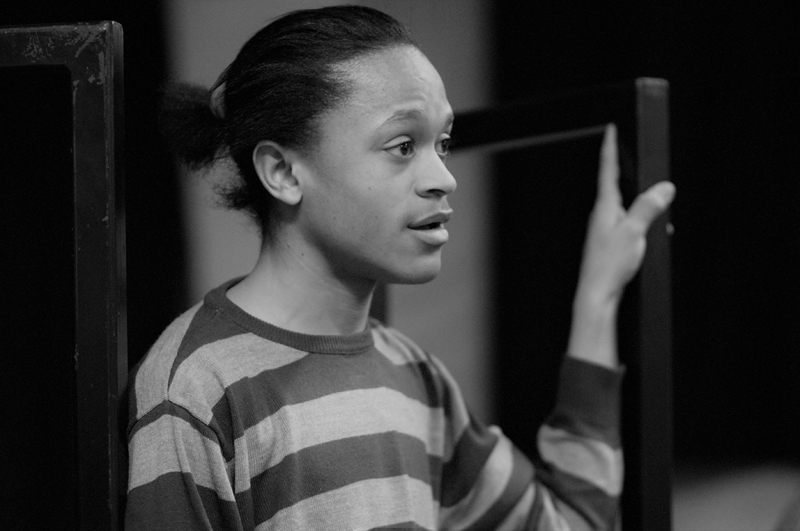
Superhuman.
Photo credit: Rob Marshall.
It’s not a tax-free future
“The future is not tax-free. We should tax the multi-nationals and share revenue to promote race justice. Free markets should not be an enslaving force – we should always be mindful of a global minimum wage and youth justice. And we should remember that hate speech is not free speech. We need to stop the hate and ban the troll farms that create it.”
Looking at the exhibition material in the corridors of Kensal House, it becomes obvious that SPID is working to challenge the managed decline of young people’s mental health and buoy it up with the positive experience of coming together across divides to create art. And that creative process involves meditation and the celebrated SPID shout-outs which help young people feel better about themselves collectively. Helena’s ethnicity is part North American Indian and she points to how inspiring the meditative practices of Native Americans can be when confronting challenges such as fracking.
Grenfell Inquiry
A phrase relating to Grenfell has stuck in my mind for nine years and I quote it to Helena. At the very first session of the inquiry it became obvious that the chair, Sir Martin Moore-Bick, was unable to command any respect from survivors and nearby residents. One resident used an evocative phrase, saying that he “had lost the room”.
As I float this phrase to her, Helena becomes impassioned. “The system serves itself and always behaves in the same way as in this situation when the Grenfell landlord [the Royal Borough of Kensington and Chelsea] profits from the pain of others. It will do anything it can to ensure that any inspections of buildings like Grenfell are carried out by itself, and if not allowed to perform such a task it will look for the closest possible representation of itself that is not inclined to push for change.”

Photo credit: Kevin Hackert.
Kensal House was designed by the Le Corbusier-influenced modernist architect and town planner Maxwell Fry who for a while worked with Denys Lasdun, designer of the National Theatre. As a young man, Fry moved from a refined neo-Georgian style to the gorgeous shallow Art Deco curves that surround us. Helena mentions Mayhew’s spiritual successor, the social housing guru Elizabeth Denby who worked here with Fry and finally nudged him towards a progressive modernist style with the cantilevered balconies that are characteristic of these flats. Denby is best remembered for the book Europe Rehoused. It’s a dank day but I’ve now been here three times and can empathize with Helena as she says, “When the sun occasionally hits the white blocks you can really fancy that you’re in Europe!”
Safety net
Helena says that while it is broadly correct to cite Clement Attlee (his post-war government created 800,000 council dwellings) as the chief proponent of public housing, there had been campaigns as early as the government of Lloyd George and his push towards “Homes for Heroes”. But right to buy heralded an end to the safety net.
The current system is broken with Grenfell having been a symptom. I think back to the Artivist’s Handbook performance at which I stood next to Sophia Ollivierre who is a co-chair of SPID. Sophia’s son attends SPID’s Far Far Away course and took part in Step Up, the company’s professional programme. Sophia and her son were displaced by Grenfell and live in social housing.
To remind me of the show, Helena brings four cardboard boxes to the table. They have apertures and pictures. The boxes represent Kensal House, Grenfell Tower, and Trellick Tower which is a little to the north in the direction of Maida Vale. In a decidedly different (Brutalist) style, the 31-storey Trellick is distinctive for its separate access tower and is the work of architect Ernő Goldfinger.
The fourth box (also part of the show) is a nod to the Frestonia Squatters from 1974 who took over derelict cottages near Latimer Road tube station. They “declared independence” from the UK in the hope of slowing the eviction process and relied on actor Heathcote Williams (Prospero in Derek Jarman’s The Tempest) as their ambassador.
Artivist’s Handbook features significant video content which is a compilation of SPID’s work with young people and local residents over 20 years. The most poignant sequences turn the spotlight on the neglect at Kensal House. I begin to realize that there is an Old Testament flavour to all this. Grenfell suffered a fire, Kensal House had floods. Images of stagnant water from the video still leave me a little queasy when I recall them. Helena regards the floods and leaks as metaphors for a systemic corruption that permeates the landlord.
She says, “It’s not about SPID or me personally. The focus should be on all the young people in the community. But I do think the theatre company is a beacon of hope at a time of despair. And I’m unashamed of exploiting a crisis if this can be a tactic for bringing lasting change in the face of global capitalism. I’ve been fighting for housing equality for those around me for half my life now. I fought against globalization in the nineties and lost. If we are to have a fairer world, the people with the most inspiring stories to tell must unite. They must show wisdom, grace, courage, and honesty. Then we can become galvanizing.”
“Galvanizing”. I can’t think of a better word to conjure up the force of nature that is Helena Thompson.
https://spidtheatre.com/
https://tinyurl.com/SPIDjoinjustice