“Marcel on the Train”, Lynn F. Angelson Theater, New York
Glenda Frank in Manhattan
★★★★☆
9 March 2026
It took many decades for writers to consider comedy as a legitimate method for telling stories about Nazis and the Holocaust. Productions like The Producers, Life Is Beautiful, and Jojo Rabbit proved the latent power in this clash of perspectives. The world premiere of Marcel on the Train, now playing off-Broadway at Classic Stage Company, is about occupied France and the saving grace of humour. It is also an extraordinary tribute to Marcel Marceau, the French mime who rescued more than 70 Jewish children from deportation to concentration camps.

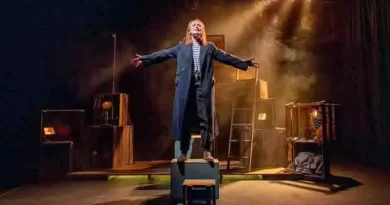
Ethan Slater as Marceau.
Photo credit: Emilio Madrid.
It’s 1943. The 20-year-old Marcel Mangel (played by Ethan Slater), who changed his surname to Marceau to survive, is about to begin his first rescue to Switzerland. Marceau did not volunteer; he was recruited. “What exactly are my qualifications?” he asks. “You’re still alive.”
But we soon see his gifts: an agility to improvise promptly, composure under stress, and a knack for making the children laugh. The four pre-teens – placed in an orphanage after their families were deported – pose as Boy Scouts, a strategy chosen because the scouts did not admit Jews. The two girls are disguised as boys. An expert forger, Marcel carries two sets of identity papers for them. Their actual papers are hidden in mayonnaise sandwiches, a ruse devised on the theory that German soldiers, fearful of staining their uniforms, would leave the messy repast wrapped. It didn’t quite work out that way.
Danger is everywhere – in the sounds outside the box car, in the logistics of the escape plan and in transporting children, who can be unpredictable, children who are sure that they face their deaths. Performed by adults, each child has a distinct personality and attitude. Etienette (Maddie Corman), has retreated into herself and become mute. Berthe (Tedra Millan, Leopoldstadt), the most articulate and the most cynical, talks about the murder of her father, brother, and mother. Adolphe (Max Gordon Moore, Indecent) and Henri (Alex Wyse, Spring Awakening), frenemies, rag on each other, exchanging quips and insults. Henri is open and needy. Adolphe is analytical.
A scene with the German officer (Aaron Serotsky, impressive in his several roles) is mesmerizing and strange. He is not fooled by the children pretending to be asleep and maybe not fooled by the girls in disguise. He orders one to remove her hat. Director Marshall Pailet and Slater, who wrote the script, build the ambiguity of the character bit by bit and because he remains an enigma, the scene is unforgettable. Marcel asks him if he has children. He never answers but tricks one of the boys to come close to confessing that they are the children the soldiers are hunting. He empties all their backpacks, asks them to eat the mayonnaise sandwiches where their passports are hidden, and stays and stays. His possible motive explores a different side of German soldiers. (“It’s my orders to catch people . . . ,” he tells Henri. “I don’t like it, but it’s my orders.”)

Lighting by Studio Luna.
Photo credit: Emilio Madrid.
Audience members worry about everyone, even the Nazi soldier. Marcel fears for his father (Serotsky), who refuses to leave France and is arrested. These light touches only increase the tension. Even though we know the outcome, as danger builds, the audacity of the plan keeps us attentive.
Ethan Slater recruited Pailet who is an actor/writer with an interest in historical wars in 2021 to co-create the script and direct. Slater received a Drama Desk Award and Tony nomination for his rendition of the lead in the 2016 musical SpongeBob SquarePants. He played Boq, a munchkin, in two musical film adaptations of Wicked in 2024 and the 2025 sequel. Slater studied the French mime’s repertoire and reprises Marceau’s signature routines throughout the play which is part of the charm of this production. His nimble gymnastics punctuate the scenes, providing cathartic interludes that both release and heighten the tension. He interacts with each of the orphans as individuals, a clever authorial choice. And who would have suspected that Berthe’s need to urinate while the soldiers are searching the train could be so interesting? Fine acting by all.
I found the last segments, where we meet the children as adults, curious additions but I appreciated Maddie Corman’s miming. The lovely, highly function set design by Scott Davis with its disappearing benches and the innovative moody lighting by Studio Luna were integral components in the escalating disquiet on a journey to safety.