“Kar”, The Studio, Edinburgh
Mark Brown in Scotland’s capital
★★★★☆
6 February 2026
In 2001 I had the good fortune to interview Harold Pinter ahead of a production of his 1975 play No Man’s Land, which he was directing for the National Theatre (of Great Britain). Speaking with me in the two-storey wing of his house in Holland Park, West London – which his wife, the historian Antonia Fraser, called his “super-study” – Pinter told me that he considered No Man’s Land to be “a comedy about death, in which one man prefers to die and another refuses to die.”
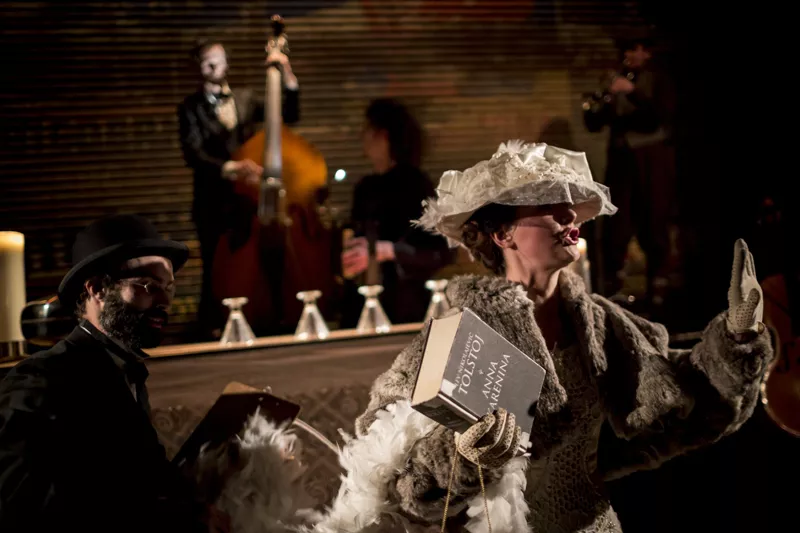
Photo credit: V. Brtnicky.
The great man’s compelling observation came to my mind while watching Kar by Czech company Studio Daumza, which played early in the programme of Manipulate, Edinburgh’s annual festival of puppetry, visual theatre and animated film. Ostensibly this theatre work – which combines musical concert, puppetry and cabaret – is a liberal adaptation of Tolstoy’s novel Anna Karenina.
However, tickets for this “funeral dinner” come with the warning, “if you’re in the market for a straightforward and faithful adaptation of Anna Karenina, this might not be the show for you.” True to this disclaimer, the piece prefers the evocation of, by turns, absurd and existentialist atmospherics to straightforward narrative. Imagine, if you will, a collaboration between the outstanding Italian comic dramatist and actor Roberto Benigni and the modernist master of Polish theatre Jerzy Grotowski and you might get something approximating to Kar.
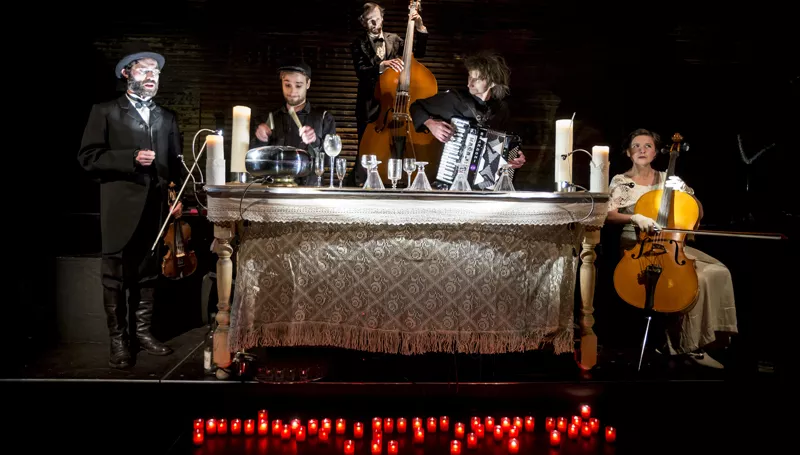
As we, the audience, arrive at the door to the auditorium we are greeted by a maitre d wearing a formal black suit, a bow tie and a pair of old-style roller skates. We are offered burning candles which, it transpires, are to be placed on the floor beside a bed where a seemingly dying man is lying, while playing the accordion.
Around the bed, in addition to the roller-skating master of ceremonies, are a bowler-hatted gentleman, a less formally attired man (who supplies the dying man with cigarettes) and, eventually, Anna Karenina herself. Asked about his condition, the apparently dying man explains that he is “leaving”, before clarifying that he will not die today, he will do so tomorrow.
He does not leave, however. He stays, prone, playing vignettes of tunes on his accordion, including excerpts from the national anthems of Germany (Das Deutschlandlied: The Song of the Germans) and the United Kingdom (God Save the King).
Meanwhile Ms Karenina expresses, in extremis, the tragic essence of human experience: namely, the nexus between love/sex and death. Her Tolstoyian speech is interwoven with often pulse-quickening live music and song (created by all five actor-musicians) which, in its moments of Slavic energy and abandon, is reminiscent of the barely controlled musical mayhem of Emir Kusturica and the No Smoking Orchestra.
Such a celebration of – to borrow a phrase from the Czech-French novelist Milan Kundera – “the unbearable lightness of being” requires alcohol, and it soon arrives. Vodka flows and is proffered to patrons seated in the front rows. Bottles and shot glasses become puppet people in scenes that are, simultaneously, humorous, charming and unexpectedly affecting.
When the booze runs dry the performers – like a group of medieval troubadours – take their leave in a delightful, bleakly comic manner that is – like so much in this excellent, bold and humanistic production – familiar to audiences in central and eastern Europe, and all too rare in the theatre traditions of the UK.
The Manipulate festival ends 10 February: https://www.manipulatearts.co.uk/festival/