“Ha Ha Ha Ha Ha Ha Ha” at Yale Rep
Robert Schneider in New Haven, Connecticut
★ ★ ★ ★ ☆
9 February 2026
It’s a mystery how Julia Masli’s Ha Ha Ha Ha Ha Ha Ha hasn’t been written up in these pages before. It started out at the 2023 Edinburgh Festival Fringe where it earned best show in the ISH Edinburgh Comedy Awards as well as the Comedians’ Choice Award and was named “best comic show of the year” by The Guardian. It then exported itself to the Melbourne International Comedy Festival where it sold out, repatriated itself to London’s Soho Theatre, then found itself in LA and Washington DC before landing at New York’s Public Theater where it attracted the attention of Yale Rep Artistic Director James Bundy. Masli, who was born in Estonia about 30 years ago, took a round-about route to New Haven, evading the pages of Plays International at every stop.
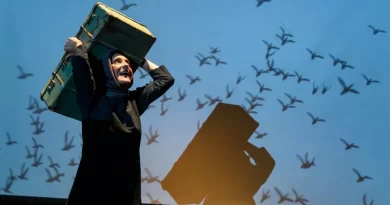
The stage is mostly dark when Masli enters. She’s draped elaborately in turquoise with a steam-punk Phrygian helmet on her head. Quickly, she acquires the hollow plastic leg of a mannequin. She’ll use this as a grotesque mic boom when she interrogates audience members. Starting with “ha” and moving on to more complex strings of syllables, she wants specific audience members to replicate her vocalizing. She rings a tiny bell to show her approval.
The people in the first row aren’t her only victims; she can pick out people further back with the flashlight built into her helmet. She has no patience for those who won’t play the game. A young man who failed to follow her vocal prompts was asked to rise. Masli took his chair upstage and smashed it to pieces. This clown gives short shrift to shy people.
Other audience members were more accommodating. “Problem?” She prompts, in a soft, mildly-accented voice. People confide in her. “I’m a people pleaser,” says one man. “I don’t like to disappoint people.” In response, Masli recruits another audience member to go to a work station that is dimly visible on stage. “People pleasing; ask Wikihow.” Not surprisingly, Wikihow suggests that he practice saying “no.” Masli moves on.
“Problem?”
“They changed my medication and it makes me tired.”
This young woman is invited to come to the stage where Masli rolls a bed out of the wings for her use. She also provides a sleep mask and headphones through which the tired audience member can follow Masli’s own guided meditation. It begins, “All your friends and family are going to die.”
“Problem?”
“General despair at the state of the world.”
For this gentleman, Masli suggests a useful occupation. She sends him upstage to repair the broken chair and supplies a cartful of tools for the purpose. She reminds him: “Jesus was a carpenter.”
“Problem?”
“I was broken up with yesterday. My partner was supposed to come to the show, but my roommate came instead.”
This is more difficult: Masli asks how long they had been together. She confides that she, too had suffered a breakup. “It will be bad for a while. Then it will be better. Then it will be worse again.” She sends the roommate upstage to help fix the chair.
As the evening progresses, more and more people are on stage, resting on the bed or getting the help they need. When a woman claims she has no problems, Masli leads her in a joyful dance around the theatre.
“Problem?”
“I don’t have time for all the beautiful things in the world.”
“What beautiful things?”
“Sunrises and sunsets.”
Masli wasn’t prepared for this, but she did her best. She asked the lightboard operator to make sunrises and sunsets, but co-lighting designer Jennifer Fok hadn’t hung enough reds and oranges to bring it off. The result was anaemic. Masli also gets help from live sound designer Sebastián Hernández who plays the audience’s problems back to it and adds live improvisation on the trumpet. All in all, the atmosphere is portentous, almost ritualistic. When she chooses an audience member to represent all the evil in the world, she declares he must be cleansed. A glass shower booth appears from the wings. Somehow, Masli’s backstage assistants persuade the man to undress, don a robe and return to the stage to take a shower. That must have been an interesting conversation. I’m sorry I missed it.
Masli comes back to the ‘people pleaser’ and asks him for a hug. She scolds him when he forgets to say “no.”
Meanwhile, three audience members upstage have managed to repair the chair.
While Masli’s solutions are baroque and often disconcertingly literal, it’s clear to me that she genuinely wants to help. Sometimes she merely repeats what people tell her, but always with compassion. She clearly has a range of props and set pieces back stage that she can use, but she gives equal attention to those for whose complaints she has no solution handy. I want to go back to see how she manages with a different audience and different problems to solve.
Kim Noble is credited as the show’s director, but you might as easily direct the Aurora Borealis.