“Shadowlands” at Aldwych Theatre
Franco Milazzo in the West End
★★★★☆
15 February 2026
It has taken six years for this production of William Nicholson’s Shadowlands to travel from its origins at Chichester Festival Theatre to the Aldwych Theatre, and that slow burn feels oddly appropriate for a play about late-found love, grief, and faith. Director Rachel Kavanaugh has resisted the urge to inflate it for the West End. Instead, she trusts stillness.
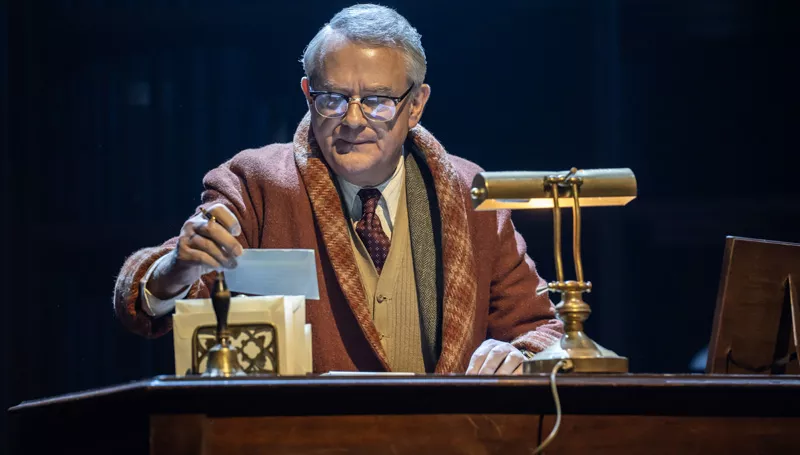
Hugh Bonneville as C.S. Lewis. Set design by Peter McKintosh.
Photo credit: Johan Persson.
C.S. Lewis’s world-famous The Chronicles of Narnia fantasy series was initially published in the 1950s and still permeates the zeitgeist; this December, Netflix will release the first of a new series of Narnia films from Barbie director Greta Gerwig. The J.K. Rowling of his day is painted by Nicholson as an academic armoured in intellect, for whom theology and literature are both shelter and spiritual sustenance through two impossibly brutal wars.
At its centre, Hugh Bonneville portrays Lewis as a bookish Christian bachelor who would pray all day if he didn’t have students to teach. As with his recent roles in the film Paddington and TV series Downton Abbey, the actor plays the professor as a slightly stiff and highly proper gentleman who feels somewhat at odds with the world around him. All that is priced in from the off but under Kavanaugh’s steady, unflashy direction, it is a joy to see him slowly but assuredly shed Lewis’s haughty veneer.
Bonneville understands that Lewis’s certainties are a form of self-defence. His voice, measured and dry, carries the authority of a public thinker. His body, slightly held, betrays the private cost. When grief finally punctures the rhetoric, the effect is quietly shattering. The late Nigel Hawthorne originated the role of Lewis in the West End and on Broadway, and his ghost casts a shadow here more so than in I’m Sorry, Prime Minister (currently playing at the Apollo).
Opposite him, Maggie Siff is best known for her TV roles as an independent woman among no end of swinging dicks in the TV shows Billions, Mad Men, and Sons of Anarchy. Her take on American writer Joy Davidman can’t help but be informed by her own personal life: in 2021, her husband Paul Ratliff died of brain cancer. Her early years as an actor working in American regional theatre also lend an influence here as seen in the clarity and muscularity of her work.
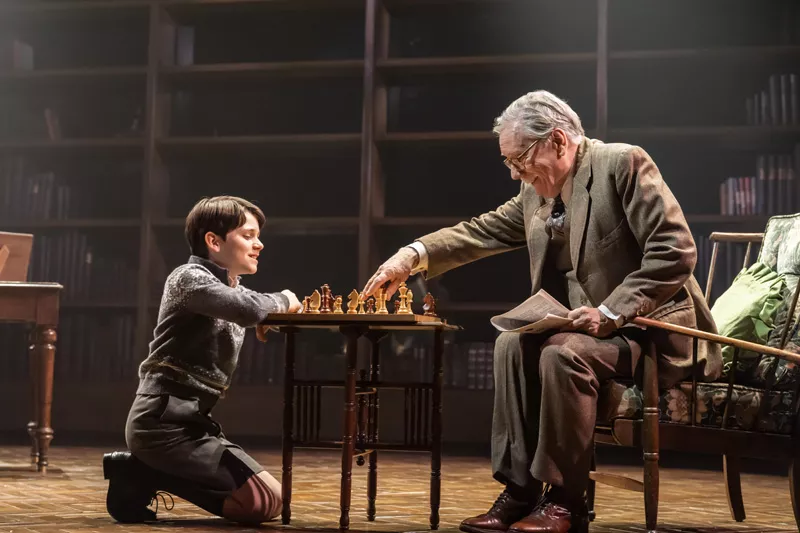
Ayrton English and Jeff Rawle.
Photo credit: Johan Persson.
In a bravura performance which invites tears both of laughter and sorrow, her Joy is witty, combative, and emotionally literate. She does not arrive to be rescued. She arrives to challenge, to speak poetry, to follow her heart. When she speaks of love as a risk rather than a reward, Siff makes it sound like a manifesto. Her chemistry with Bonneville is intelligent rather than decorative, a meeting of minds that gradually, dangerously, becomes something more.
There is invaluable support from Jeff Rawle as elder brother Warren “Warnie” Lewis. Operating beneath an avalanche of a white moustache, Rawle finds the gentle comedy in Warnie’s bewilderment and helplessness at his sibling’s unravelling but Kavanaugh never lets him become mere comic relief. He is the emotional barometer of the household, sensing the shift in Lewis long before Lewis will name it. Rawle’s performance is beautifully judged, warm without sentimentality.
Similarly noteworthy is Timothy Watson as Professor Christopher Riley, whose crisp interplay with Bonneville and Siff lends the academic debates an unexpected lightness. Watson’s Riley can be both sceptic and straight man, and he does it without denting the play’s emotional stakes. There is an essential wit to his sparky performance that makes the intellectual jousting feel vital rather than merely expository.
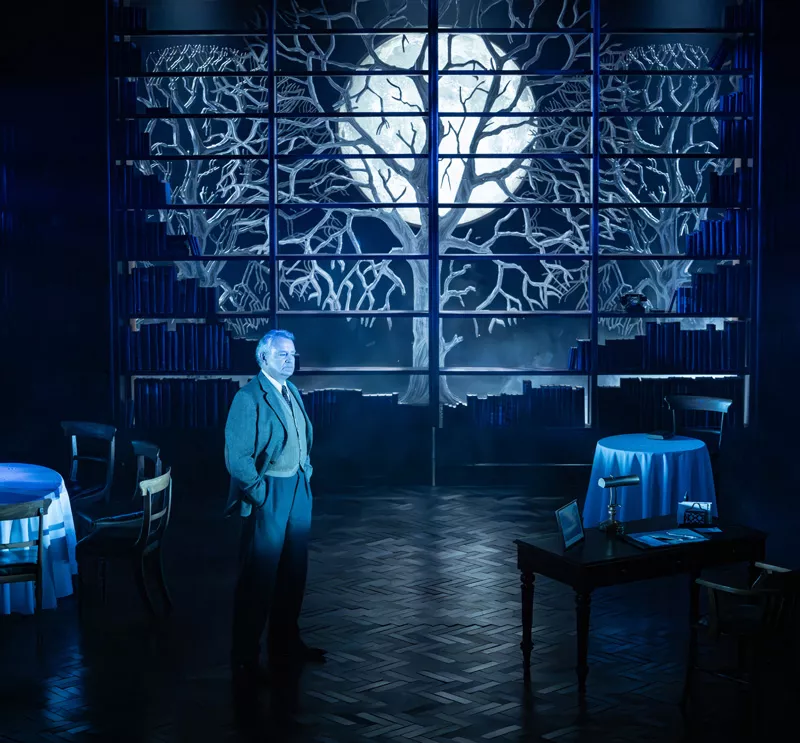
Kavanaugh’s staging, with its ordered Oxford interiors (designer Peter McKintosh) and autumnal light, mirrors Lewis’s internal architecture: neat, rational, carefully shelved. As illness intrudes, that order begins to feel fragile. Apart from some clunky dialogue, the production wisely avoids melodrama. Instead, it allows Nicholson’s central provocation to do its work. “Pain is God’s megaphone,” Lewis famously argued. Here, we see what happens when the megaphone is turned on him.
Six years on from Chichester, this transfer has not lost its emotional power. If anything, this casting has amplified it. This is a revival that understands that Shadowlands is not about tidy faith but about the mess love makes of certainty, and the unpredictable catastrophes that make that mess profoundly, piercingly human.