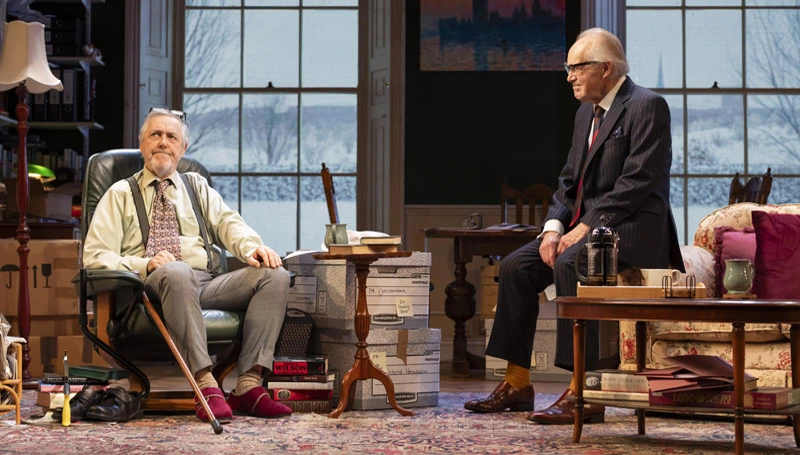
“I’m Sorry, Prime Minister” at the Apollo Theatre
Franco Milazzo in the West End
★★★☆☆
13 February 2026
There is something faintly heroic about dragging a once-surgical satire blinking into the bright lights of 2026 and asking it to comment on the modern world. Heroic, and faintly unhinged. After its respectable provincial victory lap at the Barn Theatre in Cirencester, via Bath and Cambridge, I’m Sorry, Prime Minister has pitched up at the Apollo Theatre promising a valedictory flourish for Jim Hacker and Sir Humphrey Appleby.
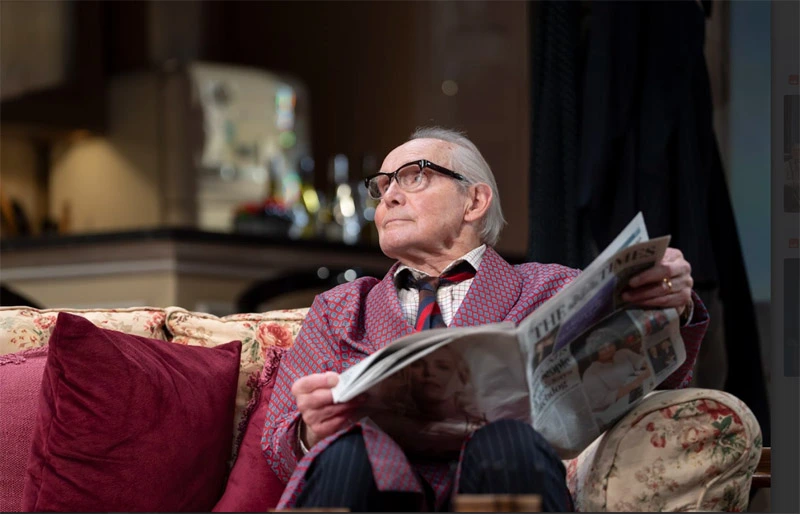
Clive Francis as Sir Humphrey Appleby.
Photo credit: Johan Persson.
Griff Rhys Jones’s Hacker is no longer merely bewildered by events and issues, he is actively affronted by them. Despite old age catching up with him physically, he is still endowed with a healthy dose of delusional self-confidence, believing he is owed respect based on his past achievements and is now bankrolled by a Russian oligarch. After some indiscreet comments, his retirement plans as Master of Hacker College, Oxford are derailed by committees, campus sensitivities, and the creeping horror of modern vocabulary.
Clive Francis plays Sir Humphrey, still capable of turning a sentence into a labyrinth with no visible exits. Francis remains the evening’s most reliable pleasure, his diction as masterfully serpentine as ever. Stephanie Levi-John brings welcome steel and pace as the modern counterweight to Hacker’s indignation, his black gay care worker Sophie, though the character is sometimes forced to embody every contemporary left-of-centre position at once; less person, more Guardian letters page.
But the targets this time feel less like institutions and more like the focus of tired screeds from a Reform Facebook group. “Woke”, Brexit, positive discrimination, trigger warnings, Black Lives Matter. The script circles them with the faint air of a butcher peering at a vegan sausage roll. Goodbye lacerating observations, hello indulgent set pieces. There are laughs, certainly, but they often come wrapped in the faint aroma of “things were better in my day” and “where did we go wrong”.
Jonathan Lynn, co-creator with Antony Jay of the original television juggernaut and of the 2010 stage spin-off Yes, Prime Minister, directs his own script with visible affection. That affection is both asset and Achilles heel. The play wants to defend its old friends rather than dissect them. Where once the machinery of government was skewered with exquisite precision, now we get genial grumbling about modern mores. The satire has softened; the targets are younger, louder, and less inclined to write thank-you notes. There are some fun Easter eggs for the uberfans – at one point, Rhys Jones’ Hacker mocks Sophie’s English degree from Oxford and their career prospects; in real life, the actor studied English at Cambridge – but that’s not enough to make up for the more obvious failings here.
There is also the structural problem that plagues so many late-20th-century sitcoms reborn for the stage like the recent Men Behaving Badly and the musical version of Only Fools and Horses. Thirty minutes of tightly wound television farce can be a thing of beauty. Stretch it to two hours plus interval ice cream and the air begins to leak out of the tyres. What was once the slice and stab of a scalpel becomes the sawing of a bread knife. Scenes repeat their comic thesis. Exchanges elongate and you start to admire the stamina more than the joke. Even Sir Humphrey might struggle to draft a memo explaining why we are still here.
And then there is that ending. Marketed as the final chapter, a graceful curtain call for two titans of bureaucratic buck-passing, the closing scene instead winks at the possibility of yet another outing. Another committee. Another crisis. Another encore. In a democracy, politicians are supposed to sense when their time is up. Hacker and Humphrey, it seems, consider themselves constitutional exceptions. The joke may be on us.
Yet, even if the original premise has run its course, there is a perverse pleasure in watching these relics of a different political era spar once more. What has remained intact from the eighties is the rhythms, the cadences, the sheer luxuriance of Humphrey-speak. Nostalgia is a powerful drug, and this production dispenses it generously.
Whether that is enough in 2026 is another question. As a eulogy for British political satire, it feels oddly unfinished. As a state-of-the-nation address, it feels like it was forwarded from a chain email. As theatre, it is intermittently diverting, handsomely staged, and anchored by two consummate professionals.
But if – as the title suggests – this play is some kind of apology, it is one delivered with the quiet confidence of two men (and their creator) who have no intention of actually leaving the building.