“When Prophecy Fails” at Beacon Arts Centre, Greenock
Mark Brown in Inverclyde
★★★★☆
26 October 2026
Humanity has been plagued by doomsday prophecies almost since the beginning of recorded time (an Assyrian prophecy, preserved on a clay tablet, dates back to 2800-2500 BCE). One of the stranger modern prophecies, led by self-described housewife Dorothy Martin (aka Marian Keech), came in the United States in 1954.

Photo credit: Mihaela Bodlovic.
Calling themselves The Seekers, the Keech cult believed that the end times were upon humanity (in the shape of a second global flood), and that the faithful would be rescued by an extra-terrestrial redeemer in a spacecraft. When the apocalypse failed to materialize, they proclaimed that their faith had saved the world from catastrophe.
Based in suburban Illinois, The Seekers represented a curious combination of Abrahamic theology and twentieth-century science fiction. As such they attracted the attention of American researchers Leon Festinger, Henry Riecken and Stanley Schachter, who published a social and psychological study of the group (titled When Prophecy Fails) in 1956.
That study forms the basis for this fascinating work of visual and physical theatre by Glasgow-based theatre company Groupwork. As the company’s name suggests, the production – which is co-written by brothers Finn and Lewis den Hertog, and co-directed by Finn and (the show’s choreographer) Vicki Manderson – carries the hallmarks of collaborative creation.
There is virtually no speech on stage. Instead we hear – and see in surtitles – recorded speech drawn from the Festinger, Riecken, Schachter study.
There is testimony from Keech and her followers, and increasingly concerned comments by family, friends and community members. There are also observations by the researchers themselves.
The recorded testimony is illustrated, on a large screen on the back wall of the set, by projections designed by Lewis den Hertog. Presented mainly in 1950s TV-style monochrome, these still and moving images (of the eternal night sky, period sci-fi flying saucers, and much else besides) combine brilliantly with the recorded speech, stage design and live performance to express the multitude of factors that coalesced in the Keech cult.
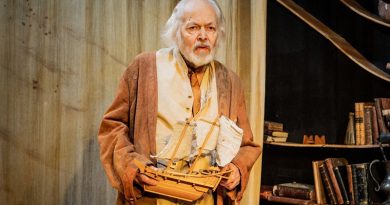
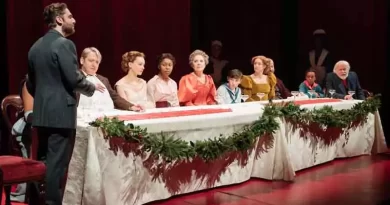
Performed by an excellent, five-strong ensemble, the piece boasts evocative design, in the shape of 1950s American clothing, furnishings and objects (including the researchers’ reel-to-reel tape recorders). The set is created on the Brechtian principle of “narrative realism”, in that it uses assiduously realistic design elements, but only when they are required to tell the story.
Otherwise, the stage is clear for Manderson’s choreography, which succeeds remarkably in representing very distinct elements of the story, ranging from Keech, alone at home, becoming convinced that she has become the instrument of an inter-planetary messiah, to the tragicomedy of The Seekers in the moment when their prophet’s prediction fails to come true.
Add to this carefully considered music and sound (curated and designed by the abundantly talented Lewis den Hertog) that is woven intelligently through the recorded testimony. The use, early in the piece, of music by Olivier Messiaen (the French composer who was fascinated by the mysteries of time, space and faith), is typical of a clever soundtrack that (with its employment of Christian hymns and atmospheric sound) is integrated beautifully into the production.
One is struck by the originality and the boldness of this stage work. It takes a considerable amount of confidence to allow recorded testimony from what is – in essence – a piece of sociological research to do the heavy lifting in the telling of a story.
Everything else in this excellent piece – from the choreography to the design and the soundtrack – is put, ingeniously, at the service of the sociological narrative. It is a brave artistic gamble and one that, unlike Keech’s prophecy, definitely pays off.
At Tron Theatre, Glasgow, 4-6 February, 2027: groupworktheatre.com