“The Moth” at Finborough Theatre
David Wootton in West London
★★★★☆
5 November 2026
On entering the small auditorium of the Finborough Theatre, one is confronted by a pair of banners framing a screen. Both the banners and the screen show an image of a man accompanied by his name, John Josana, and one further word, “Confessional”. However, it is only by the end of the performance that one begins to understand that these are the trappings of a live event. In this event, the journalist, Josana, known for his Guardian column, “Confessional”, reviews the incident that gave rise to the article that made his name, and which has haunted him ever since. That article described a long, uncomfortable meeting on a British train in 1997 between Josana and Marius Muller, both born in South Africa, one Black and the other white.

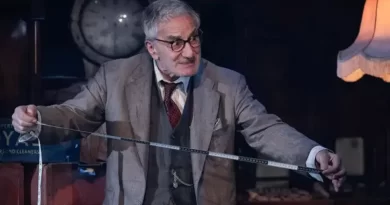
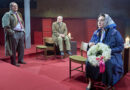
Micky Cochrane and Faz Singhateh.
Photo credit: Victoria Wai.
That meeting lies at the heart of Paul Herzberg’s play, The Moth, which premiered last year on a tour of the north of England, and now comes to London in the same production by the Elysium Theatre Company with able direction by Jake Murray. The Moth is the fourth play in which Herzberg has explored, in part, his South African military experience. It developed out of a short monologue that he based on the anecdote of a veteran of the Angolan War, and which gained great success when it was filmed as one of Elysium’s “Covid-19 Monologues”.
Despite its development into a two-hour play, The Moth remains taut and punchy, as a result of a tight structure, strong writing and powerful performances from its two actors. It is ambitious in the extent to which it surveys a complex political landscape, and impressive in the way that it reshapes that landscape, shuttling back and forth across past and present, and using a combination of monologue and dialogue to examine the lives of its protagonists and their parents.
The narrative approach is supported by an economical design, which makes the most of the function of the screen on the set’s back wall in showing both still and moving images that anchor the action in each time and place. (The set is designed by Amelia Mitchell and the sound and music composed by Paul C Clark, while together they are responsible for the video and film. The lighting designer is Simon Cole.)
Before they are shown to meet, Josana and Muller are introduced independently. Stylishly dressed in a black suit and polo neck, Faz Singhateh’s Josana speaks directly to the audience, and signals that his subject is racism. His experience is epitomised by an anecdote about his appearance at the London Press Awards of 2002 in which a white woman patronises him as the only person of colour to win an award. He takes her to task, explaining that “race” is a “system that keeps the privileged in power”, but he is clearly shaken, comparing her behaviour to that of the Balham skinheads who used to beat him up during his teens. His perception of such prejudice had been fine-tuned by his father who fled with him from Apartheid South Africa to East Germany in 1976, soon after he was born.
In stepping forward to take Josana’s place, Micky Cochrane’s Muller appears as a distinctive and contrasting figure, with his full beard and strongly patterned shirt. Preparing the way for their meeting, he talks, in an Afrikaans accent, about the impact of war on memory. Having suffered physical abuse from his father, he was conscripted into the South African army in the late 80s, at the age of 18. He then served in the Angolan War, the largest-scale conflict in Africa since the North African Campaign of the Second World War , yet one that was little reported. While he maintained a love of his country, he had no idea why he was fighting.
Josana and Muller are convincingly complex characters, and Singhateh and Cochrane do much to articulate those complexities, so revealing the deep-set vulnerabilities of both. Outwardly, Josana seems the more substantial, having graduated from Cambridge to become a successful journalist, with a loving wife, healthy children and a comfortable home in Hampstead. And, though a Black South African by birth, his personal experience has been that of a European. It is the white man, Muller, who has grown up as an African, and who has been directly affected by the operation of the Apartheid regime. The damage to his mental health has led to years of therapy, though the opportunity to speak to Josana may prove more cathartic.
Act One centres on the first meeting, a dialogue punctuated by further monologues. Muller joins Josana at a table in the carriage of a train heading from Scotland to King’s Cross, the screen behind them acting as a window that reveals a monochrome moving image of the landscape through which they travel. There is an awkward atmosphere as Muller tries to engage Josana in conversation and Josana initially resists (“I am not a chatterer”). However, he eventually starts to talk, though he tends to do so in more general and theoretical terms, while Muller focuses on the particular. They find some surprising areas of common ground, but these only sharpen their differences. For instance, their fathers both lived in Germany, but one as a Nazi in the Second World War and the other as a refugee from Apartheid.
The act ends with a shocking revelation from Muller about his military service, during which he describes the soul leaving a body like “the wings” of a moth “fluttering over my head”. Act Two then tracks his craving for absolution and the degree to which Josana is willing, or even able, to satisfy it.
The play has been described as a political thriller, and it certainly grips. In the references to Alfred Hitchcock and specifically his 1951 film, Strangers on a Train, there is the danger of trivialising deeply serious issues that have traumatised a nation and remain painfully relevant. However, the use of the film’s phrase “criss cross” to suggest the ways that two men can take on each other’s burden is sensitively explored.
For much of its action, the play emphasizes the relationships between the two men and their fathers, thus tracing the political connections between the present and the past. But gradually their absent mothers become more prominent, and, through Muller’s intervention, Josana’s mother is even given her voice (in a recording of Adjoa Andoh reading a letter). Thus, the motif of swapping takes on a new significance and offers the possibility of healing, however fragile – fragile like the wings of a moth.