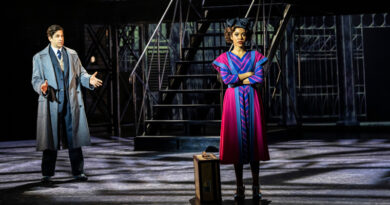
“The Lives of Others” at the Adelphi Theatre
Jane Edwardes in the West End
★★★★★
2 November 2026
The record for turning films into plays is decidedly spotty, with more failures than successes. Fidelity in this case is not a virtue. It’s necessary to respect the original but not to cringe before it and, above all, to make the material one’s own. That makes Robert Icke the ideal director for this theatrical version of The Lives of Others, Florian Henckel von Donnersmarck’s film about the intense surveillance that went on in the German Democratic Republic between the founding of the Ministry for State Security (the Stasi) in 1950 and the fall of the Berlin Wall in 1989. I saw the award-winning film when it first came out and found it deeply affecting, but I came to the theatre for the play, not to focus on whatever changes Icke had made.

Keira Knightley and Luke Thompson.
Photo credit: Pamela Raith.
Brechtian in feel, Icke’s production makes it clear that we are in a theatre, witnesses to what is happening on stage. We are not, as Brecht once said, to hang up our brains with our hats in the cloakroom. Are we ready to be an audience, we are asked at the beginning. There are dismissive jokes about theatre throughout as if to remind us where we are.
The setting is the artistic milieu of East Berlin in 1984. Playwright Georg Dreyman (Luke Thompson) is celebrating the opening of his new play at the first night party. Dreyman is supportive of the government and feels that he is secure, but regrets that his one-time director Jerska has lost his job and is under suspicion of treachery. A playwright can carry on writing, but a director is lost without actors. Dreyman forlornly appeals to the Minister of Culture, Andrew Woodall’s odious Hempf, on Jerska’s behalf. Instead, Hempf, who has the hots for Dreyman’s girlfriend, the celebrated actress Christa-Maria Sieland (Keira Knightley), orders that Dreyman’s apartment be bugged in the hope of implicating the playwright in subversive activities.
Icke brilliantly creates an atmosphere of fear and suspicion as Stephen Dillane’s Wiesler, renowned for viciously breaking down potential suspects, sets up his recording equipment above Dreyman’s apartment, which has been thoroughly bugged. The sound crackles whenever he puts on his headphones. Instead of staying in the attic (as in the film), Wiesler becomes a ghost-like figure who wanders into the flat and sometimes stands intrusively between Dreyman and Sieland when they are having the most personal of conversations. Wiesler begins the play as a true believer in the socialist state, although unimpressed by the fact that his task is designed to help his boss, Paul Higgins’s Grubitz, to ingratiate himself with Hempf.

Stephen Dillane.
Photo credit: Manuel Harlan.
If anybody thinks this is a theatrical version of Celebrity Traitors, they couldn’t be more mistaken. The stakes are all too high as Hempf’s demands on Sieland become increasingly cruel and hard to fulfil without arousing Dreyman’s suspicions. Keira Knightley’s angular beauty seems perfectly suited to portraying the fearful Sieland who is gradually cracking under the pressure. She can never relax, terrified of Hempf and afraid for Dreyman. Luke Thompson is also excellent as Dreyman, naively convinced that his apartment isn’t bugged, but gradually becoming braver as reality closes in. It’s a world where hard choices must be made between fear and the desire to protect those close to you, against the horrible cost of taking a stand.
Stephen Dillane is superb as Wiesler. He depicts a man who is forced to question his life’s work. There is a quote from Lenin about the power of music to make people become softer and kinder, and we see that in Wiesler as he begins increasingly to care about Dreyman and Sieland and is moved by the music they play. He even intervenes in their lives. The fear of turning the film into a play is that the intensity of Wiesler’s expressions will be lost, but not a bit of it, not just because of the use of video, but also because Dillane makes you feel the gradual thawing of Wiesler’s soul.
Icke has put together an outstanding production team who support his work all the way. Hildegard Bechtler’s design is noteworthy for the austerity of the black flats that slide back and forth, and for a revolving stage which adds to the sense that the state can probe into every aspect of one’s life. It would be wrong to dismiss such surveillance as being a thing of the past. Her costumes are also excellent from the fact that Wiesler’s coat is too small for him, to the attempts of the artists to stand out from the crowd. Giles Thomas’s sound design brilliantly shifts from the classical music in Dreyman’s apartment to the crackle of the sound waves, to the insistent sound of Max Richter’s music.
The Adelphi Theatre is huge and more often home to musicals than plays. Fortunately, Keira Knightley, Stephen Dillane and Luke Thompson all appeal to different constituencies and with luck between them they will draw in large audiences to see this remarkable piece of work. Given our uncertain times, not least the rise of the AfD in Germany, it feels even more important than ever that we should understand the past.