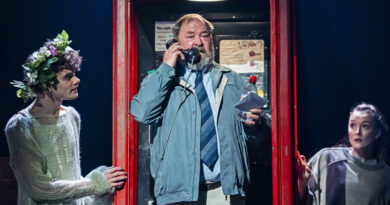
“The Gang of Three”, Richmond Theatre
Jeremy Malies in South-West London
★★★☆☆
19 October 2026
Dramatic partnership Robert Khan and Tom Salinsky focus on political projects that sit between verbatim theatre and fictionalized writing. Their subjects (to date involving the Cameron and Johnson years) have included the Coalition government after the UK general election of 2010 and Brexit. Their latest play The Gang of Three (first seen at the King’s Head Theatre last year and now on tour) is less satirical, with the focus on relationships between big beasts of the political jungle who were clear-sighted about the main chance but retained core integrity.

Hywel Morgan as Roy Jenkins.
Photo credit: Manuel Harlan.
After a projected montage of tabloid headlines, the voice of a newscaster informs us that a million people are out of work. A placard indicates that the year is 1972. Labour politician Roy Jenkins (played by Hywel Morgan) has just resigned as Deputy Leader. He is fiercely pro-Europe – at the time the organization was the European Economic Community (EEC) – and wants his party to agree to membership if they gain power. More senior leaders will only commit to consulting the country via a referendum.
Jenkins is in his Ladbroke Grove study and serving claret (cue signature jokes of the time about wine lakes) for louche, rackety Tony Crosland played by Alan Cox. (Crosland has the minor shadow portfolio of Environment, and both are reporting to Harold Wilson.)
All of the acting is first-rate with Morgan hinting at but not overdoing his character’s rhotic speech trait. You can sense director Kirsty Patrick Ward calibrating matters precisely here. The performance of the night is from Colin Tierney as Denis Healey. It is closely observed character acting that mirrors known mannerisms without smacking of plain impersonation.
As with their other pieces, the writers’ method has characters break the fourth wall frequently to make confidences to us, with Jenkins being the most confessional. “One is never lonely when drunk.”
Why did this play not speak to me more? It struck me as smacking of inside baseball, notably when, in a scene set early in 1977, Healey and Crosland tease Jenkins about his ongoing work as President of the European Commission. You would have to be steeped in the period to even get the gist which perhaps I am. As a child in 1975, I watched my pro-Europe (he would still have hated Roy Jenkins) father gently mock a Europe sceptic in the run-up to the referendum of that year as they put up rival posters in our village. Thirty years later, a few miles along the Sussex coast, I would interview Denis Healey (by then a life peer) on two occasions.

Hywel Morgan and Alan Cox.
Photo credit: Manuel Harlan.
Tierney captures the flavour of the man, and I enjoyed the true if chestnut anecdotes such as Healey stepping away from his lectern at Leyton Town Hall to lamp a skinhead Far Right activist who had invaded the stage at a conference. But the gags elsewhere are often feeble. Would a trio of Oxford graduates really cackle over the suggestion that “Foot and Benn” sounds like a farmyard disease? And there are careless anachronisms. Khan and Salinsky might like to note that at the time, a defibrillator would have been barely liftable by a single person and would run on a car battery. And it would not have been the subject of wisecracks by non-medics.
Cultural content can be similarly clunky. Crosland makes a reference to Ziggy Stardust and the Spiders from Mars only for Jenkins to say that he does not watch Doctor Who. Better gags include Healey telling Crosland, “If you want to know if MI5 are bugging you, stop paying the telephone bill. They won’t cut you off!”
The play is at its strongest when it deals with no fewer than four election processes within the Labour Party (including when all three men stood for the leadership in 1976) and the dangers of tactical voting. The writing (it would be fair to say that the authors are politics junkies) proves skilful as it catapults us forward subliminally to more recent manipulation of early rounds of voting with catastrophic backfiring. Many will have thought of Michael Portillo in 2001 and James Cleverly in 2024. Crosland tells us, “Members of Parliament form the most duplicitous electorate in the whole world.” I hope a few ambitious political grandees see the play and absorb the lesson that you need co-ordination for this sort of thing in a single elimination ballot. Or maybe they could just do things in a straightforward manner and take their chances!
This is a touring production that must adapt to quite a few configurations. Designed by Libby Watson, the set has a massive bookcase that serves for the homes of Jenkins and Crosland. Sadly we cannot make out any of the books that might interest these three indisputably brilliant men. All were born between 1917 and 1920, and all were educated at Oxford. A gang indeed, and one whose inherent baseline of decency meant they never truly turned on each other.
Towards the end, the time scheme winds back decades to 1940 and Jenkins’s rooms at Balliol. He has just lost a narrow vote (this play is all about narrow votes) for the presidency of the Oxford Union to the future Sir Robin Edmonds. Edmonds fought with distinction in North Africa and would prove a successful Cold War diplomat. If it is of any consolation to Jenkins’s shade, I doubt if anybody will be writing a play featuring Edmonds any time soon. Jenkins also features in the play Limehouse by Steve Waters.
The Oxford scene is noteworthy (the men are largely reflecting on events a short time earlier during the term) in making the claim that Crosland and Jenkins were lovers. The writing becomes particularly clumsy here and I would nominate it for a theatre equivalent of the now defunct Bad Sex in Fiction Award. More importantly, it sticks in my craw that the play’s authors have interviewed contemporaries of the politicians and used that material forensically but gone against advice from the interviewees on this matter. The consensus is that any allegations of an undergraduate romance are untrue. There is of course a source, this being the 2014 biography of Jenkins by John Campbell. But Campbell includes the assertions with the rather feeble source citation of “private information”.
The script is strong when conjuring up unseen but significant presences such as the daughter of a Lincolnshire grocer who became leader of the Conservative Party in 1975. Michael Foot seems to have almost entered the room when he is described as “like an eccentric vicar with a speech impediment”.
Between them these men abolished theatre censorship (part of Jenkins’s liberalizing of social legislation as Home Secretary under Wilson), partially legalized homosexual acts (Jenkins again when ensuring that a bill by Leo Abse received adequate time), and oversaw the creation of the polytechnics (Crosland when Education Secretary in the mid-sixties). There is also the small matter of keeping Britain out of the Vietnam War (Healey as Defence Secretary for much of the sixties). This play is often witty and thought-provoking. It has real insight but often misses the mark in what is a huge arena and high-stakes undertaking.