“The Ford-Hill Project” at Long Wharf Theatre
Robert Schneider in New Haven, Connecticut
★★★★★
7 October 2026
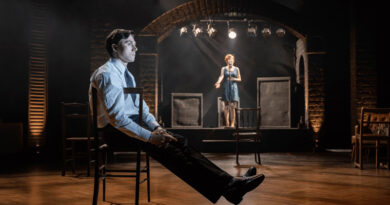
Nine chairs in a semi-ellipse on an empty stage; we know right away what they represent. Who sits in nine special seats in Washington has always been important. The Trump administration has reminded the present generation just how much power the Supreme Court wields over our everyday lives.
I am of an age to remember television coverage of the Clarence Thomas confirmation hearings before the Senate Judiciary Committee in 1991. I remember Anita Hill recounting the nominee’s persistent harassment of her, describing in a measured way incidents whose oddness and specificity convinced me instantly that she wasn’t making any of it up. I remember how the committee chair bent over backwards to be fair to Thomas, all the time thinking what he might do to keep this despicable man off the Court. The Chairman was a Democratic senator from Delaware: Joe Biden.
The hearings were gripping to the same degree that the O.J. Simpson trial would be unlettable-go-of four years later. I remember thinking on both occasions what a challenge it would be for the theatre to match them for intensity, for detail, for the grinding of remorseless fact … and this was my opinion despite long sections of both proceedings that I recognized as extraneous, inessential, as lengthy parenthesises. Yet all of it was compelling. Even the Republican senators’ rehashing of Thomas’s judicial merits, even the endless DNA testimony at the Simpson trial, it all played a role in discovering the event. It was all so real.
But the Clarence Thomas proceedings took days, the Simpson trial weeks, durations the theatre could never support.
The Ford-Hill Project at the Long Wharf seeks to distil the Thomas/Hill confrontation to a mere 60 minutes of stage time. What’s more, it revisits and sets in parallel the Brett Kavanaugh confirmation hearing of 2018, a hearing that heard Christine Blasey Ford allege experience of sexual assault at the hands of Kavanaugh and his friends when all of them were teenagers.
Curiously, setting the two controversial nominations side by side makes the play’s coverage of each seem more complete and concise. It’s the same thing twice, but told this way, it’s all one story. The authors, Elizabeth Marvel and Lee Sunday Evans, have braided the hearing transcripts together in parallel strands, intercut them and stretched it all taunt. We get key moments in the testimony from both cases. It doesn’t feel rushed. It feels definitive.
We hear the chairman stumble over a simple invitation to the witness to introduce her family members, his formal language dissolving into a repetitive drone. We hear Hill recount the curious tale of Thomas asking (while drinking a soft drink), “Who has put pubic hair on my Coke?” We hear Thomas declare that he’s the victim of “a high-tech lynching.” We hear Ford apologise for not knowing exactly who was present when she was assaulted while insisting that Kavanaugh was her principal assailant. We hear Kavanaugh repeat several times that he liked to drink beer—still likes it—as if that somehow explains everything. He says he worked hard in school; he “busted his ass” to get into Yale College and then Yale Law School as if this were somehow exculpatory. Kavanaugh says he treated many women well—just ask them.
Both judges swear there’s no truth to the accusations against them. Both referred to their televised hearings as “a national disgrace.” Thomas’ denial seems the less credible because it’s more absolute. But it did the trick. Kavanaugh denied the facts, but implicitly blamed youth and alcohol. Both men were confirmed.
More than anything else, setting the two cases side-by-side shows how little we learned in the 27 years that separate them. With Trump and the #MeToo era how much have we learned since?
There are only four actors on the stage: Mayaa Boateng plays Anita Hill; Christina Kirk as Christine Blasey Ford; Amara James Aja as Clarence Thomas; Roderick Hill as Brett Kavanaugh. But all four actors have a go at playing the interrogating senators (with Boateng shining as a Southern Republican in a towering rage over the treatment of Kavanaugh, “this fine individual…”) The stage is sparse on actors but crowded with personalities. Occasionally, we hear recorded voices from the actual hearings. If you have two and a half hours to spare, you can find many of them here: https://www.c-span.org/program/senate-committee/thomas-confirmation-hearing-day-1-part-1/15198
This is a work of theatre, not a recitation. At one point Hill and Ford sit side-by-side and question each other on their feelings during their respective turns in front of the committee. The conversation throbs with female solidarity, but because it’s played by male actors it also seems chummy, an amalgam of feminine and masculine behaviour that lights up from both ends of the sexual battleground.
At the end of The Ford-Hill Project, Thomas and Kavanaugh stride around those nine empty chairs before ducking into the wings to don their judicial robes. As telling as it is, this is not the final moment of play. At the very end, the two women accusers meet centre stage and say—exactly nothing. Because there’s nothing for them to say. Marvel and Evans wisely refuse to fish for a curtain line that neither history nor politics can provide.
The adaptors and the entire team (Lee Sunday Evans also directed) perform an admirable feat of compression: hours of testimony compacted as if by hydraulic rams. Anxious for the well-being of the audience, the Long Wharf also provides a decompression space in the same building. Here, licensed mental health professionals are available to carefully undo the work of the play next door. They’ve come with a panoply of decompression tools: incense, crayons, colouring books, plastic blocks and simple musical instruments.
Can works of theatre trigger temporary psychosis? The notion seems romantic and more than a bit far-fetched, but with The Ford/Hill Project the Long Wharf has taken Antonin Artaud at his word. The theatre, Artaud wrote in 1938, “invites the mind to share a delirium which exalts its energies… impelling men to see themselves as they are… It causes the mask to fall, reveals the lie, the slackness, the baseness, the hypocrisy of our world.”
There’s no question that The Ford/Hill Project creates a sort of delirium. Audiences will find themselves compressed with anger. Whether they should decompress immediately or stay angry and go to the polls is an open question.