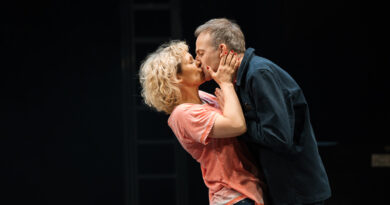
“Pride and Prejudice, Part 2: Napoleon at Pemberley”, Westport Country Playhouse
Robert Schneider in Connecticut
★★☆☆☆
30 October 2026
Napoleon Bonaparte was no good at talking to women. He usually contented himself with asking about the profession of their husbands and the number of their children. Even the historical Napoleon, however, could probably invent more consequential dialogue than Ken Ludwig confects for him in Pride and Prejudice, Part 2: Napoleon at Pemberley. This new comedy asks us to imagine the vanquished emperor going from Fontainebleau to Elba by an extremely unlikely route: through Derbyshire. While the British prepare a ship to carry him to the Mediterranean, Elizabeth Bennet, the witty protagonist of Jane Austen’s novel, volunteers to lodge him incognito for week or so. A newly-wed, she and her husband, Mr. Darcy, are already a bit bored.

Photo credit: Carol Rosegg.
For all its improbability, the premise of the play is the best thing about it. A mashup of geopolitical fact and romantic fiction, it’s vastly more diverting than the play Mr. Ludwig manages to craft from it. Emmanuel de Las Cases and Armand de Caulaincourt recorded all of Napoleon’s table-and-salon talk; we know a great deal about his manners and sensibility. Bennet is one of Austen’s most vivid characters and diametrically opposed to the Corsican Ogre in nearly every way. So, if subjected to each other’s company for a week, what would they talk about? Could Bennet convince the emperor that a thrust at matrimony can be planned as remorselessly as a military campaign? Would Napoleon show his hostess the advantage of striking first and striking hard, keeping momentum and never dividing her forces before an engagement? Plunging into the no-man’s-land between these formidable personalities would be a brave undertaking. Unfortunately, the playwright prefers to ignore their differences entirely. He treats Napoleon like a raw recruit conscripted unceremoniously into Austen’s novel. He gives the emperor perfect English and a fondness for Byron and Coleridge. They end up in the drawing room talking about literature.
Bonaparte manages to strike a few sparks off other Austen characters who have come to visit, notably Lady Catherine (an amusing Kristine Nielsen) and Mr. Collins (played by Carson Elrod). Mr. Elrod is genuinely funny in the role and doubles as Major Hudson Lowe, destined to become Napoleon’s jailer after his second abdication.
Mostly, however, people mill about the stage hoping that something will happen that might reveal a bit of depth in their characters. There is talk of a ball. There is talk of a duel. There is talk of Napoleon escaping Pemberley and returning to Paris. There is even talk of an engagement between Anne de Bourgh (Allison Wick) and Lieutenant Melville (Mathias Goldstein), Napoleon’s American (American?) aide de camp, a character with no credibility even as a plot device. There is a great deal of exposition, some anachronistic declaration and a bit of flirting. At one point, Bonaparte teaches Elizabeth’s sister (Lucy Austin) the waltz. Napoleon harangues Elizabeth into becoming a new sort of woman who can change the world.

Photo credit: Carol Rosegg.
When we learn that Josephine, the Emperor’s ex, is deathly ill and has come to Coventry (Coventry?) to seek medical care, Elizabeth rises to the occasion. She volunteers to ride to Coventry and fetch Josephine back in a carriage. When Josephine has a relapse, the emperor slips out and takes her to a local doctor. (Why didn’t he go to Coventry himself?) Having entrusted the love of his life to Regency rural medical care, Napoleon then slips back into the very house from which he had been planning to escape earlier.
As historical fiction, Napoleon at Pemberley is nonsense from the get-go. As the incongruities accumulate, however, Mr. Ludwig’s work fails to even make sense on its own terms. It harkens back to a former period of American playwriting when audiences knew less about the world and were willing to give authors the benefit of the doubt. A century ago, we had the magic what if…? Now we have Wikipedia.
How does it end? Josephine goes back to Malmaison, Napoleon goes to Elba, Elizabeth decides to stand for parliament (in 1813?). She has also started a novel. To nobody’s surprise, the novel turns out to be Pride and Prejudice.
As Elizabeth, Delphi Borich has all of the character’s cuteness and none of her steel. Reg Rogers soldiers bravely on with Napoleon. After this, St. Helena will be a treat. Emily Mann directed.
Beowulf Boritt designed a circular room a bit like a Wedgwood punch bowl. While attractive, it’s equally unsuitable as a drawing room, ballroom, music room, sickroom and private study. Unfortunately, Ludwig forces it to be each of the above in turn with his characters resorting to clunky pretexts to get themselves on or off stage: “I was just leaving.”/”As was I.”
Jennifer von Mayrhauser’s costumes are lovely but don’t manage to save the situation.
Let me add, as a sort of appendix to this review, that the historical Napoleon had a choice to make after his second abdication: he could have slipped through the British blockade and made his way to Louisiana, claiming back that territory back from the Americans to whom he had sold it ten years earlier. To pull it off, he would have had to disguise himself—or perhaps hide in a barrel—which he considered beneath his dignity. But wouldn’t it be fun to watch him re-negotiate the Louisiana Purchase with Thomas Jefferson?
Instead, he surrendered to the British with the expectation that they would confine him to house arrest in a cute little mansion outside of London where he could still receive visitors—Jane Austen among them. He never dreamed they would be so ungentlemanly as to confine him on a wind-swept island in the South Atlantic.
These alternate endings are still available to any playwright or novelist who wants them. All that is needed is to slide open a door that circumstances slid shut. Put a note in the programme; make a single leap and let an authentic Bonaparte take it from there. There is no reason for playwrights to cram historical characters into novels where they are not needed. Give them a break! Let them roam free!