“Present Laughter” at Richmond Theatre
Jeremy Malies in South-West London
★★★☆☆
26 September 2026
“I don’t know what London’s coming to – the higher the buildings the lower the morals.” Noël Coward had a character say this in his 1928 sketch “Law and Order”. Having divided much of his time between London and New York – particularly in the 1930s – he would probably have been intrigued by the premise of Tracy-Ann Oberman’s radical adaptation of his 1942 play Present Laughter.

Photo credit: Simon Annand.
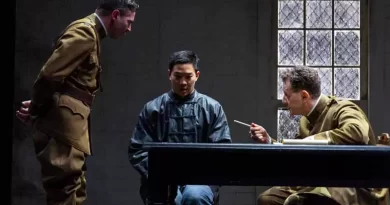
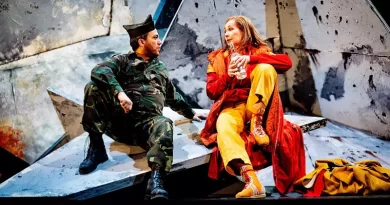
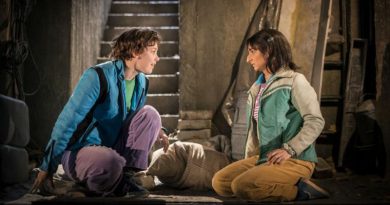
The buildings (we see the Manhattan skyline from apartment windows) are certainly high and the morals could not be much lower as Lindsay Posner directs Oberman’s version which is set in a New York loft apartment in 1977 among the hedonistic vibes characterized by the opening of Studio 54 that year. Indeed, one of the characters here, Fred played by Theo Burns, is a doorman at the club.
Oberman has also gender-flipped six characters and taken on Coward’s own central figure, the somewhat faded, sardonic leading actor Garry Essendine. The changed genders create a teasing sense of sexual ambivalence which is well calibrated by Posner.
Garry becomes Geri and there is immediate impact from Peter McKintosh’s design with an evocative safety curtain of newspaper cuttings. The articles show us how Geri has been hailed as something between Joan Collins and Farrah Fawcett by major news outlets. She is pictured with everybody from Princess Margaret to Andy Warhol whose influence permeates the set with hand-cut stencil pictures of Geri in high-contrast Pop colours.
Casting a woman of any kind as being sexually voracious (and unapologetically so) would have been a problem in the forties but it works in this seventies environment. All of the native city dwellers are avant-garde. They are contrasted with Geri’s urbane ex-husband Len, played by Adrian Lukis. Len is still involved (no doubt unwillingly) in his ex’s business affairs, knows when to deflate her self-dramatizing behaviour, and oozes a Jeffrey Bernard charisma in a succession of Savile Row suits. His equal in waspishness, mock world-weariness, and timing is Monty, Geri’s secretary played by The Thin Blue Line star James Dreyfus.
Another success across two erotically charged scenes (one straight, one gay) is Kit Young as sexual athlete Johannes who proves credible when seducing Geri. The stakes between him and Geri rise in the second act. Geri’s first conquest (all these men mysteriously forget their front-door keys and end up staying over) is youthful star-struck David played by Seb Carrington. He is from the right social class but not part of her network. His aunt, Lady Saltburn (played by Richenda Carey), is perhaps anachronistic, carrying a whiff of Wodehouse aunt about her but this at least underlines the character’s bemusement at the overall sexual candour. Johannes, in contrast to David, is married and a component in a house of cards that surrounds the main characters.
As the plot begins to revolve around Johannes, the piece becomes a subtle admixture of comedy of manners and farce. Oberman, Posner, and McKintosh all understand this and work together effectively. Entrances and exits speed up with many erroneous assumptions, eavesdropping or overhearing, and general lack of understanding. The production team do not lose sight of the fact that the mechanics of farce are being used in a piece whose core is a comedy of manners that satirizes the values of theatrical New York and its hangers-on.
There is one full-on comic turn that is pulled off adroitly. Coward obviously loathed progressive playwrights and skewered avant-garde, Uckfield-based, aspiring dramatist Roland Maule in the original. Here, Eva Feiler excels as Rosina Maule who must balance her exotic ideas on new directions in drama – she is trying to foist her latest play text on Geri – with her origins in unexotic Yonkers, a dour city immediately north of New York. This amuses Monty greatly.
McKintosh, who also designed the costumes, is on good form with Maule’s dowdy and yet uncoordinated woollen clothes and deliberate minor wardrobe malfunctions. Even if she proved useful as an uber-fan of Geri, Rosina would be gently turned away at the Studio 54 door.
Coward invested the original Garry with his own frustration at being compelled to continue acting even in private life and his horror at the ageing process. He might empathize with Geri’s PR blurb that has kept her at 39 for a decade.
Some of the physical humour here is less assured. I wonder if there could have been an illusion of greater spontaneity as the farce elements kick in. The production is touring and the cast should be allowed a day or so to acquire muscle memory as they move around a new playing space. One of the many merits of the set is that it is all-enveloping with the illusion of rooftop terraces and construction workers in the far distance.
Even if it does not fire on all cylinders throughout, this is a project with an understanding of Coward’s core motivations in writing such a play, a good deal of flair from the principals, and the rigour you would expect from Posner. It summons up the giddy circus of seventies New York. Oberman showed her intelligence and stagecraft when re-interpreting another beleaguered egotist, Shylock, in The Merchant of Venice 1936. I hope she continues to investigate the theme of self-absorption in other similar projects.