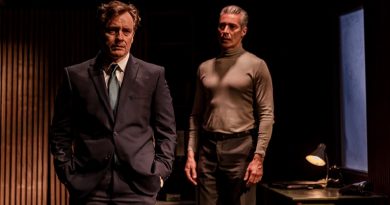
“Other Desert Cities”, Hudson Theatre, New York
Glenda Frank in Midtown Manhattan
★★★☆☆
27 October 2026
A revival of Other Desert Cities by Jon Robin Baitz opened at the Hudson Theatre on October 18. Some orchestra (main ground level) tickets are priced at over $4,000 a seat. The play premiered on January 2011 off-Broadway at the Newhouse Theatre, Lincoln Center, directed by Joe Mantello, before a Broadway transfer. Other Desert Cities is a family drama with fangs: conflicting politics, a life-changing secret, addiction, a federal terrorism charge, a social ladder that includes a few presidents, and media personalities. At its heart is a suicide, an absent character who sparks the action.

Lily Rabe and Joe Keery.
Photo credit: Emilio Madrid.
Lyman (Ed Harris) and Polly Wyeth (Julia Louis-Dreyfus) were once the ideal Hollywood couple. She was a script writer and he, a celebrated western actor – who treats us to a master class in how to die on film. His good friend Ronald Reagan appointed him an ambassador. Polly is unquestionably the matriarch, she who must be obeyed.
The setting is the living room of their home in Palm Springs, 2004. The huge Christmas tree in the living room – capped with perhaps a Jewish star – speaks of their assimilation, a compromise to “fitting in”. It’s not the only masking. They have found their niche and their country club friends mean everything to them. The title of the play refers not just to a California freeway sign but also to the war in Iraq that President George W. Bush, the son of their friend, George H. W. Bush, is pursuing.
Brooke and Trip, their children, believe that their elder brother is dead, drowned after committing a terrorist act against the country. Trip (a charismatic Joe Keery in his Broadway debut, television SAG award for Stranger Things) runs his own daily television show with celebrities. Brooke, a novelist and an addict, has struggled for seven years to complete her second book. She lives on the East Coast, as far from her parents as possible. She has returned home because she wants the family to read her new book and to prepare them for a feature article in a national magazine. Silda Grauman (Allison Janney) was once Polly’s script partner but is now in and out of rehab. Her key scene is when she sniffs some alcoholic fumes in a moment of ecstasy and longing.
Act I is prequel to the second act’s revelations. It’s filled with dozens of acting opportunities, especially for Julia Louis-Dreyfus in her Broadway debut, and she is alert to every opportunity – even what might at first seem nondescript lines – to make the audience laugh. Sometimes it’s more about delivery than content. After reading Brooke’s new work, Polly changes into almost another woman, a shift I welcomed but one that distressed my friend, a playwright. Louis-Dreyfus handled the tonal shift with awareness and technical skill.
Love takes many forms in the play, and it is always the family’s saving grace. Lyman’s deep affection for his wife is revealed when he explains how Polly managed to win back all their friends after news of his son’s involvement in a bombing. Harris is a versatile, insightful actor and the scene proves moving. Their whole world had collapsed and Polly, taking advice from Nancy Reagan, changed the trajectory. Brooke’s new book is a betrayal of her family, and Aunt Silda, angry at her sister and maybe the world, was her silent partner.
Okay. Suicide. Brooke’s golden childhood was ruined by her brother’s death, and she has lived most of her life blaming her parents. Like so many others, she never saw the family picture clearly, only snapshots of moments from a daughter/sister’s perspective. Many surviving families are torn apart by suicide, and blame is generously assigned. Some parents mourn for decades. Other family members become resentful and jealous of the lost child, who may become a parental obsession.
With a deft twist in the story, Baitz sketches out the dynamics of loss by suicide but keeps his focus on the present moment and Brooke. She must decide whether to publish her family exposé, and the parents must decide if they want to heal the rift. These choices bring a rare magnitude to the funny and poignant script.
John Benjamin Hickey won a Tony for his performance in The Normal Heart, but his direction of Other Desert Cities is disappointing. Actors who usually have the delivery equivalent of being loose limbed and an ability to give the illusion of spontaneity – I’m thinking particularly of Allison Janney – seem stiff in this production as though it were a rehearsal. There was rarely an ensemble feel although there were glimpses. Only Keery seemed totally at home in his fictional dwelling, and that is the stagecraft we all want.