“Murder in the Cathedral”, Orange Tree Theatre at Church of Saint John the Divine, Richmond
Jeremy Malies in South-West London
★★★★☆
22 October 2026
My aisle seat is next to the Third Station of the Cross in which Our Lord falls. It was created in the 1960s and is in a vibrant, non-naturalistic style. At the beginning of the century, a team of sculptors carved the Crucifixion here under the direction of Eric Gill whose own work is on the triptych. And it’s from behind this that a Greek-style female chorus (community performers of varying ability and stage presence) emerge under the direction of Tom Littler working with movement director Lizzi Kew Ross, in this site-specific production of T.S. Eliot’s verse drama Murder in the Cathedral.

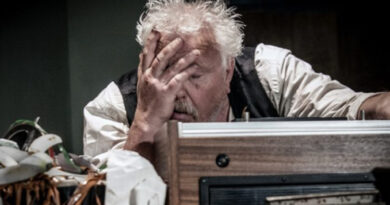
David Suchet as Thomas Becket.
Photo credit: Marc Brenner.
In grubby tunics ranging from grey to off-white, the women scamper towards the vestibule, pausing only to strike – it’s a little hackneyed – a bass drum that later serves as a cauldron when they become Macbeth-inspired witches. The chorus members are successful in suggesting that something with its own momentum over which they have no control is about to come crashing in. Their distress is going to become spiritual, psychological, and physical.
Archbishop Thomas Becket enters and seems focused on his own mortality. (He immediately describes escaping would-be assassins on the coast of Kent.) Later, David Suchet is deft in showing internal processes as his character goes through cycles of doubt, recognition, risk assessment, and fatalism.
Becket has returned from a seven-year absence in France with his base being a Cistercian abbey in Burgundy. He left England after disputes with Henry II. The year is 1170. Suchet and the principals (he is supported by three senior clerics played by Michael Lyle, Paul Hickey, and Mensah Bediako) benefit from the varied rhythms that never become laboured as they move from Greek tragedy to biblical verse, medieval mystery plays (which came centuries later) to the English metaphysical poets.
Eliot has Becket explain that his martyrdom should not become a source of spiritual pride for anybody. Matters are more abstract. “Now is the triumph of the Cross, now!” But Suchet draws on his technique to convey world weariness. This is a cleric who sees death as a general defeat in temporal terms rather than another Crucifixion. Eliot had become an Anglo-Catholic in 1927, converting from the Unitarianism that dominated his St Louis youth. If he could make them dramatic, he wanted to analyse the new ideas that he was juggling with through a documented religious figure.
From the northern chancel, composer Orlando Gough and music director Michael Waldron introduce the inevitable organ. It moves from low burbling to elegant, fluted tones. An achievement of this production is to adapt the sometimes turgid addresses by the chorus to the audience. The original relies on assonance and part-rhyme. Here, under Gough, they become songs with a declamatory Benjamin Britten flavour. Eliot’s ferment of conversion comes alive or at least is more digestible.

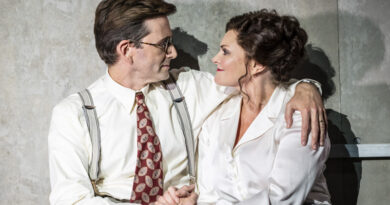
Photo credit: Marc Brenner.
There are state-of-the-nation elements in the play as written and in the contemporary spin that Littler puts on its political aspects. These mainly concern the assassins, the four knights (barons associated with Henry II) who slay the archbishop. Earlier they have doubled up as the Tempters like an avenging force in a J.B. Priestley play with the morality inverted.
Most chilling among them is the leering psychopathic relish for the violence shown by Fourth Knight. This is David Yelland whose historical character is Richard le Breton. Interestingly, he has been Suchet/Poirot’s manservant in many Agatha Christie adaptations. No man is a hero to his valet as Hegel reminds us!
The knights are goonish in their vaguely fascistic uniform of long black leather coats. For most spectators, the thought will be Pinter heavies though Pinter did not have a monopoly on such an approach. All this would have made sense in Eliot’s 1930s Europe when there were attacks on clergy by ultranationalists labouring under mistaken notions of the public good. The play had its premiere in the Chapter House of Canterbury Cathedral in 1935 during a year that saw Hitler implement the Nuremberg Laws. The Führer was talking about “positive Christianity” but this was in fact a politicized brand that included racial nationalism. It was discriminatory in the manner of the Far Right in our own era.
But the current extremists on the UK political scene that Littler is obviously trying to skewer are, with varying degrees of risibility, embracing religion. So this aspect made no sense for me. But as the barons give their rabble-rousing speeches from the pulpit (Suchet has naturally used it for the Christmas sermon) the project becomes truly site-specific. The speeches remain a strong sequence.

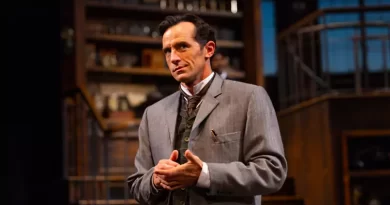
Photo credit: Marc Brenner.
Lines such as “I have seen these things in a shaft of sunlight” are gifts for lighting designer Peter Mumford. Mumford outlines a blue-and-gold cross with red LEDs and the effect becomes slightly Eastern Orthodox. Elsewhere he floods the venue with shades of vermilion and an appropriate cardinal red. There is an extraordinary moment when backlighting makes Suchet’s silhouette (in a posture of supplication) appear on the tunics of the women.
The Orange Tree works almost on a repertory basis, and charismatic actors from other productions sat in the chancel as supportive audience members. Mumford’s lighting gave them an ethereal quality that transfixed me, and they almost merged with a painting of a communion of saints above them.
The set by Rob Jones has a raised catwalk along the length of the nave used by all the characters and to particularly good effect by the chorus. Otherwise, Jones is simply making good, restrained decisions with a few props, notably around a Madonna and Child in the Lady Chapel and in the sacristy where the minor figures gather before their entrances.
Influences and themes tumble through this, many of them being Miltonic. I thought of the colour plates from editions of Paradise Lost that feature illustrations by Blake. The text references the Fall and apples early on. The rapt appearance of the audience became part of the spectacle. Perhaps the atmosphere was particularly charged on press night, but this was theatre where attendance became truly part of a group experience.
Littler who directs here with Francesca Ellis (responsible for the community ensemble) has chosen a high-wire act for a project that allows him no hiding places. There are crucial lines early on: “They know and do not know, that action is suffering / And suffering is action.” Everybody knows what is going to happen, and a less assured creative team might allow the plot to collapse into inertia. The production transfers to the main house at Theatre Royal Bath – clearly not site-specific. Littler and his team will ensure that it remains compelling.