“Martin Guerre” at the Old Vic
Franco Milazzo on the South Bank
★★★★☆
22 October 2026
Alain Boublil and Claude-Michel Schönberg learnt in 1996 that the third time is not necessarily the charm. Fresh from Les Misérables and Miss Saigon, they followed up with the tale of a 16th-century peasant returning to his wife, and Martin Guerre became the misfire that haunted them for the rest of their partnership. They rewrote it over and over to no avail, reopening in London more than half new within months, Leeds got a third version in 1998 and Newbury a fourth in 2007. In the meantime the pair managed only two more shows together (The Pirate Queen and Marguerite), neither of which anyone hums on the bus home.

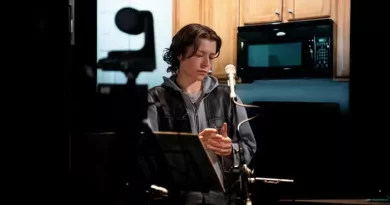
Liv Andrusier and Shane O’Riordan.
Photo credit: Helen Maybanks.
Matthew Warchus is on a curiously similar trajectory. His two musicals with Tim Minchin are part of West End history: Matilda turns 15 this month and was made into a film in 2022, while Groundhog Day went the other way, converting Harold Ramis’s 1993 comedy into a show that sold out the Old Vic twice in runs seven years apart. Now, in his last outing as the theatre’s artistic director, he too has reached for the peasant. The good news is that he gets closer to making this musical a success than its creators ever did.
For those who slept through Le Retour de Martin Guerre starring Gérard Depardieu (1982) or its American cousin Sommersby with Richard Gere (1993), the story opens with the young heiress Bertrande married off to an unwilling Martin. That reluctance follows the couple into the marital bed and, bullied by villagers who blame their childlessness for a drought, Martin runs off to join the army. Seven years later a man walks into town claiming to be the errant husband and Bertrande takes him into her home and her heart. Whether he really is Guerre is the question the village, and eventually a courtroom, wants settled.
To his credit, Warchus has pulled out all the stops, then gone out, bought some more, and pulled those out too. Even semi-staged and in the round, the evening crackles. Riotous family celebrations sit cheek by jowl with the harsh judgements handed out to anyone who doesn’t conform, and those scenes are realized with real kinetic bite. The staging switches without a wobble between booming chorus numbers and a whispered conversation between two people. The 90 minutes rattle past even if the pace cannot quite paper over the cracks in the original.
Liv Andrusier’s Bertrande is the standout. Even when the emotional footing turns boggy, she brings a gravity and psychological intensity the script doesn’t always earn. Opposite her, Shane O’Riordan (as the returning Martin), Barney Wilkinson (a villainous Guillaume), and Colin Ryan (superb as the innocent Benoit) provide sterling support. Around them is a company committed to the cause, bringing bags of energy to Lizzi Gee’s choreography and plenty of vocal heft to material that doesn’t always reward the effort. The French peasants all speak with Northern English accents; it is a controversial choice but, considering how few Romeos and Juliets bother with an Italian twang, an acceptable one.
Rob Howell’s stripped-back set and costumes pay dividends, pulling the focus away from aesthetics so the ears can concentrate on a songbook that charms at nearly every turn. Rustic wooden furniture stacked barricade-style (Les Mis loyalists may feel a pang) gives the space a focal point without crowding a configuration that can easily feel claustrophobic. Lighting from Hugh Vanstone, Luca Panetta, and Toby Ison is crisp and crepuscular, and Fergus O’Hare’s sound keeps the mood suitably murky. This is not a show that goes anywhere near the funny bone, and nobody here tries to make it.
Tucked away above the stage, a six-piece band under Matthew Jackson plays Tom Curran’s folk-inflected orchestrations. New lyrics from Boublil, Annabel Mutale Reed, and Paul Hodge bring a brand-new anthem “Someday” which cleaves (for better and worse) to the Les Mis school of grandstanding. Schönberg’s melodies remain the show’s best argument for itself.
Warchus has asked critics not to reveal the ending, which is a shame as that is one of the weakest points of the night. Its failure is partly down to the show’s brevity: its rattling pace gives with one hand and takes away with the other. We are never bored, but rarely have the opportunity to be invested in more than a handful of characters, and the villagers’ fury at a childless marriage plays more as plot mechanism than credible behaviour.
Still, after three decades of rewrites, Martin Guerre has finally come home looking like someone worth taking in. It is not quite the man it promised to be, but it makes a far better husband than the original.