“Ghosts” at Jermyn Street Theatre
David Wootton in the West End
★★★★☆
19 October 2026
In 2013, Sir Richard Eyre adapted and directed Henrik Ibsen’s Ghosts for the Almeida Theatre in what proved to be a landmark interpretation, emphasizing the urgent power of both the writer and the play. Now Kwame Owusu has revived Eyre’s version for his subtly compelling production at Jermyn Street Theatre. And it is only the vivid memories of the previous experience that prompt any reservations about the present one.

Photo credit: David Monteith-Hodge.
In contrast to the spectrally translucent set that Tim Hatley designed for the Almeida, Cara Evans provides a drawing room of dark wood panelling. When its doors are closed, the space becomes contained, and even claustrophobic, though they fail to keep out the “ghosts”, the effects of long past actions that still haunt the characters. Indeed, once those ghosts have been conjured into being, they cannot be expelled. Instead, they insidiously infect the mood, so leading to a catastrophic close.
The room is in the home of Helene, widow of Captain Alving and mother of artist Oswald. He has just returned from Paris, ostensibly to help celebrate the opening of an orphanage in the Captain’s memory. However, the status of the orphanage will prove to be ambiguous, in symbolizing both the Captain’s legacy of degeneracy, and dysfunctional relationships more generally between parents and children.
This dysfunctionality is seen from the outset in an exchange between Jacob Engstrand (Peter F. Gardiner), who is helping build the orphanage, and his daughter Regina (Cecilia Appiah), who is Mrs Alving’s maid. Speaking in Scots accents, which link them together and perhaps suggest their working-class standing, they are quick to find fault with each other. In assuming a position once held by her dead mother, Regina has disassociated herself from her father and developed a liking for Oswald, so is unwilling to entertain the idea of joining Jacob in his new scheme, a rest home for sailors. Swearing too freely and wearing workwear, which contrasts with Regina’s black dress and crisp apron (costumes designed by Natalie Johnson), Engstrand seems out of place.
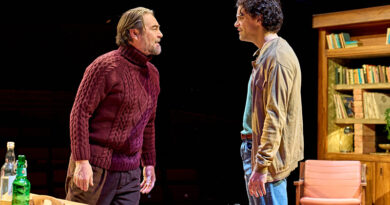
Both also dressed in black, Pastor Manders (Oliver Alvin-Wilson) and Helene Alving (Flora Montgomery) behave more appropriately in the drawing room, standing stiffly with their hands held together, and speaking in hushed tones. Though they are meeting to discuss the final arrangements for the orphanage, and especially its insurance, they soon establish opposing views, she free thinking (reading feminist pamphlets) and he conservative (advising her to “rely on the views of others”). They become more impassioned when they rehearse their shared past – and the involvement of the Captain – and its consequences.

Photo credit: David Monteith-Hodge.
Relaxed in dress and manner, Oswald (Joe Pitts) appears as a challenge to the upright Manders as he lounges on the chaise longue and smokes his pipe. And he alarms both Manders and Mrs Alving when he engages with Regina. In a rare moment of expressionism in a highly naturalistic production, the older characters freeze as the younger ones flirt. The atmosphere is heightened by eerie lighting and intense music for solo violin, accentuating the embodiment of ghosts. (The lighting designer is Ben Ormerod, and the composer and sound designer is Francesca Amewudah-Rivers.)
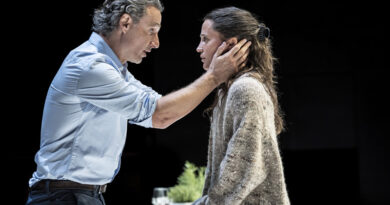
Increasingly, the space that the characters inhabit appears to be an experimental isolation chamber. In this restrictive environment, each change in body language tells. In a moment of affection, Mrs Alving calls Manders “a big child” and puts her arms around him, he responding by noting that she is “extravagant” with her feelings. And, while it may be more acceptable for Mrs Alving to touch her son, even their contact is sometimes tentative, as if likely to elicit an electric shock.
Mrs Alving tries to relieve Oswald’s depression, brought on by his describing his medical condition, by ordering Regina to bring him champagne, and allowing her to drink it too. Oswald cherishes Regina’s energy and joy, and sees in her the possibility of salvation. However, dramatic change is effected from outside, when disaster briefly encourages all to take action, before decisively setting the characters on separate paths. While some escape, others remain trapped.
Eyre’s taut version, running for just 90 minutes and proceeding without interval, is shaped by Osuwu with great care, controlling the emotional landscape until the impassioned end. He is well aided in this by his actors, each of whom is terrific in their roles. If Gardiner portrays Engstrand’s opportunism through quick shifts from the wheedling to the bullying, Appiah traces Regina’s development and disillusion with immense delicacy. Alvin-Wilson’s Manders is surprisingly sensitive and even sympathetic, as if aware of an alternative life that he has denied himself. Pitts is extremely affecting in the way in which he enacts Oswald’s existential implosion, and Montgomery commanding as Mrs Alving, whose restraint is tested, and then broken when she fails to outrun the past.